Loading...


Plate Tectonics
Quiz by Robrion Sills
Tag the questions with any skills you have. Your dashboard will track each student's mastery of each skill.
Which of the following describes why earthquakes are common along the San Andreas Fault?
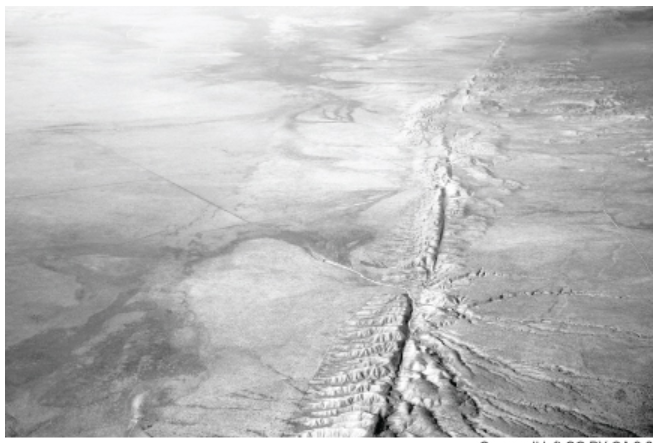
divergent plate boundary
convergent plate boundary
subductive plate boundary
transform plate boundary
This type of tectonic plate boundary occurs between two plates because —
distant boundaries at other locations on the same plates are causing the plates to move.
earthquakes and volcanic activity at the boundary force the plates to slide past each other.
ocean basins near the boundary push the plates in opposite directions.
magma from the magma chamber under the boundary forces the plates apart in a parallel motion.
Which of the following describes why earthquakes are common along the San Andreas Fault?

This type of tectonic plate boundary occurs between two plates because —
The picture below shows a cross section of a mid-ocean ridge.
This mid-ocean ridge formed as divergent tectonic plates moved —

The picture below shows a cross section of a mid-ocean ridge.
Over time, the tectonic plates that move to form the mid-ocean ridge will —
The picture shows a cross section of Earth's convection currents with circulating arrows.
The area on the surface of Earth, located near the upward moving arrows and marked S, is an area where —

The picture shows a cross section of Earth's convection currents with circulating arrows.
The areas on Earth, marked R, where convection arrows are moving away from the crust back into the mantle, are —
Continental mountain ranges are formed when two tectonic plates —
This volcano could have formed and erupted when —

The multi-directional movement of tectonic plates causes many geological events such as volcanoes, earthquakes, mountain building, and the formation of new ocean basins. The source of this movement that causes these events is —
The model below shows how mountains build on Earth's crust through the movement of tectonic plates X and Y.
This type of mountain building occurs when —

The picture below shows a portion of a mountain range between the Indian and Eurasian plates called the Himalayas, which has some of the largest mountains in the world.
These mountains formed —

The picture below shows an aerial view of the Hawaiian islands, which were formed in a geological hotspot in Earth's mantle.
The Hawaiian islands were formed in this geological hotspot because —

Ocean basins are formed under the surface of the water on the sea floor. What process forms an ocean basin?
What is the most likely result of one tectonic plate being forced under another tectonic plate?
Mountains can be formed when one plate is forced under another. Sometimes, the plate that was forced under melts. Which event is most likely to occur after much of the plate forced under has melted?
Ocean basins are formed under the surface of the water on the sea floor. What process forms an ocean basin?
Convection cells in the earth's mantle rise underneath which locations beneath the crust?
Convection cells cause lithospheric plates to move away from —
Areas that receive eroded sediment are called —
Which is a possible result of plates moving along a transform boundary?
Continental-continental plate collisions produce —
Climate is generally affected by plate tectonics because plate motions —
The pictures show the change in Earth's geography.
Using the picture, Earth's geography has been affected by —

The diagram shows a transform boundary with two plates moving past each other in opposite directions.
Which is most likely to occur at this plate boundary?

Which of the following correctly describes the length of time it takes for sea-floor spreading and mountain building to occur?
What is most likely to occur as the result of seafloor spreading?
Which tectonic plate movement results in the formation of huge mountain systems such as the Rocky Mountains?
When a dense oceanic plate moves underneath a less dense continental plate, the rock will begin to get hot and melt. What surface feature does molten rock produce?