Loading...


PRE TEST IN EARTH AND LIFE SCIENCE
Quiz by YSABEL ANGELA EMBILE
Track each student's skills and progress in your Mastery dashboards
Which of the following characteristics make the Earth unique?
I. The Earth is called the green planet.
II. There are different types of living and nonliving organisms on Earth.
III. Earth is the only known planet where life forms exist.
IV. The Earth's atmosphere enables living things to exist and thrive
In the Earth’s subsystems, there are prevailing interacting processes between the hydrosphere and the geosphere. Which of the following is NOT an example of an interaction between the hydrosphere and geosphere?
Which physical property describes graphite when you scratch it using your fingernail?
Why is a pearl not considered a mineral even though it is classified as a gemstone?
Obsidian and granite are examples of what type of rock?
Which of the following best describes how erosion by groundwater can create a landform?
Mantle convection is the gradual creeping motion of Earth's solid silicate mantle generated by convection currents that transport heat from the planet's interior to the surface. How does convection happen in the mantle?
Manila and Philippine trenches are examples of subduction zones. The magma in these subduction zones can create a series of active volcanoes. How is magma made at the subduction zone?
Metamorphism is the process of transforming a pre-existing rock into another form of rock due to extreme heat, pressure, and chemical reaction. How do temperature and pressure affect metamorphism?
Metamorphic rocks were once igneous or sedimentary rocks but have been changed because of intense heat and/or pressure. Which of the following is correct?
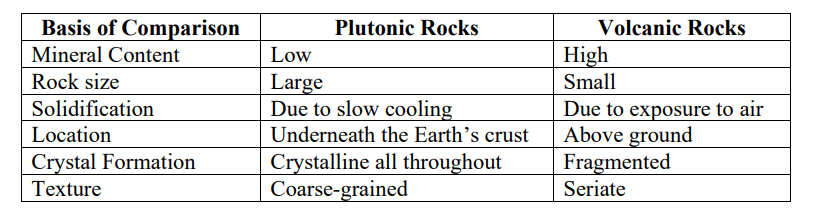
The table below shows the comparable characteristics of plutonic and volcanic rocks. Which of the following is TRUE about plutonic and volcanic rocks?
The movement of the Earth’s plates leads to rocks being compressed into each other, leading to the formation of folds and faults. Which of the following statements is NOT correct about the formation of faults?
Which of the following statements about folds is true?
Which of the following situations best describes stratification?
How does relative dating differ from absolute dating?
Carbon-14 is the most well-known radioactive isotope with a half-life of 5730 years. How reliable is this isotope that is used in fossils and rock dating?
The following descriptions are true about Geologic Time Scale EXCEPT:
Geologic Time Scale indicates the arrangement of time based on rock records of Earth. Which of the following is considered the largest division of Geologic Time?
Mt. Pinatubo erupted in 1991, causing the destruction of vegetation and the roofs of houseBs and even killing numerous victims in Zambales. From these descriptions, what are the different volcanic hazards that harmed the area and nearby places?
I. Giant mudflows
II. Pyroclastic flow
III. Phreatic ashfall
IV. Reduced ozone layer density
Volcanic tremors and earthquakes were felt on Volcano Island and in the barangays of Agoncillo, Batangas. Ashfall was also present southwest of Taal. Based on the given situation, what are the signs of the impending eruption of the Taal volcano?
I. Steaming activity
II. Volcanic tremors
III. Volcanic quakes
IV. Increased atmospheric temperature
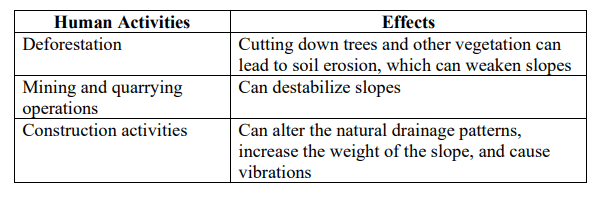
Based on the hazard map shown, which places are at high risk of volcanic eruption?
I. Albay
II. Bataan
III. Camiguin
IV. Sulu
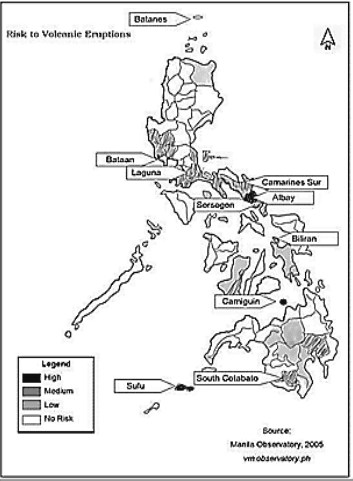
The table below displays information about the human activities that contribute to the speeding up or triggering of landslides and their effects.
Based on the table above, what effects can trigger or speed up landslides?
What is described as an induced flow of seawater into freshwater aquifers primarily caused by groundwater development near the coast?
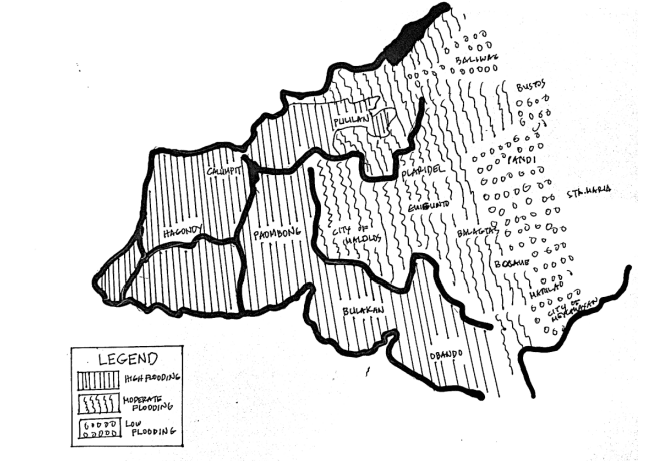
C From the image shown, which municipalities in Bulacan may experience high flooding?
Waste reduction is anything that reduces waste by using a smaller amount of materials. Which of the following activities does not show the practice of waste reduction?
Which of the following best describes the Paleozoic Era?
Some members of a species have a genetic change that causes them to survive in their environment. They have survived to reproduce and pass these genetic changes to their offspring. What best explains this situation?
Why do animals exhibiting external fertilization produce many gametes?
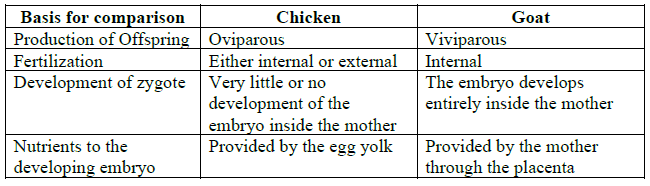
The table below shows how goats and chickens reproduce. Based on the table above, which statement does NOT correctly explain the process of reproduction of the two animals?
When a mature woman stopped menstruating when she is pregnant for the whole duration of nine months. Which statement best explains the cessation of menstruation during her pregnancy?
Examine the following cases below.
Case A: Corn is created to produce the Bifidobacterium toxin to avoid diseases.
Case B: Golden rice is produced by inserting the gene for vitamin A production into a common rice strain.
Case C: Cotton that has been engineered to be more resistant to pests or herbicides and produce Pseudomonas
Case D: Cows that produce large amounts of milk and have high fertility were selected to breed over cows that do not create modern dairy cows.
Which of the above cases shows an example of a genetically modified organism?
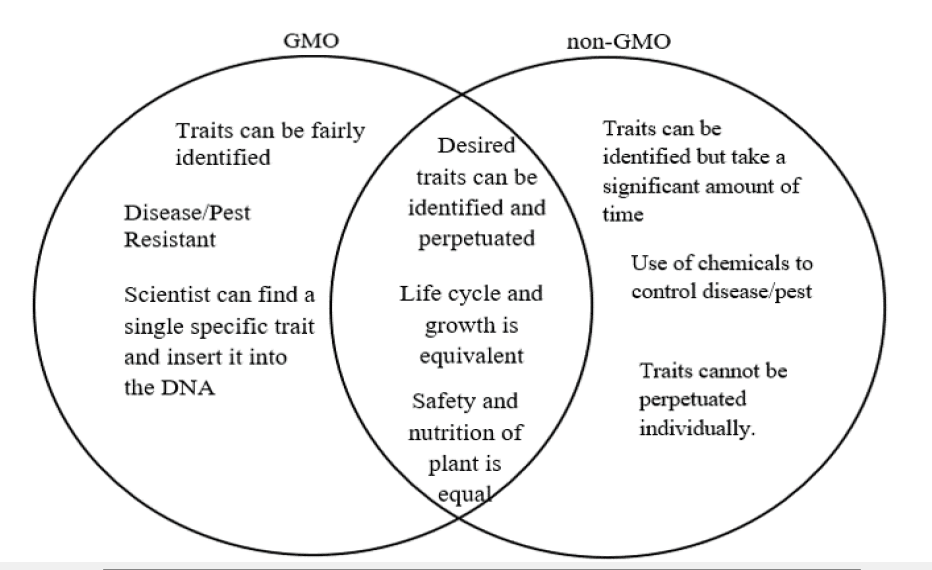
The Venn Diagram below shows the comparison between GMOs and Non-GMO. How will you determine the difference between GMO to Non-GMO?
Which of the following statements is a potential benefit of using GMOs in agriculture?
A genetically engineered salmon has the genes that regulate the release of the growth hormone. What is the advantage of modifying its genetic makeup?
Which of the following best describes the current scientific consensus on the risks associated with genetically modified organisms (GMOs)?
Which of the following statements about muscles and the muscular system is true?
Your brother suffered from an inversion sprain in his left ankle during a basketball game. Immediate pain and swelling and inability to bear weight happened. The following are ways of managing sprain by the expert EXCEPT _______.
In respiration, living organisms produced energy for the cells. What essential gases are exchanged between the outside air and the cells?
Some of your friends are hesitant about getting vaccinated because they heard about certain untoward reactions from getting the vaccine. Which of the following idea does NOT support the COVID-19 vaccination?
I. It is safe and tested.
II. It contributes to infertility.
III. It heightens the severity of the virus's symptoms.
IV. It has the potential to elicit an immunological response
Which of the following best explains why the heart beats faster when we run?
Which of the following best describes the potential consequences of a disruption in the functional relationship between the respiratory and circulatory systems?
Natural selection acts on ________ which in turn may result in the evolution of __________ over time.
In a small group of people living in a remote area, there is a high incidence of “blue skin”, a condition that results from a variation in the structure of hemoglobin. What mechanism of evolutionary change best explains this situation?
Pandas developed longer wrists to better eat bamboo over time and in turn increase their chance of survival. Which of the following is an example of this?
What is described when one common ancestor and all the descendants share a common characteristic including their most recent ancestors?
The modified plasmid containing the gene of interest is called the recombinant plasmid. It will be reintroduced to a bacterial cell to make the transgenic organism produce the desired genes. In which stage of genetic engineering is the recombinant plasmid placed into a bacterial cell?
There are factors that can restrain the expansion of a population such as predators, competitors, lack of food and water, diseases, and reasonable living space. Which of the following refers to these factors?
Which of the accompanying reasons explains why various life forms have diverse biotic potentials?
During the class discussion, Ms. Cruz asked her students to identify and explain the kind of symbiotic interactions that occur in a picture showing: “a clownfish taking shelter in the sea anemone’s tentacles.” What would be the best response to Ms. Cruz's query?
While watching the news with your younger sister, tons of dead fish floating in Manila Bay were flashed on screen due to fish kill. She asked you “What is it? And how does it happen?” Which of the following statements explains fish kill?
I. It is an occurrence of massive death of fish in the area caused by pollution due to human activities.
II. These aquatic animals have a short lifespan and a sudden increase in water temperature can make their life expectancy shorter.
III. It is an occurrence of massive death of fish in the area that is associated with a variety of reasons, including reduced oxygen in water or release of toxic materials in the water.
IV. The massive death of fish in the area may be associated with lots of possible reasons, including reduced oxygen in water, algal blooms, red tides, or the presence of infectious parasites and diseases.