Loading...

PRESENTATION OF DATA
Quiz by Alma Morillo
Customize this quiz to suit your class
Instantly translate to 100+ languages
Tag the questions with any skills you have. Your dashboard will track each student's mastery of each skill.
Give this quiz to my class
What do you call the visual representation of data that is used to show how all the parts of something are related to the whole?
A. pie chart
A bar graph that shows the frequency data occur within a certain interval and there are no gaps between adjacent bars.
D. Ogive
A.pie chart
B.histogram
C. line graph
What do you call the visual representation of data that is used to show how all the parts of something are related to the whole?
A bar graph that shows the frequency data occur within a certain interval and there are no gaps between adjacent bars.
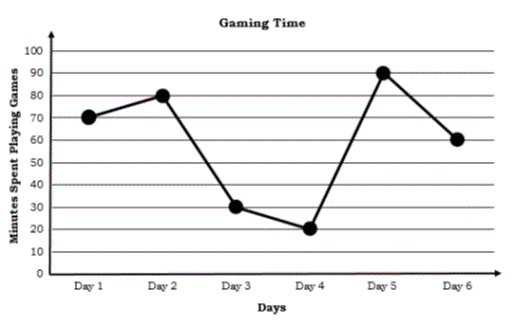
What is the difference of the time spent playing on Day 5 and Day 2?
Last month, the amount of electricity used in Mrs. Cruz Restaurant was 2,700 kwh (kilowatt-hours). What appropriate graph must be used to show the percentage of the amount used by different appliances in her restaurant.
Which is the appropriate type of graph to show the kilograms of garbage and kilograms of recycling produced by four different schools?
 Organisation & Presentation of data Class quiz 18: Ch.12 Presentation of Data (I)2.6 Class Quiz 10: Organization and Presentation of Data (II)Statistics Branch of science that deals with the collection, organization, analysis, interpretation, and presentation of data. Purpose of statistics is to make an inference about a population by examining a sample. Collection of Data Refers to the process of gathering information. Primary source: questionnaires, interviews. Secondary source: journals, books. Presentation of Data Organization and arrangement of data in tabular form (tables), graphical representation (graphs). Analysis of Data Application and interpretation using statistical tools to derive meaning. Inspection of Data Descriptive Statistics: Involves describing the basic features of the data in a study. Provides simple summaries about the sample and measures. Inferential Statistics: Makes judgments and reaches conclusions about populations based on samples. Population vs Sample Population: entirety Sample: only part of population Fundamental or Descriptive Statistics: Measures Of Central Tendency: Mean (average) Median (middle value) Mode (most frequent) Measures Of Dispersion/Variability: Range (difference between highest & lowest) Variance & standard deviation Measures Of Position: Quartiles & percentiles Measures Of Relationship Between Variables: Correlation coefficient Types Of Data: Primary Data – original source. Secondary Data – derived from primary. Major Characteristics Of Data Sources: Primary Source – direct from respondent; more accurate; costly; time-consuming. Secondary Source – characteristic not1.Which Part Of The Science Investigatory Project Report Provides A Concise Summary Of The Entire Study? A) Title Page B) Abstract C) Chapter 1: Introduction And Its Background D) Chapter II: Review Of Related Literature And Studies 2.In Which Chapter Of The Science Investigatory Project Report Is The Problem Being Investigated Stated? A) Chapter 1: Introduction And Its Background B) Chapter II: Review Of Related Literature And Studies C) Chapter III: Methodology D) Chapter V: Summary, Conclusion, And Recommendation 3.Where Can You Find The Formulation Of Hypothesis In The Science Investigatory Project Report? A) Chapter 1: Introduction And Its Background B) Chapter III: Methodology C) Chapter IV: Presentation, Analysis, And Interpretation Of Data D) Chapter V: Summary, Conclusion, And Recommendation 4.Which Part Of The Science Investigatory Project Report Explains The Significance And Relevance Of The Study? A) Title Page B) Abstract C) Chapter 1: Introduction And Its Background D) Chapter V: Summary, Conclusion, And Recommendation 5.Which Chapter Of The Science Investigatory Project Report Presents The Scope And Limitations Of The Study? A) Chapter 1: Introduction And Its Background B) Chapter II: Review Of Related Literature And Studies C) Chapter III: Methodology D) Chapter V: Summary, Conclusion, And Recommendation 6.Where Can You Find The Definition Of Terms Used In The Science Investigatory Project Report? A) Title Page B) Abstract C) Chapter 1: Introduction And Its Background D) Chapter III: Methodology 7.In Which Chapter Of The Science Investigatory Project Report Are The Related Literature And Studies Discussed? A) Chapter 1: Introduction And Its Background B) Chapter II: Review Of Related Literature And Studies C) Chapter III: Methodology D) Chapter V: Summary, Conclusion, And Recommendation 8.Where Can You Find The Subject Of The Study In The Science Investigatory Project Report? A) Chapter 1: Introduction And Its Background B) Chapter II: Review Of Related Literature And Studies C) Chapter III: Methodology D) Chapter IV: Presentation, Analysis, And Interpretation Of Data 9.Which Chapter Of The Science Investigatory Project Report Presents The Research Design And Procedure Used? A) Chapter 1: Introduction And Its Background B) Chapter II: Review Of Related Literature And Studies C) Chapter III: Methodology D) Chapter IV: Presentation, Analysis, And Interpretation Of Data 10.In Which Chapter Of The Science Investigatory Project Report Are The Results And Analysis Of The Gathered Data Presented? A) Chapter 1: Introduction And Its Background B) Chapter II: Review Of Related Literature And Studies C) Chapter III: Methodology D) Chapter IV: Presentation, Analysis, And Interpretation Of DataInitially the recording and communicating of economic events occurred through narratives in early civilisation. As businesses grew in size there became a need to record the procedures. In 1494, Luco Pacioli, an Italian, described the double entry system of debit and credit to be recorded in journals and ledgers. The Italians were the first bankers however accounting can be traced from the Greeks and Romans in the 4th and 5th century BC who were traders. The system has remained the same. The initial stewardship role of securing cash developed into a system of accounting which involves recording, summarizing and analysing data to ensure the efficient operation of the business currently known as financial accounting. Formerly, the data only reflected receipts and payments of cash. Today the practice is to match income earned with expenses incurred. Later on cost management was identified as a tool to help managers in making business decisions. Other services now include taxation etc. In the quest for consistency in record and presentation, the profession has developed and instituted organised rule making authorities including the International Accounting Standards Board (IASB). They create generally accepted accounting principles (GAAP) and concepts. They are established principles, standards, and legislation unique to each jurisdiction. The profession now requires accreditation and certification given the complexity involved in the record and presentation of accounts and statements.Create 5 questions with 4 multiple choices A, B, C and D of the following text Understanding a text may require constant practice and good technique. One of the techniques is using an advanced organizer. Examples of advanced organizers include metaphors, analogies, flowchart, graphs, tables, illustrations, or even pictures. Understanding is synonymous to interpreting. When you interpret an advance organizer, you need to draw relationships of data, thus, forming a certain message or meaning out of the relationship drawn. It is vital for any advance organizer to use appropriate figures or symbols to stand for a certain data or idea. Just like writing like a short story, poem or song, it is important to label it with a title that usually bears the main idea in the whole graphic presentation. Using an advance organizer is like transferring what you have understood from the text with much lesser word used. As a result, you are summing up the bulk of information written in long sentences and paragraphs, synthesizing it into more important concepts or ideas in what you are reading.Revolutionising Education: Unleash AI to Spark Joy in the Classroom. What is Artificial Intelligence (AI)? • Definition: AI involves creating computer systems that can perform tasks typically requiring human intelligence. These include learning, reasoning, problem-solving, perception, and language understanding. • Examples in Everyday Life: From personal assistants like Siri and Alexa to more complex applications like predictive analytics in healthcare and autonomous driving. Two Types Artificial Intelligence (AI) • Generative AI: refers to a type of artificial intelligence technology that can generate new content, such as text, images, music, and videos. It leverages advanced algorithms to understand and replicate patterns from existing data, allowing it to create original outputs that mimic human-like creativity. Examples include models that can write like a human, generate realistic images from textual descriptions, or compose music. • Large Language Models: are a subset of Generative AI specifically designed to understand and generate human language. These models are trained on vast amounts of text data, which enable them to perform a variety of language-based tasks such as translation, summarization, answering questions, and even engaging in conversation. Notable examples include OpenAI's ChatGPT, Google Bard, and Microsoft Bing. AI in Education? • Enhancing Learning: AI can personalise learning based on individual student needs by adapting materials and pacing. • Automating Tasks: AI can automate administrative tasks like lesson planning and scheduling, allowing educators more time to focus on teaching and building relationships. Ethical Considerations? • Privacy and Security: Ensuring student data is protected and not misused. • Bias and Fairness: Developing AI systems that provide equal opportunities for all students and do not inherit or amplify biases. • Transparency and Accountability: Making AI decisions in education understandable and subject to checks and balances. Our Top 10 AI For Educators • Classroom conductor – ChatGPT - A versatile AI that assists teachers with emails, lesson plans, generating quiz questions, and example student pieces. • Digital Design Dynamo – Canva - With its AI Magic Media app, Canva helps create engaging visuals and videos, making digital design accessible. • Maetstro of Music – Suno - Instantly generates songs on any lesson topic or converts your lyrics into music, enhancing learning with tunes. • Teacher’s AI Ally – School AI - Focused on educator needs, it features tools for creating interactive exit tickets and engaging chat bots. • Differentiator – Diffit - Transforms PDFs and YouTube videos into differentiated worksheets and activities across languages and reading levels. • Quiz Master – Quizalize - Turns any content into quizzes or games, engaging students with interactive challenges based on lesson material. • Presentation Pro – Gamma - Helps create stunning presentations quickly, ideal for classroom use or professional meetings. • Interactive Lesson Launcher – Cruipod - Quickly generates interactive presentations for classroom use, integrating activities seamlessly into lessons. • Note-Taking Ninja – LLava - Produces study notes and quiz questions from any photo or image, simplifying study material generation. • Creative Story Spinner – StroyWizard - Enables teachers to create custom stories incorporating elements from their own classrooms, linking imagination with academic achievement.