Loading...

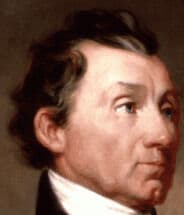
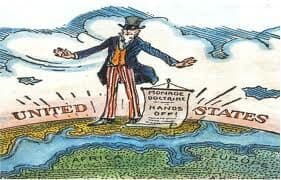
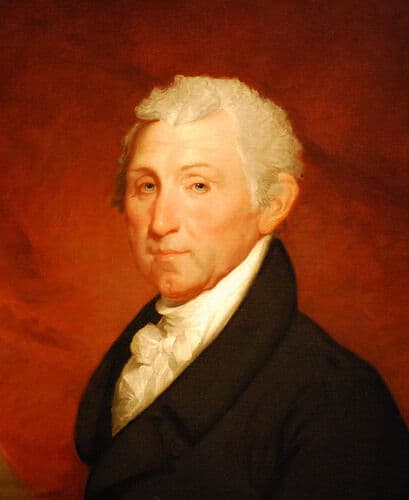
President James Monroe
Quiz by Steven Jones
Customize this quiz to suit your class
Instantly translate to 100+ languages
Tag the questions with any skills you have. Your dashboard will track each student's mastery of each skill.
Give this quiz to my class
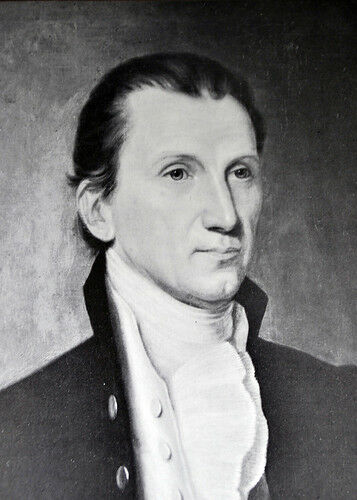
California
Texas
New York
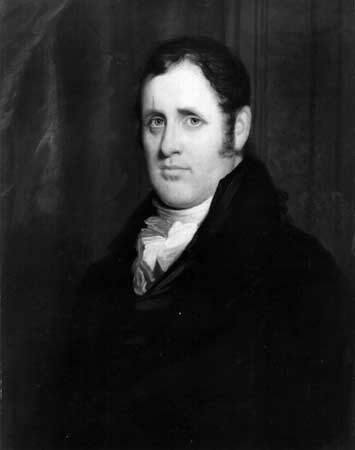
John Adams
Thomas Jefferson
Andrew Jackson


 James Monroe Sixty Second PresidentPresident James GarfieldPresident James MadisonPresident James K PolkPresident James BuchananJames Madison Sixty Second PresidentJohn Adams the first Vice President and second President of the United States James Armistead black slave who served in the colonial army as a spy General Edward Braddock commander of all British forces in North America during the French and Indian War Nathan Hale "I only regret that I have but one life to lose for my country." Patrick Henry Virginian who said, "Give me liberty, or give me death!" New York City our nation's first capital Battle of Bunker Hill the first major battle in the War for Independence judicial the branch of government that interprets the law executive the branch of government that enforces the law legislative the branch of government that makes the law Articles of Confederation the first plan of government that the United States had agreed upon Bill of Rights lists the rights or freedoms the Constitution gives to Americans; written in the form of ten amendments Constitution of the U.S. plan of government our country still follows today Declaration of Independence document written by Jefferson declaring the independence of the colonies from England First Amendment gives Americans the following freedoms: religion, speech, press, and assembly Treaty of Paris document signed by England giving up the American colonies and making them officially free and independent Inauguration Day The day the President takes his oath of office Valley Forge Washington's army spent the harsh winter of 1777-1778 Second Continental Congress The decision to organize the Continental Army was made at the ??? in 1775. constitutional republic The form of government in which the people and their elected representatives are limited by a constitution patriots Those who wanted America to be free from Britain's controlRichard Bland College (RBC), Virginia’s selective, two-year, residential, liberal arts transfer institution, was born through innovation. In 1959, years before the Virginia Community College system was imagined, Frank Ernst – a Gateway region native, entrepreneur, and retired executive of Hopewell’s Allied Chemical Plant – proposed the creation of an institution grounded in the liberal arts tradition with opportunities for specialized training in in-demand fields such as engineering to the State Council of Higher Education. After discussions with Virginia Tech and the University of Virginia, Ernst found a willing partner in the College of William & Mary, the second-oldest university in the United States, who founded Richard Bland College in 1960. RBC has since offered multiple certificates and university-parallel two-year degrees. The College was named for the Virginia statesman and champion of public rights, Richard Bland. Son and grandson of successful planters, Richard Bland was educated at The College of William and Mary. From 1742 until his death in 1776, he represented the area in which the College is now located, first in the House of Burgesses, and later, with the adoption of a state constitution, in the House of Delegates. He also served as a delegate from Virginia in both the First and Second Continental Congresses. It seems fitting, therefore, that an institution of higher learning located in an area served for so many years by this distinguished Virginia patriot and scholar, should derive its name from one whom Jefferson described “as the most learned and logical man of those who took prominent lead in public affairs.” Before the Civil War, the property on which the College is now located was a plantation owned by the Gurley family. It became an important part of the Union-occupied territory during the 1864-1865 Siege of Petersburg. The present campus was the scene of two battles during that campaign. Shortly after the turn of the century, Hatcher Seward established a dairy and cattle farm on the former Gurley property and constructed two farmhouses. Today they serve as the President’s residence and the Hospitality House. In the early 1900s, the still-beautiful grove of pecan trees was planted. The farm was used as a work camp for about twenty conscientious objectors during World War I. The Commonwealth of Virginia authorized Central State Hospital to purchase the land in 1932 for use as the Petersburg Training School and Hospital for African-American Youth. That institution was moved in 1959, and the land, still owned by the Commonwealth, became the location for the establishment of Richard Bland College of The College of William and Mary. Under the guidance of Colonel (Ret.) James M. Carson, the former hospital and training facility was transformed into Richard Bland College, and classes were held beginning in 1961. In the late 1960s, Ernst Hall (named for a local business leader influential in the establishment of the college) was added to the original campus. In addition, a Student Center Library building and a gymnasium also were constructed in the early 1970s. Colonel Carson retired as the founding President of the College in 1973. From 1973 through 1975, Dr. Cornelius Laban, Professor of Biology, Emeritus, served as the Acting President of Richard Bland College. In 1975, Dr. Clarence Maze succeeded Colonel Carson as Richard Bland College’s second President. During his tenure, Richard Bland College expanded its academic programs, added an Asian water garden that was designed by Dr. Maze and expanded international programs and travel. In recognition of his service to the College, the renovated administration building was named Maze Hall upon his retirement in 1996. In 1996, Dr. James B. McNeer succeeded Dr. Clarence Maze as Richard Bland College’s third President. Dr. McNeer introduced a residential life program and oversaw the addition of the Residential Village in 2008. The Residential Village was comprised of two dormitories, Freedom Hall and Patriot Hall, which housed 250 students. A new Science and Technology Building was added in 2010, and in recognition of his service to the College, this building was named James B. McNeer Hall. Dr. McNeer retired in 2012. In 2012, Dr. Debbie L. Sydow succeeded Dr. James McNeer as Richard Bland College’s fourth president. Dr. Sydow expanded the reach, range and diversity of students attending Richard Bland College. She oversaw a physical campus transformation through extensive building renovation and new construction, creation of a Business Innovation Park, and conservation of the iconic pecan grove and water garden. President Sydow reinstituted intercollegiate athletics in 2013 and has since hailed three NJCAA national championship teams. She supported the Foundation’s emergence as a vibrant, entrepreneurial organization led by a Board of Directors composed largely of alumni, and she secured the largest private gift in College history to launch the W&M Promise Scholars program. By effectively leveraging partnerships, President Sydow boosted work-based learning and expanded academic and career pathways for students.