Loading...


PRETEST PISA
Quiz by Jocelyn19
Tag the questions with any skills you have. Your dashboard will track each student's mastery of each skill.
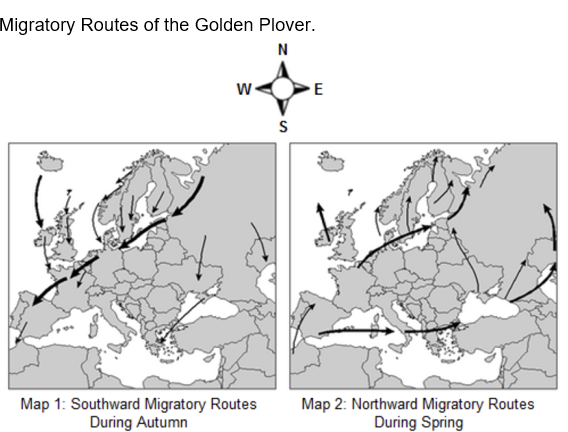
Golden plovers are migratory birds that breed in northern Europe. Inautumn, the birds travel to where it iswarmer and where more food is available. In spring the birds travel back to their breeding grounds.
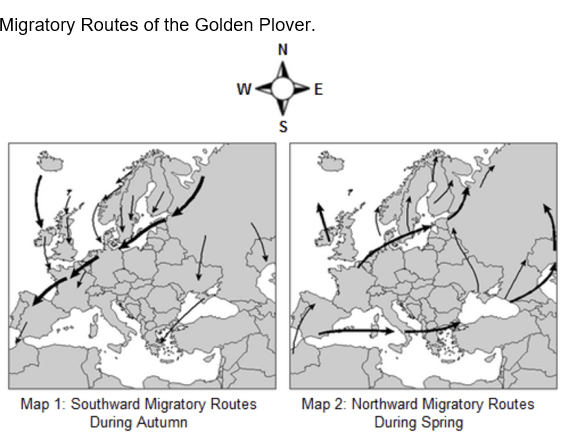
The maps below are based on more than ten years of research on themigration of the golden plover. Map 1shows the southward migratory routes of the golden plover during autumn, and map 2 shows the northwardmigratory routes during spring. Areas coloured grey are land, and areascoloured white are water. The thickness of the arrows indicates the size of the migrating groups of birds.
Migratory Routes of the Golden Plover. Remember to select one or more ANSWER
A. ☐The maps show a decrease in the number of golden plovers migrating southward in thepast ten year
B. ☐The maps show that northward migratory routes of some golden ploversare different from southward migratoryroutes.
C. ☐ The maps show that migratory golden plovers spend their winter in areas that are southand southwest of their breeding or nesting grounds
D. ☐The maps show that the migratory routes of the golden plover have shifted away from coastalareas in the past ten years.
BIRD MIGRATION
Bird migration is a seasonal large-scale movement of birds to andfrom their breeding grounds. Every yearvolunteers count migrating birds at specific locations. Scientists capture some of the birds and tag theirlegs with a combination of colouredrings and flags. The scientists use sightings of tagged birds together with volunteers' counts to determine themigratory routes of birds.
Refer to “Bird Migration” on the right. Click on a choice to answer the question.
Most migratory birds gather in one area and then migrate in large groups rather than individually. This behavior is a result of evolution. Which of the following is the best scientific explanation for the evolution of this behavior in most migratory birds?
A. offspring.
B. Birds that migrated individually or in small groups were more likely to find adequate food.
C. Flying in large groups allowed other bird species to join the migration.
D. Flying in large groups allowed each bird to have a better chance of finding a nesting site.
Golden plovers are migratory birds that breed in northern Europe. Inautumn, the birds travel to where it iswarmer and where more food is available. In spring the birds travel back to their breeding grounds.
The maps below are based on more than ten years of research on themigration of the golden plover. Map 1shows the southward migratory routes of the golden plover during autumn, and map 2 shows the northwardmigratory routes during spring. Areas coloured grey are land, and areascoloured white are water. The thickness of the arrows indicates the size of the migrating groups of birds.
Migratory Routes of the Golden Plover. Remember to select one or more ANSWER
A. ☐The maps show a decrease in the number of golden plovers migrating southward in thepast ten year
B. ☐The maps show that northward migratory routes of some golden ploversare different from southward migratoryroutes.
C. ☐ The maps show that migratory golden plovers spend their winter in areas that are southand southwest of their breeding or nesting grounds
D. ☐The maps show that the migratory routes of the golden plover have shifted away from coastalareas in the past ten years.
SLOPE- FACE INVESTIGATION
Data Analysis
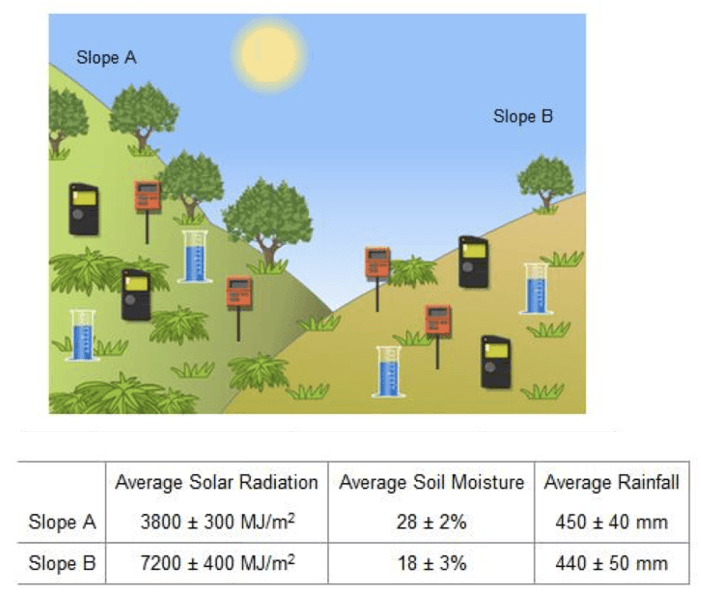
A group of students notices a dramatic difference in the vegetation onthe two slopes of a valley: thevegetation is much greener and more abundant on slope A than on slope B. This difference is shown in the illustrationon the right.
The students investigate why the vegetation on the slopes is so different from one slope tothe other. As part of thisinvestigation, the students measurethree environmental factors over a givenperiod of time:
- Solar radiation: how much sunlightfalls on a given location
- Soil moisture: how wet the soil isin a given location
- Rainfall: how much rain falls on agiven location
The students take theaverage of the measurements collected over a given period of time from each pair of instruments on each slopeand calculate the uncertainty in these averages. Their results are recorded in the following table. Theuncertainty is given following the"士 " sign. SLOPE- FACE INVESTIGATION
Question 1/1
Refer to “Data Analysis” onthe right. Click on a choice and then type an explanation to answer thequestion.
Two students disagree about why there is a difference in soil moisturebetween two slopes.
- Student 1 thinks that thedifference in soil moisture is due to a difference in solar radiation on thetwo slopes
- Student 2 thinks that thedifference in soil moisture is due to a difference in rainfall on the twoslopes
According to the data, which student is correct?
O Student 1
O Student 2
ACID RAIN
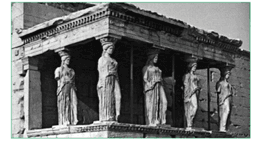
Below is a photo of statues called Caryatids that were built on theAcropolis in Athens more than 2500 years ago. The statues are made of a type ofrock called marble. Marble is composed of calcium carbonate.
In 1980, the original statues were transferred insidethe museum of the Acropolis and were replaced by replicas. The original statueswere eaten away by acid rain. ACID RAIN
Question 1/2
Normal rain is slightly acidic because it has absorbed some carbondioxide from the air. Acid rain is more acidic than normal rain because it hasabsorbed gases like sulfur oxides and nitrogen oxides as well.
Where do these sulfur oxides in the air come from?
ACID RAIN
The effect of acid rain on marble can be modeled by placing chips ofmarble in vinegar overnight. Vinegar and acid rain have about the same aciditylevel. When a marble chip is placed in vinegar, bubbles of gas form. The massof a dry marble chip can be found before and after the experiment. ACID RAIN
Question 2/2
A marble chip has a mass of 2.0 grams before being immersed in vinegarovernight. The chip is removed and dried the next day. What will the mass ofthe dried marble chip be?
A. Less than 2.0 grams
B. Exactly 2.0 grams
C. Between 2.0 and 2.4 grams
D. More than 2.4 grams
SUNSCREENS
Mimi and Dean wondered which sunscreen productprovides the best protection for their skin. Sunscreen products have a Sun Protection Factor (SPF) that showshow well each product absorbs the ultraviolet radiation component of sunlight. A high SPF sunscreen protectsskin for longer than a low SPF sunscreen.
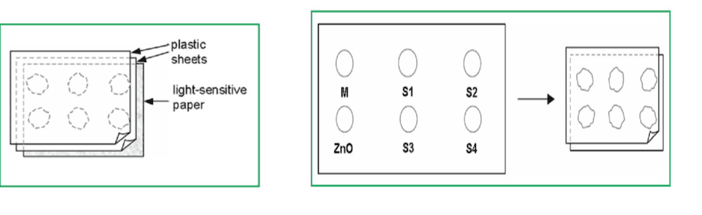
Mimi thought of a way to compare somedifferent sunscreen products. She and Dean collected the following:
- twosheets of clear plastic that do not absorb sunlight;
- one sheetof light-sensitive paper;
- mineraloil (M) and a cream containing zinc oxide (ZnO); and
- fourdifferent sunscreens that they called S1, S2, S3, and S4.
Mimi and Dean included mineral oil because itlets most of the sunlight through, and zinc oxide because it almost completely blocks sunlight
Dean placed a drop of each substance inside acircle marked on one sheet of plastic, then put the second plastic sheet over the top. He placed a large book ontop of both sheets and pressed down.
Mimi then put the plastic sheets on top of thesheet of light-sensitive paper. Light sensitive paper changes from dark gray towhite (or very light gray), depending on how long it is exposed to sunlight.Finally, Dean placed the sheets in a sunny place. SUNSCREENS Question 1/2
Which one of these statements is a scientificdescription of the role of the mineral oil and the zinc oxide in comparing theeffectiveness of the sunscreens?
A. Mineral oil and zinc oxide are both factors being tested.
B. Mineral oil is a factor being tested and zinc oxide is a reference substance.
C. Mineral oil is a reference substance and zinc oxide is a factor being tested.
D. Mineral oil and zinc oxide are both reference substances.
ITEM #9
SUNSCREENS
Question 2/2
Which one of these questions were Mimi andDean trying to answer?
A. How does the protection for each sunscreen compare with the others?
B. How do sunscreens protect your skin from ultraviolet radiation?
C. Is there any sunscreen that gives less protection than mineral oil?
D. Is there any sunscreen that gives more protection thanzinc oxide?
THE GRAND CANYON
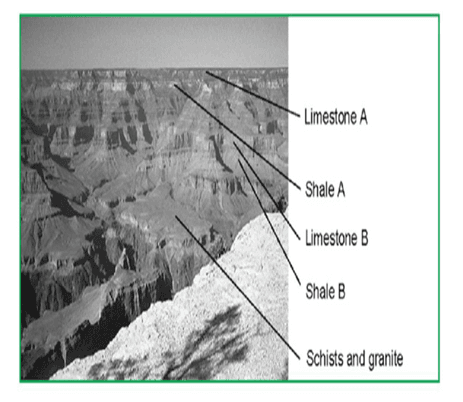
The Grand Canyon is located in a desert in the USA. It is a very largeand deep canyon containing many layers of rock. Sometime in the past, movementsin the Earth's crust lifted these layers up. The Grand Canyon is now 1.6 km deep in parts. The Colorado River runsthrough the bottom of the canyon.
See the picture below of the Grand Canyon taken from its south rim.Several different layers of rock can be seen in the walls of the canyon.
THE GRAND CANYON
Question 1/2
About five million people visit the Grand Canyon national park everyyear. There is concern about the damage that is being caused to the park by somany visitors.
1. How much erosion is caused by use of walking tracks?
Yes / No
THE GRAND CANYON
Question 2/2
The temperature in the Grand Canyon ranges from below 0 ℃ to over 40 ℃ . Although it is a desert area,cracks in the rocks sometimes contain water. How do these temperature changesand the water in rock cracks help to speed up the breakdown of rocks?
A. Freezing water dissolves warm rocks
B. Water cements rocks together
C. Ice smoothes the surface of rocks
D. Freezing water expands in the rock cracks.
Introduction
An increased demand for seafood is placing a greater burden onpopulations of wild fish. To reduce thisburden, researchers are investigating ways to grow fish sustainably in fishfarms.
Two challenges to creating a sustainable fish farm include (1) feedingthe farmed fish and (2) maintaining water quality. Farmed fish require large amounts offood. A fish farm that is sustainablewill grow the food needed to feed the farmed fish. Waste from the fish can build up in the farmto levels that are dangerous to the fish. In a sustainable fish farm, there is a constant flow of ocean waterthrough the farm. Waste and excessnutrients (food that algae and plants need to grow) are removed from the waterbefore it is returned to the ocean. Refer to the informationbelow. Use drag and drop to answer thequestion.
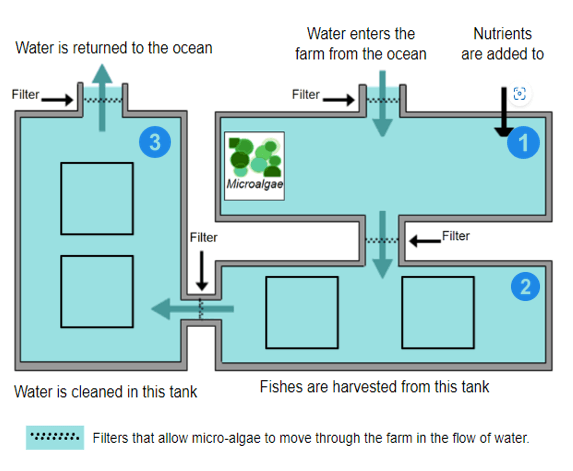
The diagram shows a design for an experimental fish farm with threelarge tanks. Filtered salt water ispumped from the ocean before flowing from tank to tank until it is returned tothe ocean. The primary goal of the fish farm is to grow common sole to beharvested in a sustainable way.
● Common Sole: The fish beingfarmed. Their preferred food is ragworms.
The following organisms will also be used in the farm:
● Microalgae: Microscopic organismsthat only need light and nutrients to grow.
● Ragworks: Invertebrates that growvery rapidly on a diet of microalgae.
● Shellfish: Organisms that feed onmicroalgae and other small organisms in the water.
● Marsh Grass: Grasses that absorbnutrients and wastes from the water
The researchers need to decide in which tank each organism should beplaced. Identify the appropriate tankfor each of the organisms below to ensure that the Common Sole is fed and thatsalt water is returned to the ocean unchanged. The micro-algae are already inthe correct tank.
Write the letter of the organism on the corresponding box in each tank.
TANK :3______ AND ______
A. Common Sole
B. Ragworms
C. Marsh Grass
D. Shellfish
Researchers have noticed that the water that is being returned to theocean contains a large quantity of nutrients. Adding which of the following tothe farm will reduce this problem?
A. More nutrients B. More ragworms C. More shellfish D. More marsh grass
Which procedure would make fish farming more sustainable?