Loading...


Properties and Locations of Solar System Objects
Quiz by Cathy Standifer
Customize this quiz to suit your class
Instantly translate to 100+ languages
Tag the questions with any skills you have. Your dashboard will track each student's mastery of each skill.
Give this quiz to my class
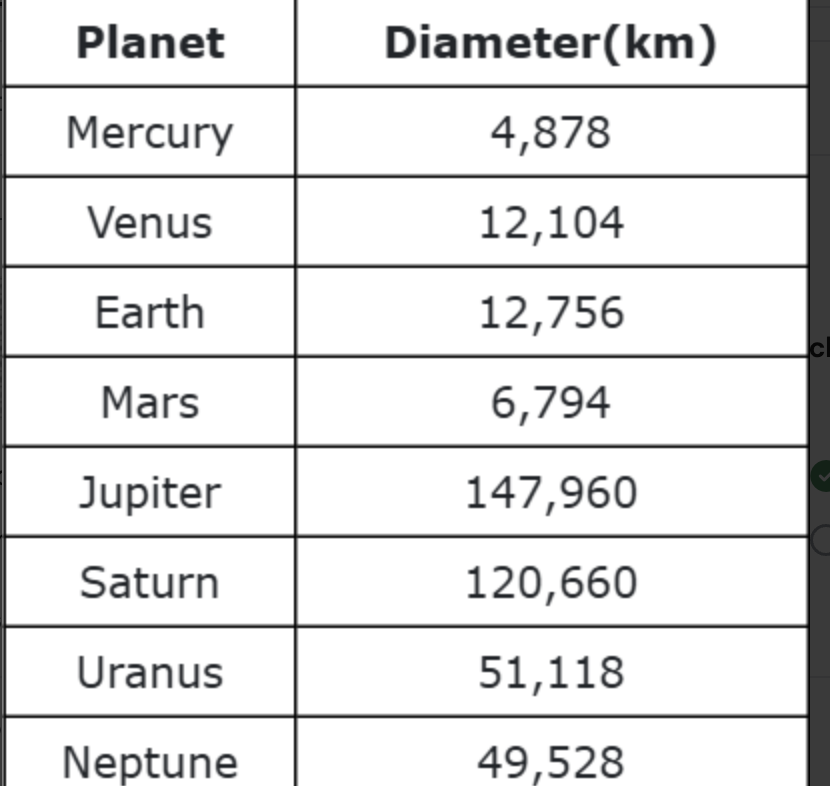
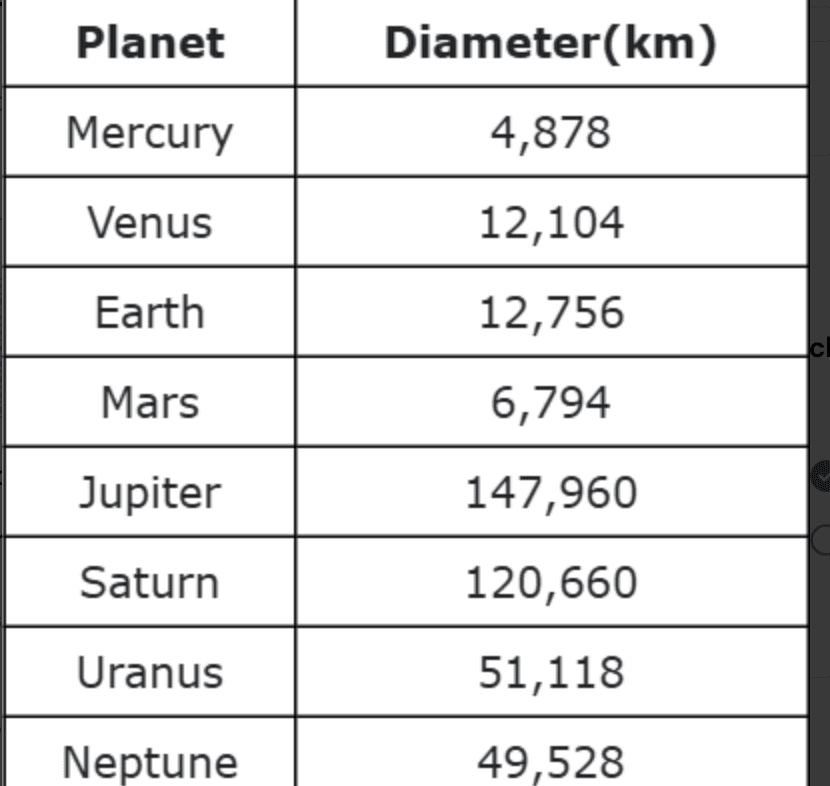
According to the table, what size ball would be the best choice to represent Earth if a 14 cm ball is used for Jupiter?
12 cm
1.2 cm
16 cm
0.5 cm
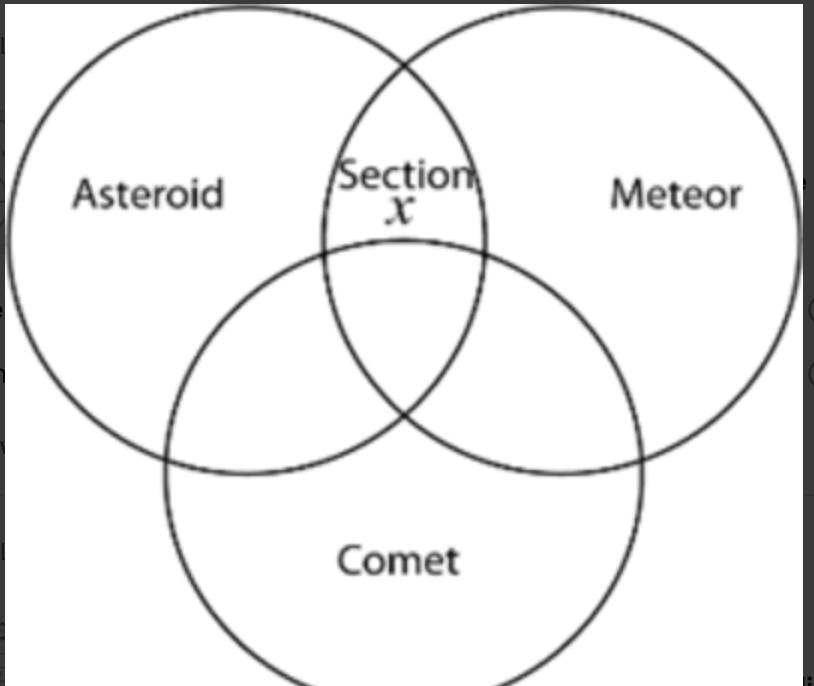
Made mostly of ice, fits best under which heading in the Venn diagram?
Asteroid
Comet
Section X
Meteor
According to the table, what size ball would be the best choice to represent Earth if a 14 cm ball is used for Jupiter?
Made mostly of ice, fits best under which heading in the Venn diagram?

Which statement below accurately describes the movement of objects in our solar system?
A student is using clay to make a model of the solar system. The student shapes the clay into different-sized spheres which are scaled to the actual size of the planets. Each sphere was placed on a platform, 5 cm apart, and in the correct order starting with the sun. This model is limited because it shows the-
Meteors, comets, asteroids, and moons are objects found in our solar system. Each has its own properties, location, and movement. Match the property, location, or movement with the correct celestial object.
Which planet has the longest orbit around the Sun?
What direction do all planets revolve in the Solar System?
What is the primary difference between the inner planets and outer planets?
Which statements below correctly describe an object located in our solar system? Select TWO correct answers.
Where are most asteroids in our solar system located?
Which of the following best describes the movement of meteors?
Which of the following is true about the movement of asteroids?
What is a comet made of?
Asteroids and Comets orbit around...
The puffy disk of objects that is aligned with plane of the solar system that lies just outside of Neptune's orbit is called the ______.
The spherical group of objects that surrounds everything in the solar system is called the ______.
Figure 18-11 represents the amount of energy stored as organic material in each trophic level in an ecosystem. The pyramid shape of the diagram indicates the low percentage of energy transfer from one level to the next. On average, 10 percent of the total energy consumed in one trophic level is incor- porated into the organisms in the next. Why is the percentage of energy transfer so low? One reason is that some of the organisms in a trophic level escape being eaten. They eventually die and become food for decomposers, but the energy contained in their bodies does not pass to a higher trophic level. Even when an organism is eaten, some of the molecules in its body will be in a form that the consumer cannot break down and use. For example, a cougar cannot extract energy from the antlers, hooves, and hair of a deer. Also, the energy used by prey for cellu- lar respiration cannot be used by predators to synthesize new bio- mass. Finally, no transformation or transfer of energy is 100 percent efficient. Every time energy is transformed, such as during the reactions of metabolism, some energy is lost as heat. Limitations of Trophic Levels The low rate of energy transfer between trophic levels explains why ecosystems rarely contain more than a few trophic levels. Because only about 10 percent of the energy available at one trophic level is transferred to the next trophic level, there is not enough energy in the top trophic level to support more levels. Organisms at the lowest trophic level are usually much more abundant than organisms at the highest level. In Africa, for exam- ple, you will see about 1,000 zebras, gazelles, and other herbivores for every lion or leopard you see, and there are far more grasses and shrubs than there are herbivores. Higher trophic levels con- tain less energy, so, they can support fewer individuals.A population is a group of organisms that belong to the same species and live in a particular place at the same time. All of the bass living in a pond during a certain period of time make up a pop- ulation because they are isolated in the pond and do not interact with bass living in other ponds. The boundaries of a population may be imposed by a feature of the environment, such as a lake shore, or they can be arbitrarily chosen to simplify a study of the population. The humans shown in Figure 19-1 are part of the pop- ulation of a city. The properties of populations differ from those of individuals. An individual may be born, it may reproduce, or it may die. A population study focuses on a population as a whole—how many individuals are born, how many die, and so on. Population Size A population’s size is the number of individuals that the population contains. Size is a fundamental and important population property but can be difficult to measure directly. If a population is small and composed of immobile organisms, such as plants, its size can be determined simply by counting individuals. Often, though, individ- uals are too abundant, too widespread, or too mobile to be counted easily, and scientists must estimate the number of individuals in the population. Suppose that a scientist wants to know how many oak trees live in a 10 km2 patch of forest. Instead of searching the entire patch of forest and counting all the oak trees, the scientist could count the trees in a smaller section of the forest, such as a 1 km2 area. The scientist could then use this value to estimate the population of the larger area. SECTION 1 OBJECTIVES ● Describe the main properties that scientists measure when they study populations. ● Compare the three general patterns of population dispersion. ● Identify the measurements used to describe changing populations. ● Compare the three general types of survivorship curves. VOCABULARY population population density dispersion birth rate death rate life expectancy age structure survivorship curve FIGURE 19-1 A population can be widely distributed, as Earth’s human population is, or confined to a small area, as species of fish in a lake are. Copyright © by Holt, Rinehart and Winston. All rights reserved. 382 CHAPTER 19 If the small patch contains 25 oaks, an area 10 times larger would likely contain 10 times as many oak trees. A similar kind of sampling technique might be used to estimate the size of the pop- ulation shown in Figure 19-2. To use this kind of estimate, the sci- entist must assume that the distribution of individuals in the entire population is the same as that in the sampled group. Estimates of population size are based on many such assumptions, so all esti- mates have the potential for error. Population Density Population density measures how crowded a population is. This measurement is always expressed as the number of individuals per unit of area or volume. For example, the population density of humans in the United States is about 30 people per square kilome- ter. Table 19-1 shows the population sizes and densities of humans in several countries in 2003. These estimates are calculated for the total land area. Some areas of a country may be sparsely popu- lated, while other areas are very densely populated. Dispersion A third population property is dispersion (di-SPUHR-zhuhn). Dispersion is the spatial distribution of individuals within the popu- lation. In a clumped distribution, individuals are clustered together. In a uniform distribution, individuals are separated by a fairly con- sistent distance. In a random distribution, each individual’s location is independent of the locations of other individuals in the popula- tion. Figure 19-3 illustrates the three possible patterns of dispersion. Clumped distributions often occur when resources such as food or living space are clumped. Clumped distributions may also occur because of a species’ social behavior, such as when animals gather into herds or flocks. Uniform distributions may result from social behavior in which individuals within the same habitat stay as far away from each other as possible. For example, a bird may locate its nest so as to maximize the distance from the nests of other birds. These migrating wildebeests in East Africa are too numerous and mobile to be counted. Scientists must use sampling methods at several locations to monitor changes in the population size of the animals. FIGURE 19-2 TABLE 19-1 Population Size and Density of Some Countries Population size Population density Country (in millions) (in individuals/km2) China 1,289 135 India 1,069 325 United States 292 30 Russia 146 8 Japan 128 337 Mexico 105 54 Kenya 32 54 Australia 20 3 dispersion from the Latin dis-, meaning “out,” and spargere, meaning “to scatter” Word Roots and Origins Copyright © by Holt, Rinehart and Winston. All rights reserved. POPULATIONS 383 The social interactions of birds called gannets, which are shown in Figure 19-3b, result in a uniform distribution. Each gannet chooses a small nesting area on the coast and defends it from other gannets. In this way, each gannet tries to maximize its distance from all of its neighbors, which causes a uniform distribution of individuals. Few populations are truly randomly dispersed. Rather, they show degrees of clumping or uniformity. The dispersion pattern of a population sometimes depends on the scale at which the popu- lation is observed. The gannets shown in Figure 19-3b are uni- formly distributed on a scale of a few meters. However, if the entire island on which the gannets live is observed, the distribution appears clumped because the birds live only near the shore. POPULATION DYNAMICS All populations are dynamic—they change in size and composition over time. To understand these changes, scientists must know more than the population’s size, density, and dispersion. One important measure is the birth rate, the number of births occur- ring in a period of time. In the United States, for example, there are about 4 million births per year. A second important measure is the death rate, or mortality rate, which is the number of deaths in aWhat is electronegativity? What element is the most electronegative? What is the trend? What is ionization energy? What is the trend? How did Mendeleev organize his periodic table? How are elements organized now? Where are the metals? Nonmetals? Metalloids? Where is the Lanthanide series and the actinide series? Why did Mendeleev leave out some elements? What can that tell us about how we place elements on the periodic table? Which element groups are located in the s-block? d-block? p-block? f-block? Where are the main properties/locations of: alkali metals, alkaline earth metals, transition metals, inner transition metals, and noble gasses? Families on the periodic table share what? What is electron affinity? What is the trend? (groups vs periods) What is the trend for atomic size and why? What is the trend for valence electrons and why? Explain nuclear charge and how it affects all of the trends. How does Coulombic attraction affect the trends?Continental Drift Theory. From the discussion of the rock cycle, it has been pointed out that through Earth's external and internal processes. Earth's surface is constantly changing. However, this idea of a changing environment did not conform with the belief of earlier scientists. Rather, they thought that the geographic positions of ocean basins and continents have been static since the beginning of time. It was around the 1500s when Leonardo da Vinci, upon his discovery of fossil seashells found at the high mountains of Italy, first thought of the idea that the areas where mountains are located may have been oceans in the past. Through time, other fossils of marine organisms found far above the current sea level further supported the idea that mountains were uplifted and weathering wore them down. At around the 1800s, most scientists have accepted the idea that Earth's crust is undergoing large vertical movements or uplifting. There was also evidence of possible horizontal movements, but the scientists then were not convinced about it. Alfred Wegener showed evidence of horizontal or lateral movement of the continents in his continental drift theory. According to him, the continents have drifted around the world and have once formed a giant landmass or supercontinent called Pangaea. To support his theory, Alfred Wegener presented a set of geographical, biological, and climatic evidence.Wegener's geographical evidence included the jigsaw puzzle fit of the current continents. He pointed out that the coastlines of South America and Africa seem to fit together. He also pointed the presence of mountain ranges having similar rock types and age but separated by vast oceans, like that of the folded rocks of the Caledonian mountains. The same folded rocks run through West Africa, North America, Newfoundland, Ireland, Wales, Scotland, Greenland, and Norway, all of which are now separated by the Atlantic Ocean. A geographical evidence on the similar rock types in West Africa, North America, Greenland, and Europe is found. The biological evidence came in the discovery of similar plant and animal fossils in different continents separated by oceans. The animal fossils of Mesosaurus and Lystrosaurus indicate that they were not capable of crossing the oceans to reach the other continents. If they were, the fossils should have been more widely distributed Africa, Australia, India, and South America were too large to be carried by wind. This indicates that the areas where the fossils were found were closely linked. It has also been found out that the plant only grew in areas with subpolar climate, which would indicate that the landmasses were located near the South Pole.Lastly, for his climatic evidence, Wegener discovered that a glacial period occurred during the late Paleozoic era in Southern Africa, South America, Australia, and India. The initial explanation for this event was global cooling, but it was rejected because large tropical swamps with so much vegetation were found at the same time in the Northern Hemisphere. This further supported the idea that the supercontinent was indeed near the South Pole, and the continents in Northern Hemisphere were once near the equator. The glacial period also left glacial striations, or the scratches glaciers make as they move across on the underlying bedrock, on the aforementioned continents. For such an event to happen, the continents would have to be connected. SCIENCE PIONEER. Alfred Wegener (1880-1930). Alfred Wegener was a German polar researcher, geophysicist, and meteorologist. He was known for his work on the continental drift theory. In his effort to defend his work, he went to the Greenland ice sheet where he died.Even with all the compelling evidence, the continental drift theory hardly convinced the scientific community at that time because Wegener was unable to identify a credible mechanism that drives the continental drift. He was unable to clearly explain how the continents moved and how the larger continents broke through the ocean floor. Eventually, critics of the continental drift began to accept the theory when new evidence supporting the theory was discovered. The new evidence led to a more encompassing theory the theory of plate tectonics. This theory provided a more convincing explanation as to how the continents moved. The evidence that paved the way for the theory of plate tectonics was the idea of wandering poles. Scientists began studying volcanic rocks to determine the location of the magnetic poles. When volcanic rocks crystallize, the minerals with magnetic properties align themselves parallel to Earth's magnetic field at the time the minerals were formed. This finding allowed scientists to determine the polarity of Earth's magnetic field and the magnetic inclination that showed the location of the poles. Upon studying the paleomagnetism of the rocks, geophysicists found out that rocks from various locations point to different magnetic north poles, suggesting that the poles have wandered. Since movement of magnetic poles is very unlikely, scientists have accepted the idea that the continents are indeed moving. And if the continents are moving, scientists thought that maybe the ocean basins are moving too. They also discovered that some rocks showed magnetic reversals, which led them to believe that the magnetic north pole now was not always the magnetic north pole. Seafloor Spreading. After World War II, exploration on the ocean floor became the focus of many geologic studies. It was only then that the ocean ridge system was discovered. A geologist in Princeton University named Harry Hess, along with other scientists, studied this ocean ridge system and hypothesized that the oceanic crust was moving away from the ridge. His hypothesis, known as seafloor spreading, showed that the ocean floor is split along the ridge where the magma rises to form the new ocean floor.Because of this, rocks located near the ridge are younger than those that are located magnetic polarity of Earth is also preserved in those rocks. Withe ridge scientists were able to see the magnetic reversals in the ocean floor, and they were able to make use of information to determine that the ocean floor is moving at a rate of about 10 cm per year. Plate Tectonics. Confirmation of the seafloor spreading hypothesis proved that continents are not moving above the ocean floor. Rather, it is the fragments of the lithosphere. The lithosphere is the rigid layer that is composed of the uppermost mantle and the crust that carry the continents and the ocean basins along. These fragments of the lithosphere are called plates. Underneath the lithosphere is a weaker region in the mantle known as asthenosphere that behaves like a fluid. Thus, the lithosphere floats above the asthenosphere, making it detached and free to move. This became the basis of the theory of plate tectonics. Now that it has been made clear that it is the plates which are moving, the question as to how they move remained. Sir Arthur Holmes proposed the driving force for this plate movement in 1919. He suggested that the movement in the mantle carries the plates along. It was previously discussed that Earth's interior is very hot due to the heat produced by radioactive decay. Convection takes place in the mantle, keeping the asthenosphere hot and weak. The convection currents produced in the asthenosphere are the ones carrying the lithospheric plates and making them move. However, convection currents are not enough. Mechanisms such as ridge push and slab pull aid the convection currents to slowly move the lithospheric plates. Ridge push occurs at mid ocean ridges which are higher in elevation than the surrounding trenches and abyssal plains. The new ocean floor from the ridge is hot and relatively thin. As it moves away from the ridge, it cools down and gets denser, heavier, and thicker. Below this cooling ocean floor is the asthenosphere, which is less dense. This area becomes a massive shear zone and the new ocean floor will effectively slide down the slope of the asthenosphere. When the plate collides with another plate with lesser density, the denser plate sinks and a subduction zone is formed. When the subducting plate sinks, it pulls on the rest of the plate behind it. These mechanisms explain the movement of the plates.Earth has seven major lithospheric plates that account for 94% of Earth's surface. These are the North American Plate, South American Plate, Pacific Plate, African Plate, Eurasian Plate, Indo-Australian Plate, and Antarctic Plate. These plates are constantly moving relative to the other plates. Thus, the interaction of plates occurs mostly along the boundaries. These movements are plotted using information from earthquakes and volcanic activities. There are three main types of plate boundaries: convergent, divergent, and transform boundaries Convergent boundaries are boundaries where two plates move towards each other A convergent boundary is also known as destructive margin since this is where the collision between two plates occhins. There are three types of convergence-oceanic oceanic, oceanic-continental, and continental-continental. Trenches are features of the ocean floor that are present in both oceanic-oceanic boundary and oceanic-continental boundary. Subduction occurs at the trenches, therefore, these are characterized as the deepest parts of Earth. A divergent boundary is the opposite of convergent boundary: two plates move away from each other. Divergent boundaries create new crust; thus, they are also known as constructive margins. The ocean ridge system is a divergent boundary where new ocean floor is produced as magma rises, pushing the older rocks aside.Transform boundary is also known as conservative plate margin since two plates just move past one another, neither creating nor destroying land. Earthquake epicenters are usually detected at transform boundaries because the rocks tend to break and not fold or sink, like in convergent boundaries. Evolution of the Ocean Basins. Both the movement of the plates and seafloor are responsible for the evolution of ocean basins. Along the divergent boundary where ocean ridge systems are found, magma is released and new ocean floor is created. Along convergent boundaries, the ocean floor is being destroyed. The evolution of the ocean basins started during the time when Pangaea was still present and was surrounded by the vast ocean or superocean known as Panthalassa, also called Paleo-Pacific or "old Pacific." Upon the initial break up of Pangaea into Laurasia and Gondwanaland, the Tethys Sea began to form. Then, the Eurasian and North about, forming the North Atlantic. The South Atlantic only started to form when the African Plate and South American Plate separated. The continued movement of the plates created the Himalayas at one side and separated the Pacific Ocean and Atlantic Ocean at the other side, which consequently formed the current ocean basins. Both the movement of the plates and seafloor are responsible for the evolution of ocean basins. Along the divergent boundary where ocean ridge systems are found, magma is released and new ocean floor is created. Along convergent boundaries, the ocean floor is being destroyed. The evolution of the ocean basins started during the time when Pangaea was still present and was surrounded by the vast ocean or superocean known as Panthalassa, also called Paleo-Pacific or "old Pacific." Upon the initial break up of Pangaea into Laurasia and Gondwanaland, the Tethys Sea began to form. Then, the Eurasian and North about, forming the North Atlantic. The South Atlantic only started to form when the African Plate and South American Plate separated. The continued movement of the plates created the Himalayas at one side and separated the Pacific Ocean and Atlantic Ocean at the other side, which consequently formed the current ocean basins.Continents do not immediately end at the point where the ocean meets the land. They may extend slightly into the oceans. The portion of the continent that is submerged is called continental margin. There are two types of continental margin: passive margin and active margin. A passive continental margin consists of a continental shelf, continental slope, and continental rise. It is not associated with plate boundaries; thus, there are very little tectonic activities. An active continental margin only has a continental shelf and a continental slope. It is associated with plate boundaries; thus, a main feature of this boundary is a trench. The different features of a continental margin are the following: 1. The continental shelf is the gently-sloping submerged portion of the continent. 2. The continental slope is the steep slope after the continental shelf. It is still part of the continent. 3. The continental rise is the gently-sloping area after the continental slope and before the ocean floor. 4. The trenches are the deepest parts of the ocean. These are narrow depressions caused by the subduction of the ocean floor along the convergent boundaries. 5. The mid-oceanic ridge is the mountain range system in the ocean. It is responsible for the production of new ocean floor. This is the region where new magma constantly emerges from. SCIENCE CAREER. A scientific illustrator uses art to inform and communicate complex details and concepts of science. He/She makes use of scientifically informed observations and research along with his/her technical art and aesthetic skills to make accurate representations. In Natural History, the scientific illustrators recreate how the extinct species look like by working with scientists and fossil records. Moreover, with the advances in technology, illustrators are now into 3D modelling, animation, and video making. Earth's History. All the processes that have been discussed require long periods of time to create a noticeable change on Earth's surface. You can just imagine how long it would take to create an oceanas vast as the Pacific Ocean if the ocean floor moves only at about 10 cm/year. It is then important to know the history of Earth to learn the complexities of its past and be able to use it to understand the present. Just like learning the history of a country that requires one to read a lot of books, learning the history of Earth involves studying a lot of rocks. Rocks, especially sedimentary rocks, contain a lot of information about Earth's past. It holds the key to most of the geologic processes that happened on Earth and the key to uncovering how life on Earth evolved. But these discoveries are worthless if there is no time perspective. Thus, one of the most important contributions of geologists to mankind is the geologic time scale, which holds a history that is exceedingly long.Understanding Quantum Theory of Electrons in Atoms The goal of this section is to understand the electron orbitals (location of electrons in atoms), their different energies, and other properties. The use of quantum theory provides the best understanding to these topics. This knowledge is a precursor to chemical bonding. As was described previously, electrons in atoms can exist only on discrete energy levels but not between them. It is said that the energy of an electron in an atom is quantized, that is, it can be equal only to certain specific values and can jump from one energy level to another but not transition smoothly or stay between these levels. The energy levels are labeled with an n value, where n = 1, 2, 3, …. Generally speaking, the energy of an electron in an atom is greater for greater values of n. This number, n, is referred to as the principal quantum number. The principal quantum number defines the location of the energy level. It is essentially the same concept as the n in the Bohr atom description. Another name for the principal quantum number is the shell number. The shells of an atom can be thought of concentric circles radiating out from the nucleus. The electrons that belong to a specific shell are most likely to be found within the corresponding circular area. The further we proceed from the nucleus, the higher the shell number, and so the higher the energy level (Figure 9.4.1). The positively charged protons in the nucleus stabilize the electronic orbitals by electrostatic attraction between the positive charges of the protons and the negative charges of the electrons. So the further away the electron is from the nucleus, the greater the energy it has. This quantum mechanical model for where electrons reside in an atom can be used to look at electronic transitions, the events when an electron moves from one energy level to another. If the transition is to a higher energy level, energy is absorbed, and the energy change has a positive value. To obtain the amount of energy necessary for the transition to a higher energy level, a photon is absorbed by the atom. A transition to a lower energy level involves a release of energy, and the energy change is negative. This process is accompanied by emission of a photon by the atom. The following equation summarizes these relationships and is based on the hydrogen atom: The values nf and ni are the final and initial energy states of the electron. The principal quantum number is one of three quantum numbers used to characterize an orbital. An atomic orbital, which is distinct from an orbit, is a general region in an atom within which an electron is most probable to reside. The quantum mechanical model specifies the probability of finding an electron in the three-dimensional space around the nucleus and is based on solutions of the Schrödinger equation. In addition, the principal quantum number defines the energy of an electron in a hydrogen or hydrogen-like atom or an ion (an atom or an ion with only one electron) and the general region in which discrete energy levels of electrons in a multi-electron atoms and ions are located. Another quantum number is l, the angular momentum quantum number. It is an integer that defines the shape of the orbital, and takes on the values, l = 0, 1, 2, …, n – 1. This means that an orbital with n = 1 can have only one value of l, l = 0, whereas n = 2 permits l = 0 and l = 1, and so on. The principal quantum number defines the general size and energy of the orbital. The l value specifies the shape of the orbital. Orbitals with the same value of l form a subshell. In addition, the greater the angular momentum quantum number, the greater is the angular momentum of an electron at this orbital. Orbitals with l = 0 are called s orbitals (or the s subshells). The value l = 1 corresponds to the p orbitals. For a given n, p orbitals constitute a p subshell (e.g., 3p if n = 3). The orbitals with l = 2 are called the d orbitals, followed by the f-, g-, and h-orbitals for l = 3, 4, 5, and there are higher values we will not consider. There are certain distances from the nucleus at which the probability density of finding an electron located at a particular orbital is zero. In other words, the value of the wavefunction ψ is zero at this distance for this orbital. Such a value of radius r is called a radial node. The number of radial nodes in an orbital is n – l – 1. Consider the examples in Figure 9.4.2. The orbitals depicted are of the s type, thus l = 0 for all of them. It can be seen from the graphs of the probability densities that there are 1 – 0 – 1 = 0 places where the density is zero (nodes) for 1s (n = 1), 2 – 0 – 1 = 1 node for 2s, and 3 – 0 – 1 = 2 nodes for the 3s orbitals. The s subshell electron density distribution is spherical and the p subshell has a dumbbell shape. The d and f orbitals are more complex. These shapes represent the three-dimensional regions within which the electron is likely to be found. Principal quantum number (n) & Orbital angular momentum (l): The Orbital Subshell: https://youtu.be/ms7WR149fAY If an electron has an angular momentum (l ≠ 0), then this vector can point in different directions. In addition, the z component of the angular momentum can have more than one value. This means that if a magnetic field is applied in the z direction, orbitals with different values of the z component of the angular momentum will have different energies resulting from interacting with the field. The magnetic quantum number, called ml, specifies the z component of the angular momentum for a particular orbital. For example, for an s orbital, l = 0, and the only value of ml is zero. For p orbitals, l = 1, and ml can be equal to –1, 0, or +1. Generally speaking, ml can be equal to –l, –(l – 1), …, –1, 0, +1, …, (l – 1), l. The total number of possible orbitals with the same value of l (a subshell) is 2l + 1. Thus, there is one s-orbital for ml = 0, there are three p-orbitals for ml = 1, five d-orbitals for ml = 2, seven f-orbitals for ml = 3, and so forth. The principal quantum number defines the general value of the electronic energy. The angular momentum quantum number determines the shape of the orbital. And the magnetic quantum number specifies orientation of the orbital in space, as can be seen in Figure 9.4.3. Figure 9.4.4 illustrates the energy levels for various orbitals. The number before the orbital name (such as 2s, 3p, and so forth) stands for the principal quantum number, n. The letter in the orbital name defines the subshell with a specific angular momentum quantum number l = 0 for s orbitals, 1 for p orbitals, 2 for d orbitals. Finally, there are more than one possible orbitals for l ≥ 1, each corresponding to a specific value of ml. In the case of a hydrogen atom or a one-electron ion (such as He+, Li2+, and so on), energies of all the orbitals with the same n are the same. This is called a degeneracy, and the energy levels for the same principal quantum number, n, are called degenerate energy levels. However, in atoms with more than one electron, this degeneracy is eliminated by the electron–electron interactions, and orbitals that belong to different subshells have different energies. Orbitals within the same subshell (for example ns, np, nd, nf, such as 2p, 3s) are still degenerate and have the same energy. While the three quantum numbers discussed in the previous paragraphs work well for describing electron orbitals, some experiments showed that they were not sufficient to explain all observed results. It was demonstrated in the 1920s that when hydrogen-line spectra are examined at extremely high resolution, some lines are actually not single peaks but, rather, pairs of closely spaced lines. This is the so-called fine structure of the spectrum, and it implies that there are additional small differences in energies of electrons even when they are located in the same orbital. These observations led Samuel Goudsmit and George Uhlenbeck to propose that electrons have a fourth quantum number. They called this the spin quantum number, or ms. The other three quantum numbers, n, l, and ml, are properties of specific atomic orbitals that also define in what part of the space an electron is most likely to be located. Orbitals are a result of solving the Schrödinger equation for electrons in atoms. The electron spin is a different kind of property. It is a completely quantum phenomenon with no analogues in the classical realm. In addition, it cannot be derived from solving the Schrödinger equation and is not related to the normal spatial coordinates (such as the Cartesian x, y, and z). Electron spin describes an intrinsic electron “rotation” or “spinning.” Each electron acts as a tiny magnet or a tiny rotating object with an angular momentum, even though this rotation cannot be observed in terms of the spatial coordinates. The magnitude of the overall electron spin can only have one value, and an electron can only “spin” in one of two quantized states. One is termed the α state, with the z component of the spin being in the positive direction of the z axis. This corresponds to the spin quantum number ms=12. The other is called the β state, with the z component of the spin being negative and ms=−12. Any electron, regardless of the atomic orbital it is located in, can only have one of those two values of the spin quantum number. The energies of electrons having ms=−12 and ms=12 are different if an external magnetic field is applied. Figure 9.4.5 illustrates this phenomenon. An electron acts like a tiny magnet. Its moment is directed up (in the positive direction of the z axis) for the 12 spin quantum number and down (in the negative z direction) for the spin quantum number of −12. A magnet has a lower energy if its magnetic moment is aligned with the external magnetic field (the left electron) and a higher energy for the magnetic moment being opposite to the applied field. This is why an electron with ms=12 has a slightly lower energy in an external field in the positive z direction, and an electron with ms=−12 has a slightly higher energy in the same field. This is true even for an electron occupying the same orbital in an atom. A spectral line corresponding to a transition for electrons from the same orbital but with different spin quantum numbers has two possible values of energy; thus, the line in the spectrum will show a fine structure splitting. The Pauli Exclusion Principle An electron in an atom is completely described by four quantum numbers: n, l, ml, and ms. The first three quantum numbers define the orbital and the fourth quantum number describes the intrinsic electron property called spin. An Austrian physicist Wolfgang Pauli formulated a general principle that gives the last piece of information that we need to understand the general behavior of electrons in atoms. The Pauli exclusion principle can be formulated as follows: No two electrons in the same atom can have exactly the same set of all the four quantum numbers. What this means is that electrons can share the same orbital (the same set of the quantum numbers n, l, and ml), but only if their spin quantum numbers ms have different values. Since the spin quantum number can only have two values (±12), no more than two electrons can occupy the same orbital (and if two electrons are located in the same orbital, they must have opposite spins). Therefore, any atomic orbital can be populated by only zero, one, or two electrons. The properties and meaning of the quantum numbers of electrons in atoms are brieflyMake mcq quiz with 4 option in which one is correct -'10 Basis of Material Science • .....;;;";;;"~~;;,,;;,,,,;.;.,,;;,,,;,,;.;,.,------------ 6. Temporary materials: Some materials are meant to be placed in the oral cavity for a short period of time for different reasons. • Temporary crowns: While a permanent crown is prepared in the dental laboratory, the patient must wait for few days before it can be fabricated and cemented into place. Does patient experience any problems during this time period? If the tooth is vital (the pulp is alive), the patient is likely to experience pain and sensitivity while eating and drinking, also it looks unesthetic. What can be done to solve this problem? A temporary crown is placed before the patient leaves the clinic. It is constructed and luted in the same appointment in which the crown preparation is done. Temporary crowns are not very strong or esthetic but they serve adequately till the permanent crown is ready to be cemented. • Temporary restorations: Sometimes it is difficult to decide immediately the best line of treatment for a particular tooth. The exact condition of the pulp may not be obvious to the dentist from the patient's symptoms. A dentist removes all or part of the decay and then places a temporary restoration to have time to observe the behaviour of the pulp or to give the pilip time to heal before deciding the further treatment required. Classification based on Location of Fabrication 4,9 Materials can be classified based on the location of fabrication into: • Direct restorative materials. • Indirect restorative materials Direct restorative materials: They include those materials which are used to restore cavity preparations directly in the oral cavity (Box 1.5). Box 1.5: Examples of direct restorative materials Amalgam, composites, glass ionomer and other materials, which set by chemical reactions in the mouth. Indirect restorative materials: It includes those restorations which must be fabricated outside the mouth, indirectly on a cast/ model/ die, because their processing condition would harm oral tissues. Materials used in the construction of such prosthesis are called indirect restorative materials (Box 1.6). Box 1.6: Examples of indirect restorative materials Gold inlays, crowns of metal, ceramic and polymers, which are processed at elevated temperatures. Some indirect composite restorations can be processed under specific wavelength of light, e.g. Ceramage. Classification based on Longevity of Use 1. Permanent restorations: These restorations are not planned to be replaced for a particular time period. Though they are referred to as permanent, actually they are not, e.g. fillings, crowns, bridges and dentures do not last forever (Fig. 1.5). 2. Temporary restorations: These restorations are planned to be replaced in a short period of time, such as few days to weeks. For ~ Permanent C/) c c -.2 0 c- :;::; Cll co Interim ~ Q; 0 .8ll::1iJ C/) o~ Cll a:: c:=:J Temporary Time period Fig. 1.5: Diagram depicting the time period of use of a restoration. (Arrow in permanent restoration depicts that such restorations are not planned to be replaced for a long period of time.) Introducton to Dental Materials Dental materials Box 1.7: Characteristics of metals 1. High thermal and electrical conductivity 2. Ductility (pure metals are very soft and they can be bent without breaking) 3. Opacity (they do not transmit light) 4. Luster (they have a surface that strongly reflects light and appears bright and shiny) 5. They tend to dissolve to some extent in water or other aqueous solutions, producing cations. 6. All metals are white (actually gray) except for gold, which is yellow, and copper, which is reddish. 7. All metals are solid at room temperature except mercury, which is liquid at room temperature and is used with silver alloys as amalgam. 8. All metals have high melting temperatures because of high strength of the metallic bond that holds the atoms together. 3. Polymers 4. Composites Composites are mixtures of two or more of the first three classes in which the different components remain distinct from one another in the final structure. A common example is composite resin. Fig. 1.7a: Three-dimensional structure of iron (metal) Metals Metals are the oldest of the three classes of materials that have been used as dental materials. Metals are characterized by metallic bonds (Box 1.7) which will be discussed in the next chapter. Metals solidify with their atoms in a regular or crystalline arrangement (see Chapter 2), often in the form of a cube (Fig. 1.7a). example, temporary fillings done in a tooth during root canal treatment, which have to be replaced within 2-4 days during subsequent visits. They are used to protect the tooth and provide function till the final restoration is done. 3. Interim restoration: At times, dental treatment requires "long-term" definite temporary restorations or "interim" restorations. For examle, a 7-year-old child, met with trauma and fractured one of his central incisors. A large composite build- up may serve his immediate requirement until the root formation is completed and a permanent crown is placed. 5 Classification based on the Chemical Nature of the Material These are the atoms that make up a material and the way they are bonded together determine the properties of that materiaLS Weak bonds make for weak materials and vice versa (Table 1.4). Materials can be classified into different categories based on their primary atomic bonds (Fig. 1.6): 1. Metals 2. Ceramics Fig. 1.6: Classification of dental materials based on chemical nature 12 Basis of Material Science Box 1.9: Benefits of ceramics in dentistry 1. Many ceramic oxides are used as pigmenting agents. These oxides produce good range of colors. Due to this characteristic, we are able to match almost any tooth color with good esthetic results. 2. They are inert, i.e. not chemically reactive. This quality provides ceramics with good bio- compatibility. 3. Ceramic materials are translucent, like natural teeth. This translucency gives the ceramic crown a more natural appearance than any other dental material. Fig. 1.7b: Internal arrangement of tetrahedral structure of ceramic (silica) four large oxygen atoms surround smaller silicon atom Ceramics A ceramic is a compound formed by the union of a metallic and a non-metallic element (Box 1.8). Most of these materials are oxides, formed by the union of oxygen with metals such as silicon, aluminum, calcium and magnesium (Fig.1.7b). Ceramics may be simple or complex. Examples of simple ceramics are alumina and silica. Examples of complex ceramics are feldspar (potassium aluminum silicate) and kaolin (hydrated aluminum silicate). Ceramics may be crystalline or non- crystalline (i.e. amorphous). Porcelain is a specific type of ceramic used extensively in dentistry (Box 1.9). Box 1.8: Characteristics of ceramics 1. High melting points. 2. Brittleness, which means they cannot be bent or deformed (no sliding) to any extent without actually cracking and breaking. 3. They are poor conductor of heat and electricity. 4. They are chemically inert. 5. They have excellent esthetic result in terms of matching natural teeth. Fig. 1.8: Stucture of synthetic polymer Polymers They are the latest addition (early to mid- 1900s) to dental materials. Most of the polymers are nowadays synthesized by humans. Polymers are giant, long-chain organic molecules (Fig. 1.8). Polymers are characterized by covalent bonds within each molecule, giving them tremendous strength in a single direction. Try to break a nylon rope by pulling it! They are poor conductors of heat and electri- city. Most polymers have a structure containing thousands of carbon atoms linked together like beads on a string. Others, such as silicone polymers are formed with silicon-oxygen bonds. Introducton to Dental Materials Table 1.4: Characteristics of different materials 13 Characteristics Bond Properties Crystal structure Metals Metallic bonding High strength and hardness, high electrical and thermal conductivity BCC, FCC, or HCP unit cells Ceramics Ionic or covalent bonding, or both High hardness and stiffness, electrically insulating, refractory, and chemically inert Crystalline or amorphous Polymers Covalent bonding Low sensitivity, high electrical resistivity, and low thermal conductivity, strength and stiffness vary widely Amorphous and crystalline Composites Composites are combinations of any of the basic ceramic, metallic and polymeric materials (Box 1.10). Each material that makes up composites is called a phase. Their properties tend to be somewhere between those of their basic constituents and are used to enhance their performance, longevity and handling chracterstics. Box 1.10: Types of composites in dentistry 1. Ceramic - metallic composite: Tungsten carbide bur. 2. Metal - polymer composite: Die materials in dental laboratory. 3. Ceramic - polymer composite: Enamel, dentin, bone and restorative composites. A composite is a kind of "combination" of materials, which compliment each other. The properties lacking in one material are compensated by those of the other material. For example, restorative composite has two phases, namely resin and fillers. Teeth and bones are examples of natural composites. Enamel is a composite of hydroxyapatite (which is a ceramic material) and protein (which is a polymer). EVALUATION OF DENTAL MATERIALS Most manufacturers of dental materials maintain a quality assurance programme (As per international standard like ADA specifications) and materials are thoroughly tested before being released into the market for dental practitioner (Fig. 1.9). Laboratory Evaluations Most ADA/ ANSI specifications involve laboratory tests. The tests performed as per these specifications are useful but they all are performed in vitro, (carried out in the laboratory away from the clinical conditions) which have a lot of limitations in clinical practice.lO Clinical Notes 1. For example, most of the direct restorative materials are tested for their compressive strength but ultimately the material is subjected to a combination of compressive, tensile and shear stresses, which may decide the final success or failure of the material under masticatory load. 2. Similarly upper dentures mostly fracture along the midline because of bending. Hence a bending or transverse strength ~B-a-s-is-o-f-M-a-t-e-ria-I-S~c-ie-n-c-e-------------- ---------. test is far more meaningful for denture base materials than a compression test. Clinical Trials The majority of new materials are subjected to extensive clinical trials normally in co-operation with a dental college or hospital departments prior to their release. CONCLUSION As the number of available materials is going up, it is important that the dentist remains more aware about new products so that their judgement about the selection of material remains successful. Materials which have not been thoroughly evaluated should be avoided, specially with clinical dentistry falling under Consumer Protection Act (CPA). I Research and development I iI Manufacturer/analysis Ideal requirements for clinical use: Thermal, optical, mechanical, chemical, biological Available materials and their properties are evaluated Launch of new I product Choice and selection of material by the dentist Critical assessment based on clinical performance I I H feedback to ICovalent Molecules and Compounds Just as an atom is the simplest unit that has the fundamental chemical properties of an element, a molecule is the simplest unit that has the fundamental chemical properties of a covalent compound. Some pure elements exist as covalent molecules. Hydrogen, nitrogen, oxygen, and the halogens occur naturally as the diatomic (“two atoms”) molecules H2, N2, O2, F2, Cl2, Br2, and I2 (part (a) in Figure 3.1.1). Similarly, a few pure elements exist as polyatomic (“many atoms”) molecules, such as elemental phosphorus and sulfur, which occur as P4 and S8 (part (b) in Figure 3.1.1). Each covalent compound is represented by a molecular formula, which gives the atomic symbol for each component element, in a prescribed order, accompanied by a subscript indicating the number of atoms of that element in the molecule. The subscript is written only if the number of atoms is greater than 1. For example, water, with two hydrogen atoms and one oxygen atom per molecule, is written as H2O. Similarly, carbon dioxide, which contains one carbon atom and two oxygen atoms in each molecule, is written as CO2. Covalent compounds that predominantly contain carbon and hydrogen are called organic compounds. The convention for representing the formulas of organic compounds is to write carbon first, followed by hydrogen and then any other elements in alphabetical order (e.g., CH4O is methyl alcohol, a fuel). Compounds that consist primarily of elements other than carbon and hydrogen are called inorganic compounds; they include both covalent and ionic compounds. In inorganic compounds, the component elements are listed beginning with the one farthest to the left in the periodic table, as in CO2 or SF6. Those in the same group are listed beginning with the lower element and working up, as in ClF. By convention, however, when an inorganic compound contains both hydrogen and an element from groups 13–15, hydrogen is usually listed last in the formula. Examples are ammonia (NH3) and silane (SiH4). Compounds such as water, whose compositions were established long before this convention was adopted, are always written with hydrogen first: Water is always written as H2O, not OH2. The conventions for inorganic acids, such as hydrochloric acid (HCl) and sulfuric acid (H2SO4), are described elswhere. Note! For organic compounds: write C first, then H, and then the other elements in alphabetical order. For molecular inorganic compounds: start with the element at far left in the periodic table; list elements in same group beginning with the lower element and working up. Write the molecular formula of each compound. a. The phosphorus-sulfur compound that is responsible for the ignition of so-called strike anywhere matches has 4 phosphorus atoms and 3 sulfur atoms per molecule. b. Ethyl alcohol, the alcohol of alcoholic beverages, has 1 oxygen atom, 2 carbon atoms, and 6 hydrogen atoms per molecule. c. Freon-11, once widely used in automobile air conditioners and implicated in damage to the ozone layer, has 1 carbon atom, 3 chlorine atoms, and 1 fluorine atom per molecule. Solution: a. • A The molecule has 4 phosphorus atoms and 3 sulfur atoms. Because the compound does not contain mostly carbon and hydrogen, it is inorganic. • B Phosphorus is in group 15, and sulfur is in group 16. Because phosphorus is to the left of sulfur, it is written first. • C Writing the number of each kind of atom as a right-hand subscript gives P4S3 as the molecular formula. b. • A Ethyl alcohol contains predominantly carbon and hydrogen, so it is an organic compound. • B The formula for an organic compound is written with the number of carbon atoms first, the number of hydrogen atoms next, and the other atoms in alphabetical order: CHO. • C Adding subscripts gives the molecular formula C2H6O. c. • A Freon-11 contains carbon, chlorine, and fluorine. It can be viewed as either an inorganic compound or an organic compound (in which fluorine has replaced hydrogen). The formula for Freon-11 can therefore be written using either of the two conventions. • B According to the convention for inorganic compounds, carbon is written first because it is farther left in the periodic table. Fluorine and chlorine are in the same group, so they are listed beginning with the lower element and working up: CClF. Adding subscripts gives the molecular formula CCl3F. • C We obtain the same formula for Freon-11 using the convention for organic compounds. The number of carbon atoms is written first, followed by the number of hydrogen atoms (zero) and then the other elements in alphabetical order, also giving CCl3F. Write the molecular formula for each compound. a. Nitrous oxide, also called “laughing gas,” has 2 nitrogen atoms and 1 oxygen atom per molecule. Nitrous oxide is used as a mild anesthetic for minor surgery and as the propellant in cans of whipped cream. b. Sucrose, also known as cane sugar, has 12 carbon atoms, 11 oxygen atoms, and 22 hydrogen atoms. c. Sulfur hexafluoride, a gas used to pressurize “unpressurized” tennis balls and as a coolant in nuclear reactors, has 6 fluorine atoms and 1 sulfur atom per molecule. Answer: a. N2O b. C12H22O11 c. SF6. Ionic Compounds The substances described in the preceding discussion are composed of molecules that are electrically neutral; that is, the number of positively-charged protons in the nucleus is equal to the number of negatively-charged electrons. In contrast, ions are atoms or assemblies of atoms that have a net electrical charge. Ions that contain fewer electrons than protons have a net positive charge and are called cations. Conversely, ions that contain more electrons than protons have a net negative charge and are called anions. Ionic compounds contain both cations and anions in a ratio that results in no net electrical charge. Note! Ionic compounds contain both cations and anions in a ratio that results in zero electrical charge.An ionic compound that contains only two elements, one present as a cation and one as an anion, is called a binary ionic compound. One example is MgCl2, a coagulant used in the preparation of tofu from soybeans. For binary ionic compounds, the subscripts in the empirical formula can also be obtained by crossing charges: use the absolute value of the charge on one ion as the subscript for the other ion. This method is shown schematically as follows: Crossing charges. One method for obtaining subscripts in the empirical formula is by crossing charges. When crossing charges, it is sometimes necessary to reduce the subscripts to their simplest ratio to write the empirical formula. Consider, for example, the compound formed by Mg2+ and O2−. Using the absolute values of the charges on the ions as subscripts gives the formula Mg2O2:Polyatomic Ions Polyatomic ions are groups of atoms that bear net electrical charges, although the atoms in a polyatomic ion are held together by the same covalent bonds that hold atoms together in molecules. Just as there are many more kinds of molecules than simple elements, there are many more kinds of polyatomic ions than monatomic ions. Two examples of polyatomic cations are the ammonium (NH4+) and the methylammonium (CH3NH3+) ions. P. The method used to predict the empirical formulas for ionic compounds that contain monatomic ions can also be used for compounds that contain polyatomic ions. The overall charge on the cations must balance the overall charge on the anions in the formula unit. Thus, K+ and NO3− ions combine in a 1:1 ratio to form KNO3 (potassium nitrate or saltpeter), a major ingredient in black gunpowder. Similarly, Ca2+ and SO42− form CaSO4 (calcium sulfate), which combines with varying amounts of water to form gypsum and plaster of Paris. The polyatomic ions NH4+ and NO3− form NH4NO3 (ammonium nitrate), a widely used fertilizer and, in the wrong hands, an explosive. One example of a compound in which the ions have charges of different magnitudes is calcium phosphate, which is composed of Ca2+ and PO43− ions; it is a major component of bones. The compound is electrically neutral because the ions combine in a ratio of three Ca2+ ions [3(+2) = +6] for every two ions [2(−3) = −6], giving an empirical formula of Ca3(PO4)2; the parentheses around PO4 in the empirical formula indicate that it is a polyatomic ion. Writing the formula for calcium phosphate as Ca3P2O8 gives the correct number of each atom in the formula unit, but it obscures the fact that the compound contains readily identifiable PO43− ions.Summary • There are two fundamentally different kinds of chemical bonds (covalent and ionic) that cause substances to have very different properties. • The composition of a compound is represented by an empirical or molecular formula, each consisting of at least one formula unit.Contributors The atoms in chemical compounds are held together by attractive electrostatic interactions known as chemical bonds. Ionic compounds contain positively and negatively charged ions in a ratio that results in an overall charge of zero. The ions are held together in a regular spatial arrangement by electrostatic forces. Most covalent compounds consist of molecules, groups of atoms in which one or more pairs of electrons are shared by at least two atoms to form a covalent bond. The atoms in molecules are held together by the electrostatic attraction between the positively charged nuclei of the bonded atoms and the negatively charged electrons shared by the nuclei. The molecular formula of a covalent compound gives the types and numbers of atoms present. Compounds that contain predominantly carbon and hydrogen are called organic compounds, whereas compounds that consist primarily of elements other than carbon and hydrogen are inorganic compounds. Diatomic molecules contain two atoms, and polyatomic molecules contain more than two. A structural formula indicates the composition and approximate structure and shape of a molecule. Single bonds, double bonds, and triple bonds are covalent bonds in which one, two, and three pairs of electrons, respectively, are shared between two bonded atoms. Atoms or groups of atoms that possess a net electrical charge are called ions; they can have either a positive charge (cations) or a negative charge (anions). Ions can consist of one atom (monatomic ions) or several (polyatomic ions). The charges on monatomic ions of most main group elements can be predicted from the location of the element in the periodic table. Ionic compounds usually form hard crystalline solids with high melting points. Covalent molecular compounds, in contrast, consist of discrete molecules held together by weak intermolecular forces and can be gases, liquids, or solids at room temperature and pressure. An empirical formula gives the relative numbers of atoms of the elements in a compound, reduced to the lowest whole numbers. The formula unit is the absolute grouping represented by the empirical formula of a compound, either ionic or covalent. Empirical formulas are particularly useful for describing the composition of ionic compounds, which do not contain readily identifiable molecules. Some ionic compounds occur as hydrates, which contain specific ratios of loosely bound water molecules called waters of hydration.LESSON 4. Cellular Respiration • Define cellular respiration • Identify the stages of clan respiration You have just learned how the energy from the sun is captured, processed, and stored in the form of glucose. Cellular respiration, another important life process, is the means by which cells release the stored energy in glucose to make adenosine triphosphate (ATP). The primary goal of this life process is to convert stored energy into usable form, such as ATP, for the cells to carry out their functions. Cellular respiration involves several chemical reactions. The reactions can be summed up in the following equation: C6 H12 O6 + 602 ----- 6 CO₂ +6H₂O + ATP Glucose oxygen carbon dioxide water energy Aerobic respiration reactions, or cellular respiration that takes place in the presence of oxygen, can be grouped into three stages glycolysis, Krebs cycle, and electron transport chain (ETC). Stage 1: Glycolysis Glycolysis is the process that breaks down one molecule of 6-C glucose into 3-C pyruvates or pyruvic acids. It also releases four molecules of ATP. This process occurs in the cytoplasm of the cell. The following is the step-by-step process of glycolysis. Take note that several enzymes are involved in this process. 1. The first step of glycolysis requires energy. It can only proceed when the two ATP molecules donate energy to the glucose by transferring a phosphate group with the help of an enzyme, producing glucose 6-phosphate 2. Then, a specific enzyme promotes the rearrangement of the atoms, producing the fructose 6-phosphate. 3. The action of the enzyme in step 2 promotes the transfer of a phosphate group from another ATP molecule, forming fructose 1,6-bisphosphate. 4. The resulting fructose 1,6-bisphosphate molecules, with the help of another enzyme, splits into two molecules, each with three carbon backbones. These two sugars are dihydroxyacetone phosphate and glyceraldehyde 3-phosphate. 5. Another important enzyme then rapidly interconverts the molecules of dihydro-xyacetone phosphate and glyceraldehyde 3-phosphate. This produces two molecules of glyceraldehyde 3-phosphate or 3-phosphoglyceraldehyde (PGAL) 6. The succeeding step involves another enzyme-mediated action. The hydrogen (H) from PGAL is transferred to the oxidizing agent, nicotinamide adenine dinucleotide (NAD), which forms NADH. A phosphate (P) is also added from the cytosol of the cell to oxidize the two molecules of PGAL, forming two 1.3-bisphosphoglycerate. 7. A phosphate (P) from 1,3-biphosphoglycerate is transferred to ADP to form ATP. This happens for each of the two 1,3-bisphosphoglycerate. resulting to a yield of two ATP and two 3-phosphoglycerate molecules. 8. A phosphate is transferred from 3-phosphoglycerate molecules from the third carbon to the second carbon, forming 2-phosphoglycerate molecules A hydrogen atom and a hydroxyl ((OH) group is released, which then combines to form water (H2O). The removal of H2O from 2-phosphoglycerate results in the formation of 2- phosphoglycerate molecules. 9. A hydrogen atom and a hydroxyl ((OH) group is released, which then combines to form water (H2O). The removal of H2O from 2-phosphoglycerate results in the formation of two phosphoenolpyruvic acid (PEP) 10. Phosphate (P) from PEP is transferred to ADP (and forms ATP) and the final product, pyruvic acid. This reaction yields two molecules of pyruvic acid and two ATP molecules In summary, a single glucose molecule that undergoes the process of glycolysis produces two molecules of pyruvic acid, four molecules of ATP, two molecules of NADEL and two molecules of H.O. However, only two molecules of ATP are counted as net products since two molecules of ATP are spent throughout the process. Stage II: Krebs Cycle The Krebs cycle, named after its proponent Sir Hans Adolf Krebs, is a cyclical series of enzyme-controlled reactions. This stage of cellular respiration occurs in the matrix of the mitochondria. It is sometimes. called the citric acid cycle (CAC) since it produces citric acid. Citric acid contains three carboxyl (COOH) groups; hence, it is also called the tricarboxylic acid cycle (TCA). This requires the pyruvic acids produced during glycolysis. The main function of this cycle is to produce high-energy-yielding molecules, namely, NADH and flavin adenine dinucleotide (FADH) that will later on be used in the electron transport chain reaction. Figure 6-7. Summary of glycolysis and corresponding products in each reaction presented (See Appendix F on page 285 for an enlarged and complete version of the image.) An initial process is needed for the Krebs cycle to begin. As a pyruvate molecule from glycolysis enters the mitochondrion, it undergoes an important preliminary ate to form acetyl-CoA reaction. Coenzyme-A (COA) combines with pyruvate help of an enzymatic complex. This conversion also produces CO, and NADH. The Krebs cycle is summarized as follows. Take note that several enzymes are involved in this process. 1. The Krebs cycle technically begins when the acetyl-CoA combines with oxaloacetic acid (OAA), a 4-C molecule, to produce citric acid, a 6-C molecule. 2. With the aid of an enzyme, the citric acid now goes through a series of reactions that releases energy. Water molecule is removed from the citric acid and is returned in a different location. The-OH group is repositioned, forming the molecule isocitrate. 3. Isocitrate is then oxidized, forming the a-ketoglutarate, a 5-C molecule. The byproducts of this reaction are NADH and CO, 4 The a-ketoglutarate loses its CO, and a coenzyme-A is added in its place. The decarboxylation occurs with the help of NAD, which then becomes NADH. The resulting molecule is called succinyl-CoA. 5. Succinyl-CoA is converted into succinate. Also in this reaction, a molecule of guanosine triphosphate (GTP) is synthesized. The GTP molecule has similar structure and energy properties to that of ATP and is used by cells the same way. The free phosphate group attacks the succinyl-CoA molecule, which detaches the COA. Then, phosphate is attached to GDP to come up with GTP, similar to the process that occur in ATP synthesis (from ADP to ATP). 6. Two hydrogens are removed from succinate, A molecule of flavin adenine dinucleotide (FAD), a coenzyme similar to NAD, is reduced to FADH, as it takes the hydrogens from the succinate. This reaction produces the fumarate. 7. Fumarate is then converted into malate as the addition of a water molecule is catalyzed. The final reaction is the regeneration of oxaloacetate. The resulting byproduct of this regeneration is NADH Recall that two pyruvate molecules were produced during glycolysis, causing the Krebs cycle to turn twice. Each tuts produces three molecules of NADH, single ATH one FADIH, and the by-product CO, which is exhaled. Stage III: Electron Transport Chain The electron transport chain (ETC) is a series of photon pumps on the inner membrane of the mitochondrion. Electron transport is the last stage of the cellular respiration. In this stage, the energy from NADH and FADH, from the Krebs cycle is transferred to ADP to produce ATP. This process is generally known as oxidative phosphorylation. This energy coupling mechanism in the cell was revealed by the work of Peter stored energy in the form of proton (1) gradient to phosphorylate (add phosphate) ADP and produce ATP. The pumping of hydrogen sons across the inner membrane creates higher concentration ions in the inner membrane than on the outside of the membrane. This chemiosmotic gradient causes the ions to flow back across the membrane where the concentration of ions is lower. ATP synthase lined in the matrix serve as a channel protein, helping the ions to move across the membrane. The chemiosmotic gradient powers the phosphorylation of ADP to ATP, which also occurs in the ATP synthase. After passing through the ETC, the oxygen, being the final hydrogen acceptor, combines with two electrons and two protons, forming a water molecule. Water is a by-product of cellular respiration and is excreted. MINI TEST 6-3 1. Which energy-releasing pathway yields the most ATF in each glucose molecule? 2. Briefly describe the two stages of aerobic respiration that follow glycolysis: (a) Krebs cycle (b) Electron transport chain Anaerobic Respiration Most cells carry out arrobic respiration when oxygen is present. Aerobic respiration is an efficient process that yields a lot of ATP. However, many organisms thrive in mud, marshes, animal gut, canned goods, sewage treatment pond, and deep oceans where oxygen is scarce. Organisms that can live without oxygen are called anaerobes. Cellular respiration that proceeds without the presence of oxygen is called anaerobic respiration. In the event that the oxygen supply becomes low, aerobic cells also perform fermentation and lactic acid fermentation anaerobic pathways. There are two common anaerobic pathways in these cells, alcoholic fermentation and lactic acid fermentation. In alcoholic fermentation, ethyl alcohol and carbon dioxide are produced by some cells using the pyruvate from glycolysis. Each pyruvate molecule is rearranged into acetaldehyde and carbon dioxide, which is eventually released. NADII gives up electrons to acetaldehyde to form ethanol Fermentation is widely used in the industry. Yeast, a fungus used in making bread. can undergo anaerobic respiration. Bakers aux sugar, flour, water, and yeast to form the bread dough. The dough rises due to the carbon dioxide and alcohol released by the yeast cells trapped in air bubbles. Beer and wine manufacturers, we yeast to ferment the sugars in wheat and grape juice, forming alcoholic beverages such as beer and wine. In some cells, glycolysis produces two pyruvates, two NADH molecules, and two ATP molecules. Pyruvate itself becomes the final acceptor of the electrons from the NADH that produces the final product: lactate. Oftentimes, this product is called lactic acid. Human skeletal muscles can carry out fermentation when the blood cannot supply the cells with adequate oxygen during strenuous activities. When lactic acid builds up in the muscles, fatigue, burning sensation, and cramps result. Lactic acid will continue to build up until there is adequate supply of oxygen. Lactic acid is then converted back into pyruvate in the liver. Muscles also restore normal functions. Have you ever wondered why milk or cream turns sour after some time? Bacterial cells that undergo fermentation are responsible in producing lactate that turns the milk sour. These bacteria are used in manufacturing yogurt and sour milk products. Fermentation pathways do not breakdown and utilize the glucose completely. ATP is no longer produced beyond the process of glycolysis. Thus, energy produced is just enough for some single-celled organisms, or the energy can only be used by multicellular organisms for a short period.THE BATTLE OF THE PHILIPPINE SEA Occured in the Philippine Sea and Marinas The battle engaged the bulk of thepagan American forces, and prevented the Japanese from reinforcing, their fleet in the •Marianas. •A month after, the Japanese LOST THEIR 4 best aircraft carriers in the Battle of Midway, an island northwest of Pearl "Harbor. 1. The Batle of the Philipine Sea lasted just one day June 19- June 20 1944 3. is also called the "Marianas Turkey Shoot” The Battle of the Coral Sea The Coral Sea is Between New Guinea and Australia The Japanese Were Trying to Attack Australia! The U.S. Navy and the Japanese Navy Fought! Nobody Won! U.S. Was Able to STOP the Attack on Australia! (Victory!) The American fleet defeated the Japanese. American planes bombarded Japanese installation in Manila from the air. Air strikes were also carried out in the Visayas. Battle of Okinawa: Battle Details The attack on Okinawa took heavy toll on both sides of the fighting... The Americans lost 7,373 men killed and 32,056 wounded on land. At sea, the Americans lost 5,000 killed and 4,600 wounded. The Japanese lost 107,000 killed and 7,400 men taken prisoner. The Japanese may have lost another 20,000 dead as a result of American tactics whereby Japanese troops were incinerated where they fought. The Americans also lost 36 ships. 368 ships were also damaged. 763 aircraft were destroyed. The Japanese lost 16 ships sunk and over 4,000 aircraft were lost. battle facts -the japanese launched fierce kamikaze attacks l-arge amouunts of civillian deaths -japanese soldiers using civilians as human shields Americans ended with more triumphs in the battles like in: General MacArthur and the Allies next turned to the Island of Iwo Jima The island was critical to the Allies as a base for an attack on Japan It was called the most heavily defended spot on earth Allied and Japanese forces suffered heavy casualties IWO JIMA American soldiers plant the flag ol the Island of Iwo Jima after their victory Battle of Leyte Gulf "Second Battle of the Philippine Sea". Time: October 23 - 26, 1944 during WW. Location: Leyte Gulf in Philippines (East coast), Philippine islands of Leyte, Samar, and Luzon. Largest naval battle in WWII. Leyte was secured and was liberated from the hands of the Japanese Americans decided to launch their attack in Leyte since the weak side of the Japanese fleet was in Visayas. Heavy bombing at the Leyte beaches cleared the way for the landing in Palo, Leyte. Leading the American troops were General Douglas MacArthur and President Osmeña, who took over after the death of President Quezon in Saranak Lake in New York. the battle for the liberation of manila The commonwealth government capital was transferred from tacloban to Manila. Manila once again became the seat of the national leadership. ON july 4, 1945, general macarthur announced the total liberation of the Philippines • The Commonwealth government capital was transferred from Tacloban to Manila. Manila once again became the seat of the national leadership. On July 4, 1945, General MacArthur announced the total liberation of the Philippines. Americans surprised the Japanese with the landing of troops in Lingayen Gulf in Pangasinan. • The Filipino guerillas had already cleared the area and neutralized many of the Japanese forces. The first target was the UST, which was used by the Japanese as a camp for civilian prisoners of war, and they were able to free them. • More than 1000 POWs from Bataan and Corregidor were also freed from the Bilibid Prisons. • The battle of Manila was recorded as the fiercest urban fighting in the entire Pacific War. WATERLOO DAILY COURIER-NEWSPAPER “PEACE! WAR ENDS; JAPANESE ACCEPT ALLIED TERMS. ON EMPEROR" On August 6, due to persistent refusal of Japan to yield, another atomic bomb was dropped in the shipbuilding city of Nagasaki. On August 15, V-J Day (Victory in Japan), Emperor Hirohito finally admitted defeat and on September 3, 1945 the document of surrender was signed on board of the U.S. battleship Missouri in Tokyo Bay. With the liberation of the Philippines, the Americar troops moved on to finally end the war in Asia. The Japanese cities of Tokyo, Osaka, Nagoya and Kure were bombed. In July 26, the allies demanded surrender but the Japanese continued to hold on to their belief that surrender is a dishonor. Atomic bomb was dropped on the populous city of Hiroshima, 60% of the city was destroyed. It was estimated that there were more than 80 000 people died on the spot and more than 37 000 suffered severe injuries. Today, the HIROSHIMA SHRINE serves as a reminder of th horrors of war and the need to preserve PEACE in the world. THE POSTWAR PHILIPPINE COMMONWEALTH-• Philippine Commonwealth resumed. Osmeña was confronted with a war - ravaged country with no financial resources for PROBLEMS • Poverty • Destruction of Properties • Unemployment • Price Increase • Hoarding • Graft and Corruption HINDRANCES -Rehabilitation of INDUSTRIES COULD NOT BE DONE BECAUSE OF LACK OF FUND -RAILWAYS WERE DESTROYED THAT LED TO SLOW PRODUCTION AND TRANSPORTATION SOLUTION -PCAU (Philippine Civil Affairs Unit) was established by MacArthur to provide emergency relief in areas liberated by the Americans. - It organized food distribution centers. CHALLENGES TO INDEPENDENCE • On April 30, 1946, the Philippine the US President. BIASED AGREEMENTS: Rehabilitation or the Tydings Act of 1946, passed by the US Congress, was approved by Commission • This Act created the US Philippine War Damage The Act also provided for the transfer of $100,000,000 surplus property of the United States to the Philippines. The Philippine Armed Forces received large quantities of valuable military equipment and supplies. BIASED AGREEMENTS: • The United States Congress offered $800 million for post World War Il rebuilding funds if the Bell Trade Act was ratified by the Philippine Congress Parity rights granting U.S. citizens and corporations rights to Philippine natural resources equal to (in parity with) those of Philippine citizens The Philippines used to celebrate its Independence Day on July 4, and not June 12, by virtue of the Truman Proclamation in 1946. In the early 1960s, however, the Philippine Historical Association lobbied to bring back June 12 as our Independence Day. In 1962, President Diosdado Macapagal issued a proclamation to make the change official. DECLARATION OF PHILIPPINE INDEPENDENCE • On July 4, 1946, the Americans granted independence to the Philippines.