Interpret a multiplication equation as a comparison. Represent verbal statements of multiplicative comparisons as multiplication equations. Example 1: Interpret 35 = 5 × 7 as a statement that 35 is 5 times as many as 7 and 7 times as many as 5. Example 2: Know that the statement 24 is 3 times as many as 8 can be represented by the equation 24 = 3 × 8 or 24 = 8 × 3.
Solve multi-step word problems posed with whole numbers using the four operations. Answers will be either whole numbers or have remainders that must be interpreted yielding a final answer that is a whole number. Represent these problems using equations with a symbol or letter standing for the unknown quantity.
Find all factor pairs for a whole number in the interval 1 through 100. Recognize that a whole number is a multiple of each of its factors. Determine whether a given whole number in the interval 1 through 100 is a multiple of a given onedigit number. Determine whether a given whole number in the interval 1 through 100 is prime or composite.
Generate a number or shape pattern that follows a given rule. Identify apparent features of the pattern that were not explicit in the rule itself. Example 1: Given the rule “add 3” and the starting number 1, generate terms in the resulting sequence and observe that the terms alternate between odd and even numbers. Example 2: Given the rule “increase the number of sides by 1” and starting with a triangle, observe that the tops of the shapes alternate between a side and a vertex.
Develop and apply number theory concepts to represent numbers in various ways.
Track each student's skills and progress in your Mastery dashboards
Give this quiz to my class
Q 1/26
Score 0
60
Q 2/26
Score 0
60
26 questions
Q.
1
60 sec
M04.B-O.1.1.1
Q.
2
60 sec
M04.B-O.3.1
Q.
Peter, Ingrid, and Anna collect posters. Peter has 14 posters. Ingrid has 6 more posters than Peter. Anna has 3 times as many posters as Ingrid. How many posters do Peter, Ingrid, and Anna have altogether?
3
60 sec
M04.B-O.1.1.3
Q.
Omar has 25 books. Nan has 3 times as many books as Omar. Nan stores her books in boxes that hold 6 books each. She fills as many boxes as she can and puts the remaining books on a shelf. How many books does Nan put on the shelf?
4
60 sec
M04.B-O.1.1.3
Q.
5
60 sec
M04.B-O.1.1.3
Q.
6
60 sec
M04.B-O.1.1.4
Q.
How many numbers are both multiples of 4 and factors of 36?
7
60 sec
M04.B-O.2.1.1
Q.
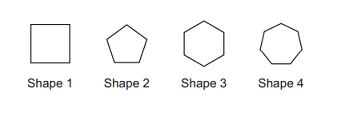
Paula starts making a pattern by drawing the shapes shown below.
The pattern continues. How many sides will Shape 20 have?
8
60 sec
M04.B-O.3.1
Q.
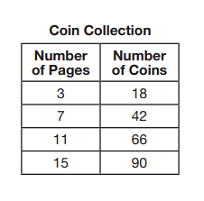
Jarod keeps his coin collection in a coin book. The table below shows the total number of coins he has stored based on the number of pages with coins.How many coins does Jarod store on each page of the book?
9
60 sec
M04.B-O.3.1.2
Q.
10
60 sec
M04.B-O.3.1.3
Q.
11
60 sec
M04.B-O.3.1.3
Q.
12
60 sec
M04.B-O.1.1
Q.
13
60 sec
M04.B-O.1.1.3
Q.
14
60 sec
M04.B-O.1.1.3
Q.
15
60 sec
M04.B-O.3.1.1
Q.
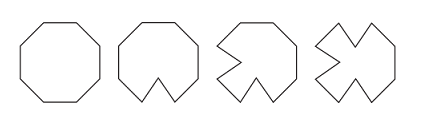
Starting with an octagon, Hillary used the rule "Replace one side with two new sides" to create the pattern shown below.
How many sides will the next shape in Hillary's pattern have?
16
60 sec
M04.B-O.3.1.1
Q.
17
60 sec
M04.B-O.3.1.3
Q.
Jesse has 4 rows of rocks. There are 6 rocks in each row. Which description shows another way
Jesse can organize all of his rocks?
18
60 sec
M04.B-O.2.1.1
Q.
The shapes below show a pattern.
The pattern continues. How many sides will shape 10 have?
19
60 sec
M04.B-O.3.1
Q.
20
60 sec
M04.B-O.2.1
Q.
Kelly made a number pattern. Each number in her pattern is a multiple of 3. Which rule could describe Kelly's pattern?
21
60 sec
M04.B-O.3.1
Q.
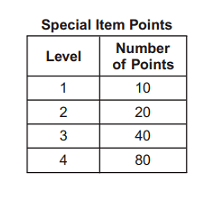
The table below shows the amounts of oats, in tablespoons, in different numbers of servings of granola bars.
The pattern continues. Which rule describes the amount of oats, in tablespoons, in any number of servings of granola bars?