Add and subtract fractions (including mixed numbers) with unlike denominators. (May include multiple methods and representations.) Example: 2/3 + 5/4 = 8/12 + 15/12 = 23/12
Demonstrate understanding of place-value of whole numbers and decimals, and compare quantities or magnitudes of numbers.
Organize, display, and answer questions based on data.
Solve multiplication and division problems involving fractions and whole numbers (straight computation or word problems).
Solve word problems involving division of whole numbers leading to answers in the form of fractions (including mixed numbers).
Use multiple grouping symbols (parentheses, brackets, or braces) in numerical expressions and evaluate expressions containing these symbols.
Create, extend, and analyze patterns.
Generate two numerical patterns using two given rules. Example: Given the rule “add 3” and the starting number 0 and given the rule “add 6” and the starting number 0, generate terms in the resulting sequences.
Identify apparent relationships between corresponding terms of two patterns with the same starting numbers that follow different rules. Example: Given two patterns in which the first pattern follows the rule “add 8” and the second pattern follows the rule “add 2,” observe that the terms in the first pattern are 4 times the size of the terms in the second pattern.
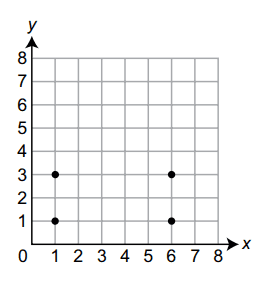
Represent real-world and mathematical problems by plotting points in quadrant I of the coordinate plane and interpret coordinate values of points in the context of the situation.
Use basic properties to classify two-dimensional figures.
Classify two-dimensional figures in a hierarchy based on properties. Example 1: All polygons have at least three sides, and pentagons are polygons, so all pentagons have at least three sides. Example 2: A rectangle is a parallelogram, which is a quadrilateral, which is a polygon; so, a rectangle can be classified as a parallelogram, as a quadrilateral, and as a polygon.
Convert between different-sized measurement units within a given measurement system. A table of equivalencies will be provided. Example: Convert 5 cm to meters.
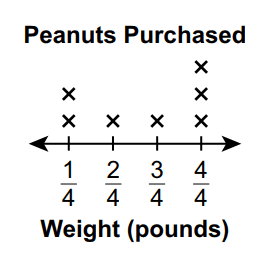
Solve problems involving computation of fractions by using information presented in line plots.
Display and interpret data shown in tallies, tables, charts, pictographs, bar graphs, and line graphs, and use a title, appropriate scale, and labels. A grid will be provided to display data on bar graphs or line graphs.
Apply the formulas V = l × w × h and V = B × h for rectangular prisms to find volumes of right rectangular prisms with whole-number edge lengths in the context of solving real-world and mathematical problems. Formulas will be provided.
Track each student's skills and progress in your Mastery dashboards