
placeholder image to represent content

Q4

Quiz by Dmitry Kislitsyn

Our brand new solo games combine with your quiz, on the same screen

Correct quiz answers unlock more play!

New Quizalize solo game modes
10 questions
Show answers
  • Q1

    Which of the following is the most frequently used measure of variation?

    The standard deviation

    The interquartile range

    The coefficient of variation

    The range

    30s
  • Q2

    Which of the following measures is not affected by extreme values in the data?

    The mean

    The median

    The standard deviation

    The range

    30s
  • Q3

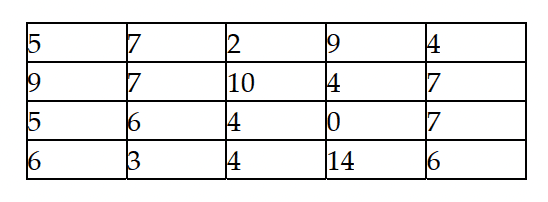
    The following data reflect the number of customers who test drove new cars each day for a sample of 20 days.

    Given these data, what is the range?
    Question Image

    4

    10

    16

    There is no right answer

    30s
  • Q4

    In order to compute the standard deviation, the level of data measurement should be:

    Nominal

    Qualitative

    Ratio or interval

    Ordinal

    30s
  • Q5

    Under what circumstances is it necessary to use the coefficient of variation to compare relative variability between two or more distributions?

    When the standard deviations of the distributions are equal

    When the means of the distributions are not equal

    When the standard deviation of the distributions are not equal

    When the means of the distributions are equal

    30s
  • Q6

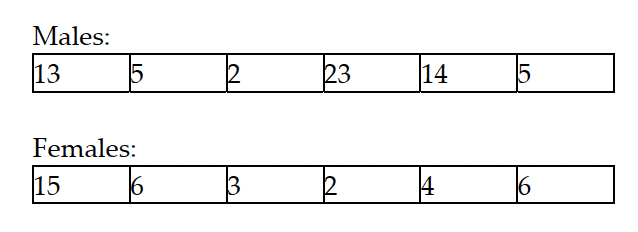
    Consider the following data, which represent the number of miles that employees commute from home to work each day. There are two samples: one for males and one for females.

    Which of the following statements is true?
    Question Image

    Males and females on overage commute the same distance

    The males in the sample commute farther on average than the females

    The female distribution is more variable since the range for the females is greater than for the males

    Females in the sample commute farther on average than do males

    120s
  • Q7

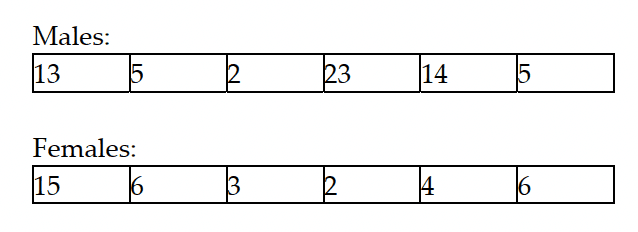
    Consider the following data, which represent the number of miles that employees commute from home to work each day. There are two samples: one for males and one for females.

    The coefficient of variation of commute miles for the males is:
    Question Image

    approximately 8%

    approximately 67%

    approximately 62%

    approximately 76%

    120s
  • Q8

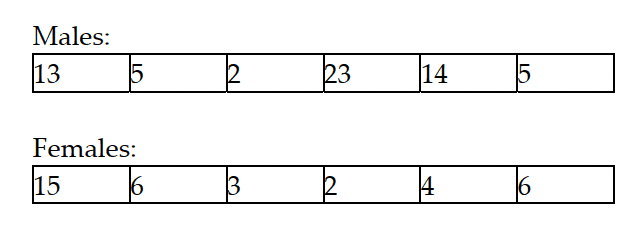
    Consider the following data, which represent the number of miles that employees commute from home to work each day. There are two samples: one for males and one for females.

    Which of the following statements is true?
    Question Image

    Females have the larger mean

    The coefficient of variation is larger for males than for females

    Females have the larger range

    The coefficient of variation is larger for females than for males

    20s
  • Q9

    Consider the following data, which represent the number of miles that employees commute from home to work each day. There are two samples: one for males and one for females.

    The variance of commute miles for the females is:

    Question Image

    Approximately 40

    Approximately 50

    Approximately 43.2

    There is no right answer

    120s
  • Q10

    The advantage of using interquartile range instead of the range as a measure of variation is 

    It is easier to compute

    It utilizes all the data in its computation

    It gives a value that is closer to the true variation

    It is less affected by extremes in the data

    120s

Teachers give this quiz to your class