Loading...


Quiz 2 in Organization and Management
Quiz by Ervin Ryann Garcia
Customize this quiz to suit your class
Instantly translate to 100+ languages
Tag the questions with any skills you have. Your dashboard will track each student's mastery of each skill.
Who among the three levels of management needstechnical skills the most?
multiplem://Top Level Management|10:MiddleLevel Management|30:Lower Level Management|50
Analyze the diagram. Do you think the flow of authority and flow of accountability at different levels of management are correct?
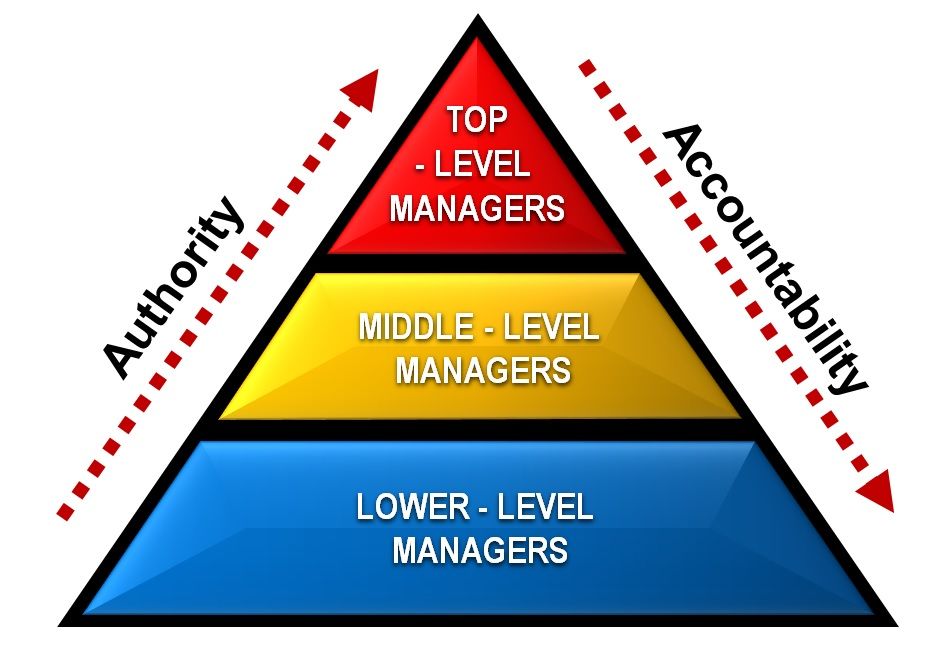
multiplem://Strongly agree|10:Agree|20:Neither agree nor disagree|30:Disagree|40:Strongly disagree|40
Who among the three levels of management needstechnical skills the most?
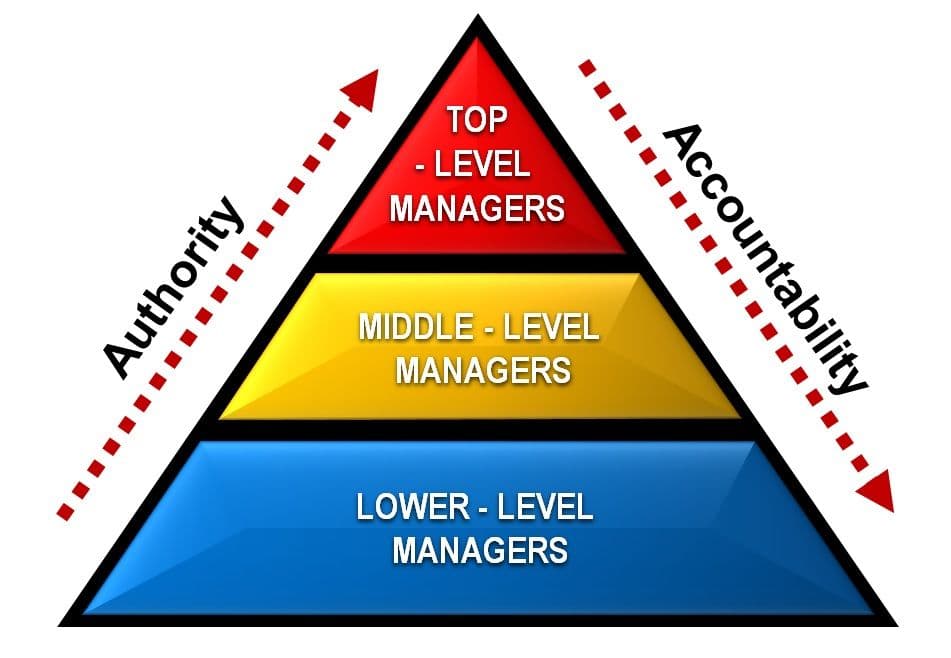
Analyze the diagram. Do you think the flow of authority and flow of accountability at different levels of management are correct?
Give this quiz to my class
I'm wanting to make a vocab quiz using the following 1. Supply chain a) The sequence of activities involved in the production and distribution of a product (Correct) b) The sequence of activities involved in marketing a product (Incorrect - refers to a different aspect of business operations) c) The sequence of activities involved in hiring employees (Incorrect - unrelated to product production) d) The sequence of activities involved in customer service (Incorrect - unrelated to product production) 2. Intermediaries a) Middlemen or brokers who facilitate transactions between two parties (Correct) b) The final consumers of a product (Incorrect - refers to end-users, not intermediaries) c) The employees working at a company's headquarters (Incorrect - unrelated to transaction facilitation) d) The shareholders of a company (Incorrect - unrelated to transaction facilitation) 3. Specialization a) Focusing on a specific task or aspect of production to achieve expertise and efficiency (Correct) b) Expanding business operations to new markets (Incorrect - refers to a different concept) c) Maximizing profits through cost-cutting measures (Incorrect - unrelated to specialization) d) The process of developing new products (Incorrect - unrelated to specialization) 4. Coordination a) Organizing and harmonizing different elements or activities to work together effectively and efficiently (Correct) b) Maintaining independence and autonomy among different departments (Incorrect - opposite meaning of coordination) c) Creating a hierarchical structure within an organization (Incorrect - unrelated to coordination) d) Maximizing competition among employees (Incorrect - unrelated to coordination) 5. Outsourcing a) Hiring external companies or individuals to perform specific tasks or functions (Correct) b) Expanding business operations to international markets (Incorrect - refers to a different concept) c) Merging with other companies to form a larger entity (Incorrect - unrelated to outsourcing) d) Expanding the scope of in-house operations (Incorrect - opposite meaning of outsourcing) 6. Inspection a) Examining and evaluating suppliers, products, or processes to ensure compliance with quality standards (Correct) b) Promoting new products through advertising campaigns (Incorrect - unrelated to inspection) c) Conducting market research to understand customer preferences (Incorrect - unrelated to inspection) d) Developing prototypes for new products (Incorrect - unrelated to inspection) 7. Efficiency a) Accomplishing tasks or goals with minimum waste of time, effort, or resources (Correct) b) Maximizing profits through aggressive pricing strategies (Incorrect - unrelated to efficiency) c) Expanding business operations to new markets (Incorrect - refers to a different concept) d) Streamlining organizational hierarchy through downsizing (Incorrect - unrelated to efficiency) 8. Expertise a) Specialized knowledge or skill in a particular field or area (Correct) b) Broad knowledge across multiple disciplines (Incorrect - opposite meaning of expertise) c) Entry-level knowledge and skills (Incorrect - unrelated to expertise) d) General knowledge applicable to various industries (Incorrect - opposite meaning of expertise) 9. Trend a) General direction or pattern of change or development over time (Correct) b) A one-time occurrence or isolated event (Incorrect - opposite meaning of trend) c) A static and unchanging state (Incorrect - opposite meaning of trend) d) A minor fluctuation in a stable market (Incorrect - unrelated to trend) 10. Demand a) Desire or need for a particular product or service (Correct) b) The quantity of a product produced by a company (Incorrect - refers to supply, not demand) c) The pricing strategy employed by a company (Incorrect - unrelated to demand) d) The promotional activities carried out by a company (Incorrect - unrelated to demand)The Compound Book Quiz - 6th Grade Reading Comprehension 1. What is the name of the main character in "The Compound"? A. Eli Yanakakis B. Marcus Yanakakis C. Luke Yanakakis D. Rex Yanakakis 2. Where do Eli and his family go to escape? A. A mountain cabin B. An underground compound C. A secret island D. A military base 3. Who built the compound? A. The government B. Eli's grandfather C. Eli's father D. A mysterious organization 4. How long was the family supposed to stay in the compound? A. 6 months B. 15 years C. 10 years D. 1 year 5. Which family member supposedly didn't make it into the compound? A. Eli's mother B. Eli's twin brother Eddy C. Eli's younger sister D. Eli's father 6. What does Eli's father tell the family happened outside? A. An earthquake B. A terrorist attack C. A nuclear war D. A deadly virus 7. What unusual food source does Eli's father plan to use in the compound? A. Artificial meat B. Insects C. Supplements only D. A special protein formula 8. How does Eli spend most of his time in the compound? A. Reading books B. Playing video games C. Exercising D. Isolating himself 9. What discovery does Eli make that makes him suspicious? A. Hidden cameras B. A working internet connection C. Secret passages D. Extra food supplies 10. What is the name of Eli's youngest sister born in the compound? A. Lexie B. Quinn C. Terese D. Lucy 11. What hobby does Eli take up to cope with his time underground? A. Painting B. Writing C. Playing music D. Cooking 12. What does Eli find in his father's private office? A. Family photos B. A radio C. A computer D. Survival guides 13. What makes Eli realize his father might be lying? A. Found newspapers B. Working internet C. Phone signals D. Television broadcasts 14. Who helps Eli discover the truth about the compound? A. His mother B. His sister C. The supplements supplier D. His grandmother 15. What is revealed about Eddy? A. He died in an accident B. He's living with relatives C. He's alive outside D. He never existed 16. What does Eli's father do when confronted with the truth? A. Confesses immediately B. Threatens the family C. Tries to escape D. Denies everything 17. How do they eventually escape the compound? A. Through air vents B. Using explosives C. With outside help D. Through emergency exit 18. What was Eli's father's true motivation for building the compound? A. Protection from war B. A psychological experiment C. Financial gain D. Government orders 19. How many years have they actually been in the compound when they escape? A. 6 years B. 3 years C. 15 years D. 9 years 20. What happens to Eli's relationship with his twin after the escape? A. They become close again B. They remain estranged C. They never meet D. They become rivals ANSWER KEY A B C B B C D D B A C C B B C B C B A AQuiz 2 - Maintenance and organisation of cells & Movement in and out of cells We found you were making a quiz on the subject of "What is a rubric? A tool comprising a set of criteria (with possible levels of performance quality on the criteria) developed to assess learners’ work, from written to oral to visual. It is used tomeasureperformance,suchastheprocess of doing something (e.g.,playing a musical instrument, making a speech) or products of the learners’ work (e.g., concept map, laboratory report, bookshelf) (Brookhart, 2013). BENEFITS OF USING RUBRICS Support authentic assessment Reflects how well learners are able to apply knowledge inthe real-world context. Communicate expectations Gives learners an idea of what is expected of them. It is especially useful when the rubrics are communicated to the learners before they are assessed. Improve performance Explicit criteria and performance level descriptions allow learners to understand the desired performance. Learners are able to assess themselves by referring to the specific criteria and performance-level descriptions. Provide informative feedback Instructors are able to provide constructive feedback to learners on their weaknesses and strengths. Promote thinking andlearning 4 Provide informative feedback Instructors are able to provide constructive feedback to learners on their weaknesses and strengths. Learners are able to review and revise their work,thus reflecting on their learning experiences. Ensure fairness Learner performance assessed fairly given its objectivity. It helps avoid disputes between learners and instructors about the scores/grades achieved. TYPES OF RUBRIC ANALYTIC It consists of individual criterion with corresponding descriptor of performance. HOLISTIC It consists of performance descriptors that are placed together to refeclet to overalll performance. ANATOMY OF ANANALYTIC RUBRIC Rating scales with corresponding scores or weights The row represents the criteria for the desired performance, while the column represents the evaluation score. Under the rating scale (corresponding weights orscorescanbeassigned),theperformance descriptors are explicitly stated ANATOMYOF AHOLISTICRUBRIC Descriptions: It comprises the rating scale (corresponding weights or scores can be assigned) in the row while the combined desired performance descriptors are placed in the column. Description of the task The purpose of the assignment is to assess learner’s cognitive and analytic skills in applying knowledge gained and constructed throughout the course Diffusion of Innovation,bywatching the Surrogates movieand writing ananalytical review of the movie in the context of innovation diffusion.Iwant to provide learners with informative feedback on their cognitive and analytic skills such as the following: applying the concepts of innovation diffusion,making judgmentson the scenes related to innovation diffusion identified from the movie,selecting and critiquing theories of innovation diffusion and making connections between the theories,aswell asarguingand proposing necessary solutions to the problemss hown in the movie. ESTABLISHING ALTERNATIVEASSESSMENTINHIGHEREDUCATION VALIDITYAND RELIABILITYOF RUBRICS. Validity Measuring what is supossedto be measured. Reability Yielding consists results. Instruments that are used in the alternative assessment must be aligned to the learning outcomes and measure well what it intends to measure (valid) and produce consistent scores (reliable). The valid instrument will manifest the true ability (latent trait) of learners and permit appropriate inferences to be made about a specific group of people for specific purposes. TYPES OF VALIDITY FACE VALIDITY Simple form of validity thatapplies a superficial and subjective assessment whether the instrument measures what it is supposed to measure. CONTENT VALIDITY Refers to the extent to which the items on a measure assess the same content or how wellthe content material was sampled inthe measure. CONSTRUCT VALIDITY Refers to the extent to which the test may be said to measure a theoretical construct or trait. CONCURRENT VALIDITY Refers to the extent to which scores onanewmeasure are related to scores from a criterion measure administered at the same time. PREDICTIVE VALIDITY Refers to the uses of the scores from the new measure to predict performance on a criterion measure administered ata later time. STEPS TO CONSIDER WHEN ESTABLISHING CONTENT VALIDITY Calculate the level of expert agreeement for the content validity, get expert to verfy. Interview the expert ,make meta contentdata análisis from literatura. STEPS TO CONSIDER WHEN ESTABLISHING CONSTRUCCT VALIDITY Administer the instrument for alll learners, revise any item necccesay, run an apropriates statistical analiysis, administerthe instrument to learners as a pilot test . CONSTRUCTMAP Morepreciseconceptthan construct. Ranges from one extreme to another(fromhightolow,small tolarge,positivetonegative,or strongtoweak). Identifiesthepositionofthe respondentsinthisrange. Representativenessofsampling (questions and ability of respondents). EXAMPLEO FACONSTRUCTMAP:AFFECTIVE LEVELOF AFFECTIVE VARIABLES EXAMPLESOFITEMSIN MEASURINGTEAM WORKING SKILLS 5. Characterisation Learnersvolunteerstodothe groupworks. 4. Organisation Learners are willing to help others,althoughitisnottheir scopeoftask. 3. Valuing Learners respect other team members’opinionwhendoing thediscussion. 2. Responding Learnergivescooperationwhen neededingroupworks. 1. Receiving Learneracceptsthediversityof races and nationalities among groupmembers. EXAMPLEOFACONSTRUCTMAP:PSYCHOMOTOR LEVELOF PSYCHOMOTOR VARIABLES EXAMPLESOFITEMSIN MEASURING DIGITAL SKILLS 7.Origination Learnerscanmodifytheirowndevicesto performbetter. 6.Adaptation Learnerscansolveandtroubleshootthe problemwhileusingthecomputer. 5.ComplexOvertResponse Learnerscanusethecomputercompetently. 4.Mechanism Learners can use the computer independently,butstillmakeminorerrors. 3.GuidedResponses Learnerscanusethecomputer,butstill needguidance. 2.Set Learnersarereadytousethecomputer. 1.Perception Learnerscanobservehowtousecomputer. EXAMPLEOFACONSTRUCTMAP:COGNITIVE LEVELOF COGNITIV E VARIABLES EXAMPLESOFITEMS IN MEASURING THINKINGSKILLS 6. Creating Learners are able to suggest anewmodelorframeworkof learningdigitalcommunity. 5. Evaluating Learners are able to judge the impactofthescenariotowards educationperspective. 4. Analysing Learnerscandifferentiate the factsusingafew theories. 3. Applying Learnerscansolveproblems usingthefactsgiven. 2. Understanding Learnersareabletoexplainthe factsusingtheirownwords. 1. Remembering Learnersonlymemorisethe. Direction of Increasing “X” Learners Learners with high “X” Learners with mid range “X” Learners with low “X” Responses to Item Item response indicate highest level of X Item response indicate higher level of X Item response indicate lower level of X The construct map shows the lower ability students are in line with the lower level of items. This shows that when educators plan to develop an instrument, it Item response indicate lowest level of X Direction of Decreasing “X” is crucial to create an item difficulty thatrepresents learners’ ability. Learners’ ability Learners who engage in level characterisation Learners who engage in level organisation Learners who engage in level valuing Learners who engage in level responding Learners who engage in level receiving Direction of Decreasing“X” MEASURINGCONSTRUCTVALIDITY Unlike content validity, this construct validity can be analysed using statistical analysis. Use Exploratory FactorAnalysis [EFA], Confirmatory FactorAnalysis [CFA] or Unidimensionality to confirm all items are measuring the right construct and the raw variance explained for the latent variables is sufficient. Gap initem map also can show accuracy in construct validity. RELIABILITY The degree to which test scores are consistent over repeated administrations of the same/ equivalent test and therefore considered dependable and repeatable for an individual learner.A test thatproduces highly consistent and stable results (i.e. relative free from random error) is said to be highly reliable. TYPESOFRELIABILITY Test-retest demonstrates the stability of a measure over time 01 Internal consistency most of the items within a rating scale of a concept show consistency of scoring. Inter-rater the extent to which two or more independent raters are consistent in observing, recording and scoring data (should be 70% or higher agreement) 04 Intra-rater relies on one rater to rate an object or event twice (70% or higher of agreement) FACTORSAFFECTING VALIDITYANDHOWTO INCREASEVALIDITY? FACTORS AFFECTING VALIDITY HOWTO INCREASE VALIDITY? 1. Inaccuracy of items in measuringtheoutcomes 1. Vetting session to get reviewsfromtheexpert. 2. Pooritemsdevelopment 2. Followtheformatandtips indevelopinggooditems. 3. Unclearinstructions 3. Do pilot testing to measuretheusabilityof thetest. 4. Interveningevents 4. Controltheinternalthreats validityfactors. 5. Itemsdifficultyisnot suitableforthelearners 5. Create a construct map toensurethereisanitem thatrepresentslearners ability. FACTORS AFFECTING RELIABILIT Y HOWTOINCREASERELIABILITY? 1. TestLength 1. Thetestlengthshouldbeappropriate withtestdifficulty. 2. Test retest interval 2. Suggesteddurationisbetween3 weeksto2months. 3. Variability of scores 3. Doconstructmaptoensuretheitems aresuitablewithlearners’ability. 4. Guessing 4. Penalisetheguessinganswers.You alsocandetecteitherthelearnersare guessing or not using the statistical analysis named guessing analysis andpersonfitanalysis. 5. Inconsistency score from different raters 5. Appointtheratertomarkcertain questionsforalllearners(Thisalways happen when you have more than onesectionandhavemorethanone lecturer). CONCLUSION Coming back to the issue of validity and reliability in assessment, there is a need for educators to put an effort to ensurethattheitemsintheformofquestionsorinstructions arenotonlyclearbutalsoabletomeasurewhatitisintended tomeasurebasedontherelatedlearningoutcomes. Establishingvalidityandreliabilityofinstrumentscan provide educators with some indications of the quality of the measuring tools being used. Valid and reliable instruments enabletheeducatorstocontinuouslyusethemeasuringtools withoutreservation. Reliablenot valid Precisenot Accurate Reliableand valid Preciseand Accurate NotReliable butvalid NotPrecisebut Accurate NotReliable butNotvalid NotPrecisebut NotAccurate 94 ". Would you like to continue making it or start afresh?Quiz#2 - Modeling Data in an OrganizationQuiz 2 in EnglishQuiz # 2 in MathQuiz#2 in Health Quarter 3