Loading...


Quiz #2: Using the Dictionary
Quiz by Airene Pascual
Customize this quiz to suit your class
Instantly translate to 100+ languages
Tag the questions with any skills you have. Your dashboard will track each student's mastery of each skill.
Give this quiz to my class
It is the most direct source of information about words.
thesaurus
glossary
word entries
dictionary
Catriona Gray is a woman full of elegance. What does elegance mean in this sentence?
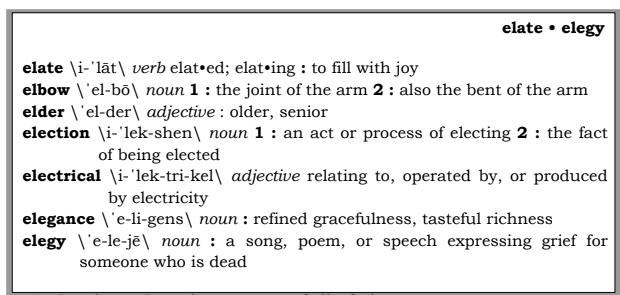
older, senior
to fill with joy
refined gracefulness, tasteful richness
a song, poem, or speech expressing grief for someone who is dead
It is the most direct source of information about words.
Catriona Gray is a woman full of elegance. What does elegance mean in this sentence?
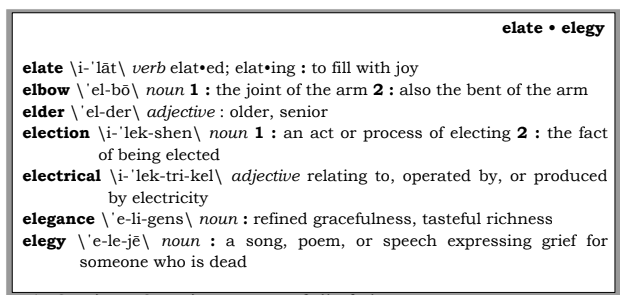
Which word in the dictionary pertains to a song that expresses too much sadness about someone who was lost or dead?
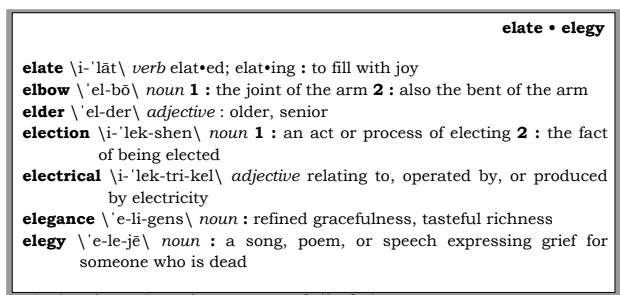
According to the dictionary above, what part of speech is the word "elbow"?
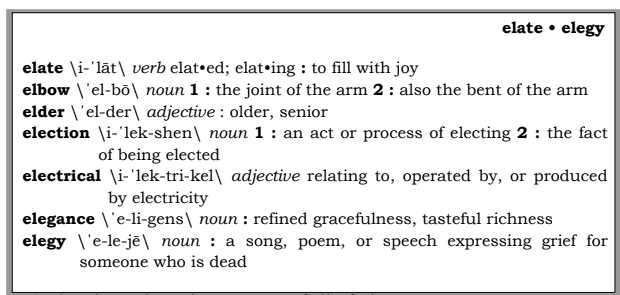
Which of these entries would you find on a dictionary page with the guide words teaspoon and telephone?
Quiz 2 - Finding the Area of Rectangle Using the Formula(Q2) Quiz #2.A Name the notes in the spaces using solfa-syllables(Q2) Quiz #2.B Name the notes on the line using solfa-syllablesMake a quiz using the partitive article with simple foods for a french 2 classMake a quiz using the following words and definitions: 1. narrative a story 2. narrate to tell a story 3. pronounce to speak in a certain way; to say aloud 4. denounce to criticize; to blame 5. fabulous amazing; fantastic 6. fabled legendary; famous 7. mythical not existing in reality; made up 8. mythology a group of stories associated with a subject or culture 9. recount to tell; to describe 10. discount to put down; to say or believe something is not worth much 11. idealistic believing in the idea of perfection or a perfect world 12. ideal perfectly suitable 13. idealize to think of as perfect 14. conscience the part of the mind that tells the diference between right and wrong 15. scientifc based on proven facts 16. savvy cleverness; understanding 17. savor to take time to enjoy 18. certify to prove good or true; to declare correct 19. certainty something about which there is no doubt; a fact 20. concerted done together; combined 21. ascertain to fgure out through reasoning. Use all 21 words in the multiple choice quiz; create distractor items in the answer choices.Short Quiz in Math 3 multiplies 2-digit by 1-digit numbers using the distributive property I'm wanting to make a vocab quiz using the following 1. Supply chain a) The sequence of activities involved in the production and distribution of a product (Correct) b) The sequence of activities involved in marketing a product (Incorrect - refers to a different aspect of business operations) c) The sequence of activities involved in hiring employees (Incorrect - unrelated to product production) d) The sequence of activities involved in customer service (Incorrect - unrelated to product production) 2. Intermediaries a) Middlemen or brokers who facilitate transactions between two parties (Correct) b) The final consumers of a product (Incorrect - refers to end-users, not intermediaries) c) The employees working at a company's headquarters (Incorrect - unrelated to transaction facilitation) d) The shareholders of a company (Incorrect - unrelated to transaction facilitation) 3. Specialization a) Focusing on a specific task or aspect of production to achieve expertise and efficiency (Correct) b) Expanding business operations to new markets (Incorrect - refers to a different concept) c) Maximizing profits through cost-cutting measures (Incorrect - unrelated to specialization) d) The process of developing new products (Incorrect - unrelated to specialization) 4. Coordination a) Organizing and harmonizing different elements or activities to work together effectively and efficiently (Correct) b) Maintaining independence and autonomy among different departments (Incorrect - opposite meaning of coordination) c) Creating a hierarchical structure within an organization (Incorrect - unrelated to coordination) d) Maximizing competition among employees (Incorrect - unrelated to coordination) 5. Outsourcing a) Hiring external companies or individuals to perform specific tasks or functions (Correct) b) Expanding business operations to international markets (Incorrect - refers to a different concept) c) Merging with other companies to form a larger entity (Incorrect - unrelated to outsourcing) d) Expanding the scope of in-house operations (Incorrect - opposite meaning of outsourcing) 6. Inspection a) Examining and evaluating suppliers, products, or processes to ensure compliance with quality standards (Correct) b) Promoting new products through advertising campaigns (Incorrect - unrelated to inspection) c) Conducting market research to understand customer preferences (Incorrect - unrelated to inspection) d) Developing prototypes for new products (Incorrect - unrelated to inspection) 7. Efficiency a) Accomplishing tasks or goals with minimum waste of time, effort, or resources (Correct) b) Maximizing profits through aggressive pricing strategies (Incorrect - unrelated to efficiency) c) Expanding business operations to new markets (Incorrect - refers to a different concept) d) Streamlining organizational hierarchy through downsizing (Incorrect - unrelated to efficiency) 8. Expertise a) Specialized knowledge or skill in a particular field or area (Correct) b) Broad knowledge across multiple disciplines (Incorrect - opposite meaning of expertise) c) Entry-level knowledge and skills (Incorrect - unrelated to expertise) d) General knowledge applicable to various industries (Incorrect - opposite meaning of expertise) 9. Trend a) General direction or pattern of change or development over time (Correct) b) A one-time occurrence or isolated event (Incorrect - opposite meaning of trend) c) A static and unchanging state (Incorrect - opposite meaning of trend) d) A minor fluctuation in a stable market (Incorrect - unrelated to trend) 10. Demand a) Desire or need for a particular product or service (Correct) b) The quantity of a product produced by a company (Incorrect - refers to supply, not demand) c) The pricing strategy employed by a company (Incorrect - unrelated to demand) d) The promotional activities carried out by a company (Incorrect - unrelated to demand)Make a quiz about the following mini-lab: Mini-Lab: Measuring Reaction Time and Hang Time Objective: In this mini-lab, you will work in groups to measure distances and use calculations to determine your reaction time and hang time. These experiments will help you understand fundamental concepts in physics and reaction time. Materials: Ruler (with metric units) Sticky notes or masking tape A vertical surface (like a wall) Clear space for jumping Calculator (if necessary) Part 1: Measuring Reaction Time Introduction: Reaction time is the time it takes for a person to respond to a stimulus. In this experiment, you will measure distances and use them to calculate your reaction time. Procedure: Preparation: Attach a sticky note or masking tape to the bottom edge of the ruler. Stand facing your partner. Hold the ruler vertically with the zero end at the bottom, lined up with your index finger and thumb. Measurement: Your partner will release the ruler without warning. When you see the ruler fall, try to catch it as quickly as you can. After catching the ruler, measure and record the distance the ruler fell. Data Collection: Each group should repeat the ruler drop experiment three times. Calculate the average distance and record it. Part 2: Calculating Hang Time Introduction: Hang time is the total time a person spends in the air while jumping. In this part of the mini-lab, you will measure distances using tape to mark your jump height and use them to calculate your hang time. Procedure: Preparation: Stand in front of a wall. Reach up as high as you can with your feet flat on the floor. Use a piece of tape to mark this point on the wall. Your partner should stand ready to observe and assist. Measurement: With a loop of tape on your finger, jump as high as you can. Stick the tape on the wall where your fingertips reach when jumping. The difference between the two pieces of tape marks your jumping height. Data Collection: Each group should repeat the jump and measurement three times. Calculations (Make sure to check your units before doing any calculations): Calculating Reaction Time: Use the average distance from Part 1. Calculate the time it took for the ruler to fall using the formula: y = viy t + ½ g t², where viy in this case is zero and "g" is the acceleration due to gravity (approximately 9.81 m/s²). This time is your reaction time. Calculating Hang Time: Use the average jump height difference from Part 2. Calculate the time you spent in the air using the formula: y = viy t + ½ g t². Remember that the velocity at the peak is zero and the total time in the air is twice the time it takes to get to the peak. Conclusion: Discuss your results with your partner and other groups. Compare your reaction times and hang times. Think about factors that may have influenced your results and how you can improve your reaction time and jump height. Consider the real-world applications of understanding reaction time and hang time in physics and sports. Assessment: Work with your partner to write a short report summarizing your findings, including calculations of your reaction time and hang time. Reflect on the factors that may have affected your results and propose improvements to your techniques. Be prepared to discuss your findings in class.