Loading...


Rafael's 4th Quarter Science Reviewer
Quiz by Rose Agito
Tag the questions with any skills you have. Your dashboard will track each student's mastery of each skill.
The scientists that study the materials that constitute the earth, and the processes that has shaped it
The earth's structure has layers: the crust, mantle, and core
The thin, outer layer of the lithosphere. It makes up only 1% of the earth's volume. It is where most earthquakes occur
It is 35-40 km thick. Made of light materials like granite, quartz, and feldspar.
It is 5-10 km thick; made of heavy rocks like basalt.
The thickest layer of the earth (67%). The temperature of the mantle varies between 1000°C to 3000°C near the core. Magma is present in this layer
Upper mantle is 7-410 km km thick.
Lower mantle - 660-2891 km thick.
It is the boundary between the crust and mantle, and where seismic waves travel faster.
It is where temperature (~5,430°C) and pressure are the most extreme. The heat of the inner core moves the outer core and the mantle. The intense pressure keeps it solid
It is liquid; made of very hot metals. Made of iron, nickel, and possibly oxygen and sulfur, and is found 2,890 km below the surface. The rotation of the earth spins the outer core and generates the earth's magnetic field.
They are the intense shaking of the earth's surface due to its movements.
The ________ is the location of the earthquake under the surface. The _________is the point on the surface directly above the hypocenter's location.
The energy that radiates outward from an earthquake is the __________.
study and memorize!

You got this!

It is the strength of the earthquake which is measured by a seismograph.
The magnitude is not classified in the Moment Magnitude Scale.
In the past, the Richter scale was used, but it has inaccuracies.
Memorize!

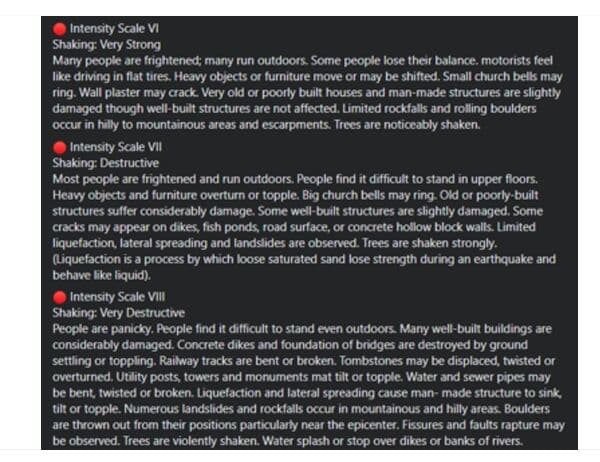
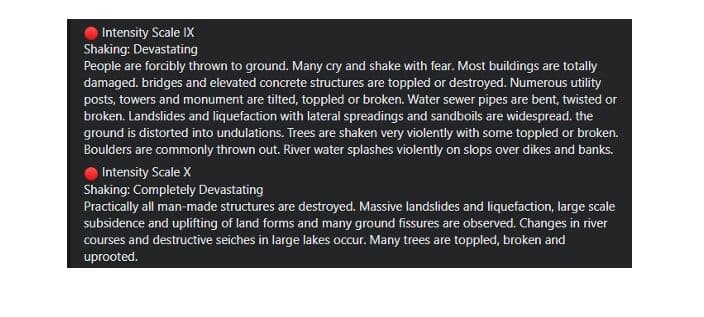
It is the strength of the shaking of an earthquake at a given area.
The PHIVOLCS Earthquake Intensity Scale (PEIS) was developed after the 1990 Luzon earthquake.
memorize!

more Rafael!
Another one!
The West Valley Fault in Metro Manila moves, on average, every 400 years. It last moved in 1658, around 350 centuries ago. Experts are expecting a powerful earthquake to occur because of the movement of this fault soon, so preparations are being done by all sectors

One of the effects of earthquake.
Are caused by underwater earthquakes or volcanic activity which displaces great amounts of ocean water.
In areas where the ground is saturated, an earthquake causes the water to rise as soil and rocks get compacted is considered as one of the effects of an earthquake.
The earthquakes may damage electrical and gas lines which cause fires to spread. Damaged roads and water lines may hinder fire fighting efforts.
It is the shaking of the ground causes earth and rocks from steep slopes to cascade down.
A man-made structures may be destroyed during earthquakes.
The structures closer to a fault will be more heavily damaged than those farther away
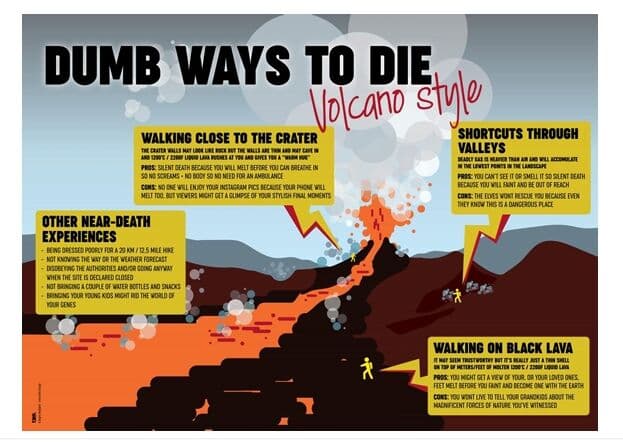
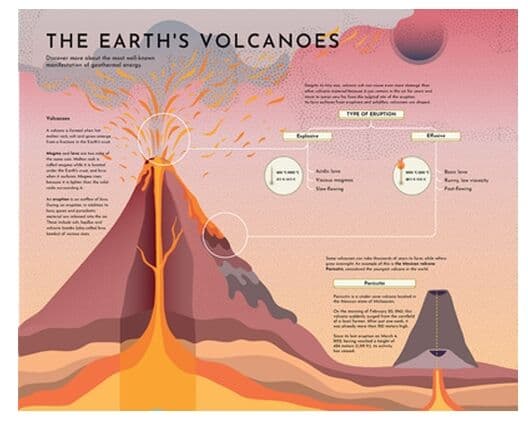
A volcano is an opening on the planet's surface through which lava, gases, and volcanic ash escape. Geologic activity such as volcanic eruptions and earthquakes happen mostly in the Ring of Fire. Volcanoes may be active, dormant, or extinct.
Check the Volcano Features
Check the correct types of eruptions
Look!

oh! oh!
yays!
Rafael be like!

Benefits of volcanic eruptions.
Fertile Soil - ash and lava bring nutrients for plant growth.
Benefits of volcanic eruptions.
Geothermal energy - volcanic activity can create reservoirs of hot water and steam. These can be tapped to generate electricity.
Benefits of volcanic eruptions.
Biodiversity - volcanic islands are home to unique flora and fauna.
Benefits of volcanic eruptions.
Mineral deposits - minerals from deep in the earth are brought out by volcanic eruptions.
Benefits of volcanic eruptions.
Tourism and recreation - volcanoes can create lava fields, craters, hot springs, and geysers and interesting hiking spots.
Benefits of volcanic eruptions.
Carbon sequestration - some volcanic rocks can absorb carbon dioxide from the air.
In ancient times, people studied the lights in the sky, and how they moved. One explanation for this was that _______ is the center of the universe, but some lights seemed to move differently from the stars. These lights were called _______ which mean "wanderers". Later, it was proposed that the planets, with the earth, went around the sun instead. This explained the motion of the planets better
A _______ is a large body that orbits a star.
A ________ is a body that orbits a planet.
A_________ consists of a star*, as well as all the planets, moons, and other bodies travelling around it.
One of the things that keep planets in their orbits is g _ _ _ _ _ y.
The more massive an object is, the greater its gravity. Also, the farther objects are, the smaller the gravity.
The other thing keeping the planets in orbit is inertia.
Inertia keeps an object in its current position or motion. Without inertia, the planets will just fall into the sun. Without gravity, they will just move in straight lines.
Mercury, Venus, Earth, and Mars are called the ______. They have similar sizes, and rocky structures. They have few moons, and rotate slowly. None of them have rings.
Between the orbits of Mars and Jupiter lies the asteroid belt. Asteroids are rocky or metallic objects that orbit the sun. The largest asteroid is 1/4 the size of the moon. Sometimes, asteroids can cross Earth's orbit
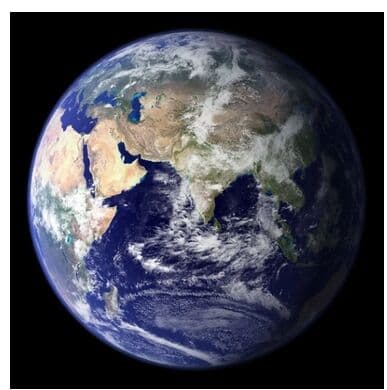
Diameter: 12750 km Distance from Sun: 149.6M km Day: 23h 56m 4s Year: 365.24 days It has one moon. Its atmosphere supports a wide variety of life. Earth has a strong magnetic field and tectonic activity
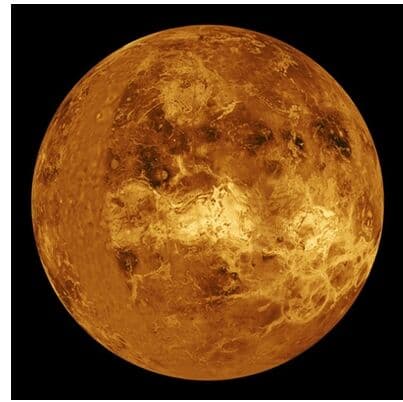
Diameter: 12100 km Distance from Sun: 108.2M km Day: 243 days Year: 225 days It has no moons. It's atmosphere is carbon dioxide that is 90 times denser than Earth's. Venus has many volcanoes
Diameter: 4880 km Distance from Sun: 57.9M km Day: 59 days Year: 88 days It has no moons. The side facing the sun can melt zinc, while the opposite side can drop to -170 ⁰C

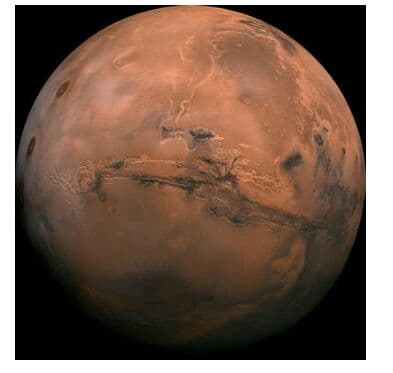
Diameter: 6800 km Distance from Sun: 227.9M km Day: 23h 37m 12s Year: 687 days It has two moons. It also has seasons. Mars has a thin atmosphere of carbon dioxide
The planets beyond the asteroid belt, These are the outer planets. They are called gas giants. They have a small, metallic core and a thick atmosphere. They all have rings and many moons. They spin rapidly, and their orbits are farther apart.

Beyond the outer planets are the smaller, icy worlds. One of the largest is Pluto. It was once known as the ninth planet. In 2003, a slightly larger planet was found beyond Pluto. The IAU reclassified Pluto as a dwarf planet in 2006

Diameter: 143000 km Distance from Sun: 778.4M km Day: 9h 55m Year: 12 years Has at least 95 moons. It is the largest planet. Its atmosphere is mostly hydrogen and helium. The great red spot is a 300 years old storm. Its most wellknown moons are Ganymede, Europa, and Io

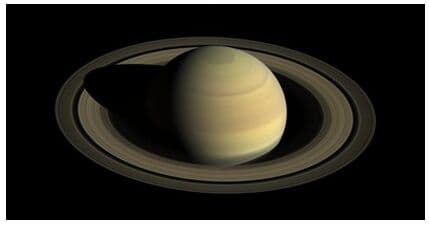
Diameter: 120500 km Distance from Sun: 1.43B km Day: 10h 40m Year: 29 years Has at least 146 moons. Its atmosphere is mostly hydrogen and helium. It has huge storms and jet streams. It has a huge ring system. Its moon, Titan, is the only moon with a cloudy atmosphere
Diameter: 51000 km Distance from Sun: 2.87B km Day: 17h 14m Year: 84 years Has at least 27 moons and 11 rings. Its atmosphere includes methane, which is why it appears blue. Its moon, Miranda, looks broken apart
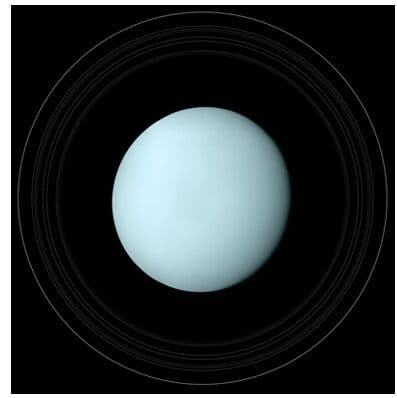
Diameter: 49500 km Distance from Sun: 4.5B km Day: 16h 7m Year: 165 years It has at least 16 moons. Its atmosphere is mostly hydrogen, helium, and methane. Possibly, has an ocean. Its moon, Triton, is larger than Pluto and has ice volcanoes

A ________ is a ball of ice and rock that orbits the sun. As a comet approaches the sun, the ice is warmed and forms a cloud of gas. The solar radiation pushes the cloud away and the comet appears to have a tail. Comets may come from a) Kuiper Belt - contains around 70,000 large asteroids or b) Oort Cloud - a huge cloud around the solar system.

_______ small rocky or metallic objects that orbit the sun.
a meteoroid that enters the Earth's atmosphere. It appears as a streak as it breaks apart and burns in the atmosphere
A meteor that did not break up in the atmosphere and has hit the Earth's surface.
Scientist that studies the universe
Everything that exists.
It magnifies distant objects to be studied.
A type of telescope that uses mirrors that focus light onto the lens
A type of telescope that uses lenses to gather light from a distant object
One complete spin is called a rotation; this occurs every 24 hours. _______ is what causes day and night.
The earth spins on its ______ and an imaginary line that runs from the North to the South Pole.
Standard time zones - there are 24 time zones of around 15° wide in longitude where it is the same time.
International date line - West of this line, it is 1 calendar day in advance.
The earth's axis is tilted at 23.5°. As it goes around the sun, the tilt causes parts of the earth to receive more sunlight than other parts. The result is the distinct seasons of the year.
The earth takes 365.24 days to orbit the sun. This is called a revolution.
The shape of the moon that we see depends on how much of it is lit up by the sun as it orbits the earth. The different shapes are called the phases of the moon.
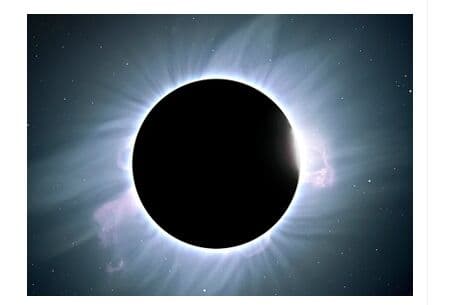
As the moon orbits the earth, and the earth orbits the sun, sometimes, they can block each other. If the moon blocks the sun perfectly - that is a solar eclipse. If the earth blocks the light of the sun from hitting the moon - that is a lunar eclipse.
The________ is the outermost part of the sun's atmosphere. It is usually hidden by the bright light, but it is easily viewable during a total solar eclipse.
________ are the regular rise and fall of the water level along a shore. Tides are caused by the gravity of the moon, earth and sun. The water on the side of the earth facing the moon bulges on both sides. This is a high tide. When the sun, earth, and moon line up, tides can be stronger. (Search: spring tides and neap tides)
Study

more

Konti pa!
yays!

hang in there!
hydrate!

PAGASA - Philippine Atmospheric, Geophysical, and Astronomical Services Administration PAGASA classifies the types of weather based on the distribution of rainfall.
The Philippine dry season occurs from Dec. to May. There is little to no rain. Dec. to Feb. - cool dry season caused by the northeast monsoon (amihan) Mar. to May - hot dry season
The Philippine dry season occurs from Dec. to May. There is little to no rain. Dec. to Feb. - cool dry season caused by the northeast monsoon (amihan) Mar. to May - hot dry season
The Study of the Earth's Weather
It is the gaseous layer of the earth.
the condition of the atmosphere at a given time and place.
the weather patterns in a long period of time.
Factors that Affect Weather
The dryness or wetness of a place. The major climates are affected by hot or cold, and wet or dry.
Factors that Affect Weather
It is the hotness and coldness depends on the latitude.
There are types of Climate
Tropical - the warmest temperature; from the equator to 30° latitude.
Polar - the coldest temperature; around the poles. Temperate - between 30° to 60° latitude.
Look!

Look familiar!
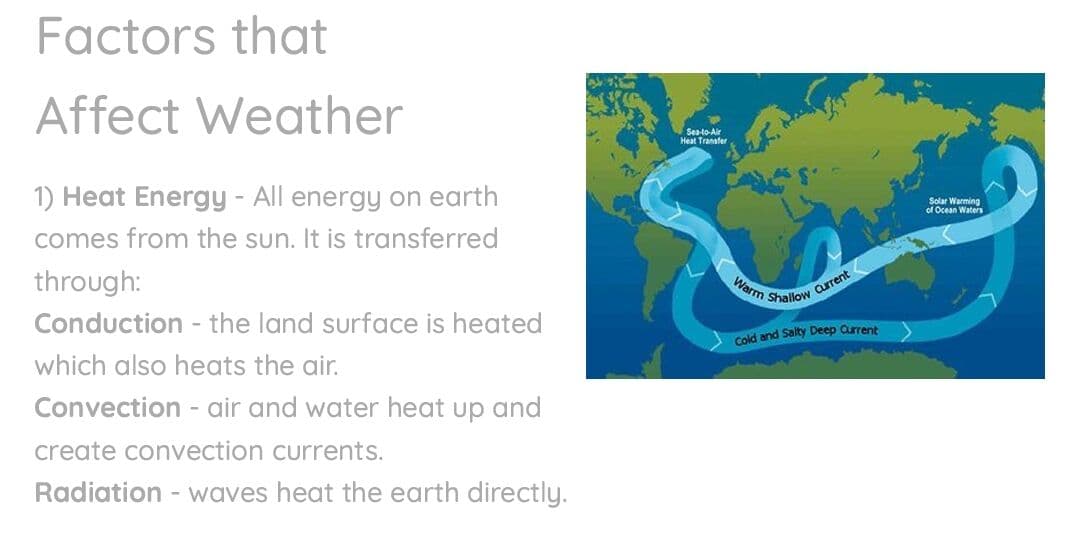
more pa!
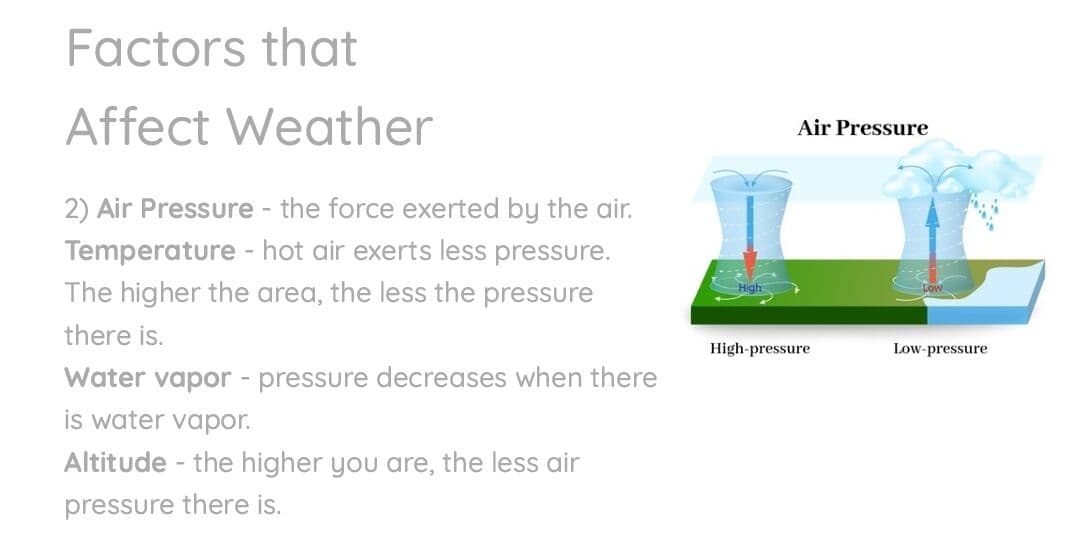
Konti na lang!

Guess what?
