Loading...


Review and Remediation Cell Organelles, Functions and Transport
Quiz by Katheryn Eubanks
Track each student's skills and progress in your Mastery dashboards
If an egg is soaked in vinegar for two days then salt water for two days, what factor explains why the egg's size changed during the experiment?
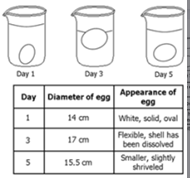
The egg was selectively permeable, and liquids diffused in and out of the egg by osmosis.
The egg was slightly shriveled on day 5 because it was placed in a hypotonic solution.
The egg could not undergo osmosis because it was placed in different solutions.
On day 3 the egg was the smallest because the shell had dissolved off of the egg
Phagocytosis, or cellular eating, occurs when the dissolved materials enter the cell.
Pinocytosis, or cellular drinking, occurs when the plasma membrane folds inward to form a channel allowing dissolved substances to enter the cell. BOTH THESE ARE EXAMPLES OF ___.
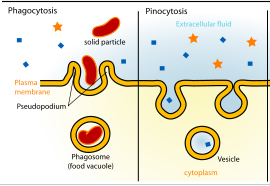
Endocytosis
Diffusion
Mitosis
Exocytosis
If an egg is soaked in vinegar for two days then salt water for two days, what factor explains why the egg's size changed during the experiment?

Phagocytosis, or cellular eating, occurs when the dissolved materials enter the cell.
Pinocytosis, or cellular drinking, occurs when the plasma membrane folds inward to form a channel allowing dissolved substances to enter the cell. BOTH THESE ARE EXAMPLES OF ___.

The image shows plant cells. What is represented by plant cell C?

Beaker B shows a red blood cell placed in a solution that is causing the water to leave the cell. Why is this happening?

Observe beaker A, what is the best explanation for what is happening?

Looking at the image, explain what is happening in Beaker C.

What is represented by the diagram?

In the diagram, the cell on the right is plasmolyzed and the cell on the left is turgid. What does this mean and under what conditions would it be in this condition?

The movement of solute molecules from an area of high concentration to low concentration is an example of

A biologist observed a plant cell in a drop of water as shown in diagram A. The biologist added a 10% salt solution to the slide and observed the cell as shown in diagram B. The change in appearance of the cell resulted from

When a molecule enters a cell with the help of proteins of its membrane, it has undergone
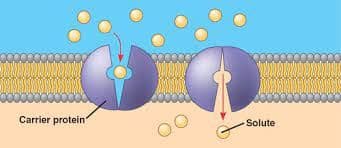
In the diagram, the dark dots indicate small molecules. These molecules are moving out of the cells, as indicated by the arrows. The number of dots inside and outside of the two cells represents the relative concentrations of the molecules inside and outside of the cells.
ATP is being used to move the molecules out of the cell by

When placed in water wilted plants regain their leaf turgor because of the

The picture shows a wilted plant. What can be assumed about the cells of this plant?

Look at the U-tube below, the left side is a hypotonic solution and the right side is a hypertonic solution. What can you predict will happen after a period of time?

This diagram represents osmosis of water across a semipermeable membrane. The U-tube on the right shows the results of osmosis. What could you do to level the solutions in the two sides of the right hand U-tube?

Observe the two beakers, which of the following statements is true.

The diagram below represents osmosis, What type of the solution has the cell been placed in causing the water to move out of the cell?

The diagram below represents movement of a large molecule across a membrane. Which process is best represented in this diagram?

The diagram below represents a section of a plasma membrane. What does structure X represent?

Which statement regarding the functioning of the cell membrane of all organisms is not correct?
A red blood cell placed in distilled water will swell and burst (lyse) due to the diffusion of
The diagram below represents a cell in water. Formulas of molecules that can move freely across the cell membrane are shown. Some molecules are located inside the cell and others are in the water outside the cell

Which of the following lists contains all of the organelles that are found in plant cells but NOT animal cells?

In which organelle is the process of protein synthesis conducted?
Which is located at S?

Which structures are present in plant and animal cells?
The arrow is pointing to what organelle and what is its function?

