Loading...


Rhythm - Intro to 16th Notes
Quiz by Laura Conrad
Customize this quiz to suit your class
Instantly translate to 100+ languages
Tag the questions with any skills you have. Your dashboard will track each student's mastery of each skill.
Give this quiz to my class
How many beats does a SINGLE 16th note get?
1/4 of a beat
1/2 of a beat
1/16 of a beat
1/8 of a beat
We will usually see 16th notes in groups of _____
16
2
4
8
How many beats does a SINGLE 16th note get?
We will usually see 16th notes in groups of _____
Four 16th notes grouped together will take up how many beats total?
What 4 words come out of your mouth to count 16th notes?
How would you count this rhythm? CAPITAL LETTERS are used for things you would say loudly. Lowercase letters are used for things you would whisper.
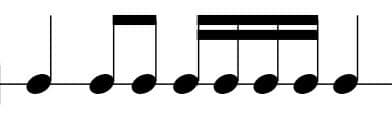
How would you count this rhythm? CAPITAL LETTERS are used for things you would say loudly. Lowercase letters are used for things you would whisper.
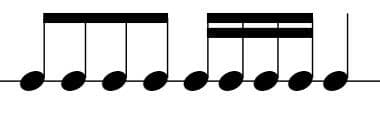
How would you count this rhythm? CAPITAL LETTERS are used for things you would say loudly. Lowercase letters are used for things you would whisper.

How would you count this rhythm? CAPITAL LETTERS are used for things you would say loudly. Lowercase letters are used for things you would whisper.

How would you count this rhythm? CAPITAL LETTERS are used for things you would say loudly. Lowercase letters are used for things you would whisper.

How do 16th notes look different from 8th notes?
Intro to Beginning Rhythm, Rests, & Time SignaturesTo understand melody in music, think about some music you’re familiar with. If you were asked to hum it, what would that sound like? The part of the music that you’d hum is the melody. It’s the main thread of sound that your brain tracks and holds onto when you’re listening to music. In vocal music, the melody is sung by the lead singer. Other vocalists can provide harmony and instruments can add accompaniment, but the melody is the star of the show.What are the characteristics of melody in music? How do you describe a melody in music? A melody needs to have two things. The first is a sequence of notes, or pitches, which range from high to low. The second is rhythm, which is the timing and duration of each note. These two simple elements can create an incredible variety of combinations. Even though a melody only consists of one note at a time, it can convey so much energy and emotion. Melodies can be fast and sparkly, like “The Flight of the Bumblebee.” They can be slow and majestic, like “Finlandia.” They might be sweeping and graceful, like a Strauss waltz. Or they can be fun and exciting, like your favorite pop tunes that you love to sing along with. Melodies often tell you a lot about where a piece of music comes from. It’s easy to recognize and identify melodies from different folk traditions such as the Japanese folk song “Sakura” or the Irish tune “Star of the County Down.” Learn how to play your favorite melodies on piano, and more! Sign up now. What is melody in music? Here are some examples. Here is the famous melody for the song “Lean on Me” written out on a staff. Notice the way that the notes move up, down, and then repeat. What is melody in music? Example of Lean On Me notes on treble staff. A melody all by itself is great, but music can be even more fun when there’s an accompaniment. Here are a few bars of “Lean on Me” with the accompaniment written out. As you listen to this song, notice how the accompaniment has a very similar rhythm and movement to the melody. Then there’s that one note in the bass line that comes along every measure with its own rhythm, which adds some extra energy and movement to the song. What makes a good melody? When you create a melody, there are four types of movement you can use: Repeat (same note) Step (up or down) Skip (up or down) Leap (up or down) Stepping and repeating are the most common types of melodic motion, and this makes a melody easier to sing. Most “hummable” tunes use steps and repeats almost exclusively. This kind of melody is called conjunct. Beethoven’s “Ode to Joy,” one of the most famous melodies of all time.Skips and leaps are generally more sparing in melodies, but when thoughtfully placed they can have a powerful emotional impact. Tunes with a lot of leaps are called disjunct. Listen to Sarah Brightman sing All I Ask of You from The Phantom of the Opera starting at 0:39. This is a very disjunct melody, and challenging to sing. Great melodies also incorporate patterns that blend unity, repetition, and contrast. Our ears love patterns, but they also love novelty and growth. A good melody incorporates all of these elements. For example, listen to John William’s “Princess Leia Theme.” Can you hear the repeated pattern in the melody that gradually moves higher as the theme progresses? Now listen to the way it changes and develops into something that fits with what came before but sounds new at the same time. This is some great melodic writing! Can melody exist without rhythm? There is no way for a melody to exist without rhythm. Even if your melody only has one note, that note has a duration, and that’s the rhythm. If your melody has two notes, how long those notes last and how much time passes between hearing them is also a rhythm. A melody in music can often be recognized even when it’s performed with different rhythms. This frequently happens in live performances of pop, rock, and jazz, in which singers typically improvise slight rhythmic differences with each performance. No two renditions are exactly the same, and this constant reinterpretation keeps the music fresh. How to make a melody for a song on piano Creating your own melodies on the piano is easy and fun! There are so many ways you can discover a melody all your own. Here are a few ideas. Get some inspiration from the world around you. What can you hear right now? A clock ticking? A bird song? A car passing by your house? See if you can find some notes on the piano that imitate the sounds you hear. Think of a feeling you’d like to put into a melody. What are some ways you could make a string of notes sound happy, sad, angry, or maybe just thoughtful. Choose a line from a poem you like, or write your own. Read it out loud and put some feeling into it. Did your voice rise and fall in pitch as you were reading? Now go to the piano, start on any note you like, and try to imitate what happened when you read. Go up when your voice naturally went up, go down when your voice naturally went down. How did that sound? Now you have the perfect melody to go with those words. Too many keys on the piano? The truth is, most melodies use only a limited number of different notes. Try creating a melody using only the black keys. These form what’s called a pentatonic scale. It’s used in a lot of folk music traditions around the world and can be a great place to start if you want to create your own melodies. Remember, when you create your melody, keep it simple. Use repeated notes and steps, but add a few skips to keep things interesting. One tip about leaps: when you do put in a big leap, try doubling back and filling in the empty space you leaped over. This keeps the melody self-contained and easier to sing. Also, see if you can use the same patterns of notes and rhythms to give the melody unity, but also change those patterns to give it variety. There is no right or wrong way to create your own music. Keep trying combinations of notes and rhythms until you find something that you like. How many bars and notes are in a melody? Many types of music tend to have a prescribed number of bars, or measures. This will vary widely between different genres, and creates an overall sense of musical structure. If you’re writing a pop song, a verse will usually have between eight and sixteen bars. The prechorus that follows often has just four bars, and this “foreshortening” creates a sense of acceleration, driving the listener toward the chorus. The number of notes can also vary widely. A melody in music needs at least two notes, and a long and complex one can have hundreds or even thousands of notes. What is a countermelody in music? How many melodies should a song have? A counter melody is a melodic line that interacts with the primary melody as an independent but supportive voice. A great example of this is the song “We Don’t Talk about Bruno.” Each character sings their own melody during the piece, but these melodies all combine at the end as countermelodies. This produces a musical texture known as counterpoint. The same thing happens in “One Day More” from Les Miserables. The different melodies are first sung separately, but end up being combined in a splendid, complex texture that leads the music to its thrilling conclusion. The difference between a countermelody and regular harmony is that harmony usually supports the rhythms of the melody. A countermelody will move more independently, with different rhythms from those of the melody, and will often sound “melodic” when sung or played all by itself. A melodic song should have one main melody. This is the part that the lead voice sings. It’s usually in the spotlight, and will be the most memorable part of the music. Anything else is either harmony, countermelody, or accompaniment. Does all music have to have a melody? A piece of music doesn’t have to have a melody. There are many different kinds of music without melody. For example, a lot of music played on percussion instruments won’t have a melody. Listen to this example of Tahitian drumming. This is some great music, exciting and fun to listen to, but you’d have a hard time humming it. It’s music, but it doesn’t have a melody. Rap music is another style of music where there doesn’t have to be a melody. In rap, words are chanted rather than sung. The performer will raise and lower the pitch of their voice for emphasis, but it’s the rhythm of the words that creates most of the music. Music can even lack any melody, at least in some sections. Listen to the opening chords of “Duel of the Fates.” This choral passage is all about harmony, with little rhythmic variance or sense of melody. But it makes an effective contrast with the next section, which is bustling with rapid instrumental melodies. In some pieces, there are multiple melodic lines but there is no one main melody. When music is made up of equally important countermelodies, it creates a contrapuntal texture. Baroque composer J.S. Bach was one of the greatest masters of this style, such as in his Little Fugue in G minor. It starts with a single melodic line, the subject, but then a countermelody is added, and then more and more until several melodic lines are playing together. It’s fun to listen to, but once all the countermelodies are playing together it becomes hard to decide which part to hum along with! You’ll also hear a lot of counterpoint in jazz music, in which the different instruments are all playing together and improvising their own melodies that combine to create a rich, thick musical texture. Experience the wonder of melody in music! Whether you’re humming your favorite tune, or creating a new song all your own, melody is a memorable, shareable part of music. Enrich your music experience by being aware of, listening for, and enjoying the melodies all around you.What Is Rhythm in Music? Rhythm is the pattern of sound, silence, and emphasis in a song. In music theory, rhythm refers to the recurrence of notes and rests (silences) in time. When a series of notes and rests repeats, it forms a rhythmic pattern. In addition to indicating when notes are played, musical rhythm also stipulates how long they are played and with what intensity. This creates different note durations and different types of accents.Why Is Rhythm Important in Music? Rhythm functions as the propulsive engine of a piece of music, and it gives a composition structure. Most musical ensembles contain a rhythm section responsible for providing the rhythmic backbone for the entire group. Drums, percussion, bass, guitar, piano, and synthesizer may all be considered rhythm instruments, depending on the context. However, all members of a music group bear responsibility for their own rhythmic performances and play the musical beats and rhythmic patterns indicated by the piece's composer.7 Elements of Rhythm in Music Several core elements comprise the fundamentals of musical rhythm. 1. Time signature: A musical time signature indicates the number of beats per measure. It also indicates how long these beats last. In a time signature with a 4 on the bottom (such as 2/4, 3/4, 4/4, 5/4, etc.), a beat corresponds with a quarter note. So in a 4/4 time (also known as "common time"), each beat is the length of a quarter note, and every four beats form a full measure. In 5/4 time, every five beats form a full measure. In a time signature with an 8 on the bottom (such as 3/8, 6/8, or 9/8), a beat corresponds with an eighth note. 2. Meter: Standard Western music theory divides time signatures into three types of musical meter: duple meter (where beats appear in groups of two), triple meter (where beats appear in groups of three), and quadruple meter (where beats appear in groups of four). Meter is not tied to note values; for instance, a triple meter could involve three half notes, three quarter notes, three eighth notes, three sixteenth notes, or three notes of any duration. Musicians and composers regularly mix duple and triple meter in their work; Igor Stravinsky's "The Rite of Spring" is a textbook example of such a technique. 3. Tempo: Tempo is the speed at which a piece of music is played. There are three primary ways that tempo is communicated to players: beats per minute, Italian terminology, and modern language. Beats per minute (or BPM) indicates the number of beats in one minute. Certain Italian words like largo, andante, allegro, and presto convey tempo change by describing the speed of the music. Finally, some composers indicate tempo with casual English words such as “fast,” “slow,” “lazy,” “relaxed,” and “moderate.” 4. Strong beats and weak beats: Rhythm combines strong beats and weak beats. Strong beats include the first beat of each measure (the downbeat), as well as other heavily accented beats. Both popular music and classical music combine strong beats and weak beats to create memorable rhythmic patterns. 5. Syncopation: Syncopated rhythms are those that do not align with the downbeats of individual measures. A syncopated beat will put its emphasis on traditional weak beats, such as the second eighth note in a measure of 4/4. Complex rhythms tend to include syncopation. While these rhythms may be more difficult for a beginning musician to pick up, they tend to sound more striking than non-syncopated rhythmic patterns. 6. Accents: Accents refer to special emphases on certain beats. To understand accents, think of a piece of poetry. A poetic meter, such as iambic pentameter, may dictate a specific mixture of stressed syllables and unstressed syllables. Musical accents are no different. Different rhythms may share a time signature and tempo, but they stand out from one another by accenting different notes and beats. 7. Polyrhythms: To achieve a particularly ambitious sense of rhythm, an ensemble may employ polyrhythm, which layers one type of rhythm on top of another. For instance, a salsa percussion ensemble may feature congas and bongos playing 4/4 time, while the timbales concurrently play a pattern in 3/8. This creates a dense rhythmic stew and, when properly executed, it can yield incredibly danceable rhythm patterns. Polyrhythms originated in African drumming, and they’ve spread to all sorts of genres worldwide, from Afro-Caribbean to Indian to progressive rock, jazz, and contemporary classical.They've Got the Beat! Some students in New York really sing their hearts out! That's because they are in the school chorus at Public School 22. These students from Staten Island had a concert at the White House. They sang at a Hollywood awards show. Audiences have clapped and cheered them on. These kids are always asked to return. How does it feel to sing on stage? "I get nervous singing for a big audience," Brianna Crispino recalls. "But when I see the joy on their faces, I get excited." Sounds Good. The P.S.22 chorus is divided into two groups. The sopranos sing high notes. The altos sing lower sounds. Instruments like drums sometimes keep the beat. It's important to keep the rhythm so they make the right sounds together. Most adult choruses have four groups of voices. Here's a look at the number of each type of voice in one adult chorus from Pennsylvania. Musical Expression. Being part of the chorus is hard work. The chorus members won't disagree. They practice for three hours each week. Gregg Breinberg, their teacher, encourages the chorus to use movements. They move their hands to show how the songs make them feel. "They have their own movements because nobody feels music the same way," he explains. The chorus members understand that singing in a chorus is a big job. "We just want to give it our best!" one student says.🔹 Quiz Title: “Which Deep Work Approach is This?” Question 1: Maya blocks off Monday–Wednesday for research, Thursday–Friday for teaching and admin. What deep work approach is she using? A) Monastic B) Bimodal ✅ C) Rhythmic D) Journalistic Correct Answer Explanation: ✅ Maya clearly separates deep work and shallow work by dedicating multiple days to each — this is a hallmark of the Bimodal approach. Question 2: Jon writes every morning from 8 to 11 AM, without fail. Which approach best fits Jon’s work style? A) Monastic B) Journalistic C) Rhythmic ✅ D) Bimodal Correct Answer Explanation: ✅ Jon has a regular daily rhythm of deep work — this is the Rhythmic approach. Question 3: Lina grabs any quiet 1–2 hour slot between her busy teaching days to do focused writing. What approach is she following? A) Monastic B) Journalistic ✅ C) Bimodal D) Rhythmic Correct Answer Explanation: ✅ Lina uses deep work opportunistically, fitting it into gaps in her unpredictable schedule — this is characteristic of the Journalistic approach. Question 4: Ali retreats to a rural cabin for 3 weeks to draft his dissertation in silence. What is Ali’s approach? A) Bimodal B) Rhythmic C) Monastic ✅ D) Journalistic Correct Answer Explanation: ✅ Ali isolates himself completely to focus on a single project — this reflects the Monastic approach. 🧩 Bonus Reflective Question (Open-ended – can be skipped in Quizalize or used in discussion): Question 5 (Reflection): Which deep work approach do you think best fits your current lifestyle? Why? (No correct answer; this is for self-awareness and discussion.)The 4 elements of music Everyone loves music, but have you ever thought how many elements thereare in a piece of music? The answer is just four: melody, harmony, rhythm and dynamics. Let's take a closer look at them. Melody: This is the tune which we hear when we listen to a piece of music. The melody is made up of single tones, or pitches, played one after the other. When we talk about the tone or pitch of a sound, we mean how high or low it is. Harmony: There are a lot of different notes and chords. Harmony is how they sound when they are played at the same time. Even if you don’t know much about music, you'll know when a song isn’t in harmony because it will sound terrible! Rhythm: This means ‘musical time’. Rhythm helps to organise music by dividing it into small sections between each strong beat. There are a few different patterns, such as every two, three or four beats. We can play music at different speeds, too. We call the speed of music the tempo. Dynamics: These tell the musicians how to play a piece of music. Some parts are quiet, while others are loud. There aren't any rules for writing music, but musicians always think of these four elements when RhythmRhythm - 8th Notes