Loading...


Science 9 - PRETEST-Q2
Quiz by JOCELLE VISTAL
Tag the questions with any skills you have. Your dashboard will track each student's mastery of each skill.
It refers to the rock’s zone of weakness where the breaking of the rocks starts.
Which of the following describes the build-up and release of stress during an earthquake?
What major fault line runs through Metro Manila?
The fault motion of a strike-slip fault is caused by __________.
You heard from the news that the earthquake has an energy of 7.6. Which of the following is the correct term to be used to describe the energy of 7.6?
How do scientists find out if a fault is either active or inactive?
What type of faulting is illustrated in this diagram?
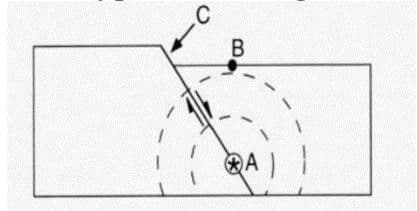
As the waves travel deeper into the mantle of the Earth, which likely to happen?
It is an instrument used to measure the amount of energy released by an Earthquake.
A type of fault which shows both dip-slip and strike-slip motion is called _______.
Which of the following statements does NOT explain the difference of earthquake’s magnitude and intensity?
Which of the following is NOT the basis used by Earth scientists in classifying faults?
Epicenter is the point on the earth’s surface that is vertically above the focus. At what point is the epicenter of an earthquake located?

Which of the following does NOT describe the Rayleigh waves?
Which of the following explains the statements below?
I. Bodywaves are vibrations which may inflict great damage to properties.
II. Body waves are vibrations that travel through the interior of the Earth.
A reverse fault is called a__________ if the dip of the fault plane is small.
What material do Primary waves can pass through?
Which of the following intensity scale is the most widely used?
For questions number 19 refer to the data of tropical cyclone with maximum windspeed in kilometers per hour (kph) below. When can we say that there’s a super typhoon?
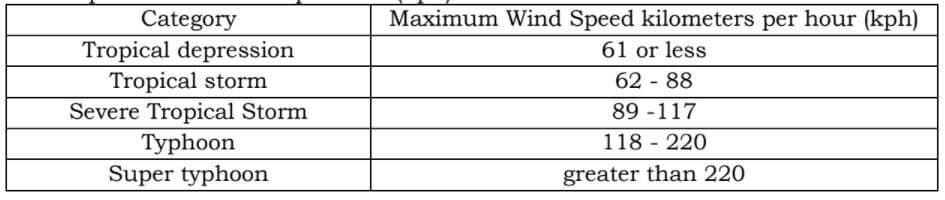
How tropical cyclones do are categorized from the given data?
Which small solar system body originates in the Oort Cloud, or in the Kuiper belt?
Why do tropical cyclones keep on developing near our country?
Which travels fastest, always being the first detected by seismic stations?
What causes seismic waves to travel in curved paths?
The diagram below shows the path of which type of seismic wave through the Earth?

In what condition do typhoons form?
Which best explains the difference between body waves and surface waves?
Why do meteors appear as a streak of light across the night sky?
Based on evidences on seismic waves movement, why is the outer core considered as liquid states of matter?
Which of the following best describes the temperature of the ocean in the vicinity of the Philippines?
For item #31, refer to the image below. Based on the track of typhoon Ompong last September 2018, at what time and date does Ompong enters the Philippine Area of Responsibility?

Which characteristic is common among comets, meteoroids and asteroids?
In what way do landmasses and bodies of water affect typhoon?
Which of the following are used as coordinate system to determine a certain location on the globe?
Which of the following statements best describes Philippine Area of Responsibility?
These are warning signals issued by PAGASA because of an incoming weather disturbance.
Which of the following best describes PAGASA?
Which interplanetary object is found between the planets Mars and Jupiter?
Tropical cyclone in the Philippines is locally known as __________.
The air pressure and wind speed on the eye of the tropical cyclone is lesser. So, in part of the eyewall, it is__________.