Loading...


SCIENCE M3 M4 M5 SUMMATIVE
Quiz by John Doe
Tag the questions with any skills you have. Your dashboard will track each student's mastery of each skill.
1. What happens to an oceanic plate when it moves toward a continental plate?
2. When does subduction occur in a convergent plate boundary movement?
3. What happens to the surface of the ocean when an oceanic plate moves towards another oceanic plate?
4. Which is formed when a continental plate converges with another continental plate?
5. Which is formed when an oceanic plate converges with another oceanic plate?
6. Which is linked to the mid-ocean ridge?
7. Which best describes the rocks in the mid-ocean ridge?
8. What geologic feature is produced by the divergence of the Eurasian plate and North American plate?
9. What body of water is associated with divergent plate boundary movement?
10. Which two plates formed the Mid-Atlantic Ridge?
11. What do you call the crack on tectonic plates that are usually produced by transform boundary?
12. Earthquake is characterized by shaking of the ground. Which boundary can produce earthquakes once they move?
13. Which is true about transform boundary movement?
14. Which two plates formed San Andreas Fault?
15. Which BEST explains plate movement?
1. Which does NOT describe Pangaea?
2. Which concepts are mismatched?
3. Which continents will best fit if their edges are attached?
4. How did Alfred Wegener explain the possible movement of the continents?
5. The formation of the new oceanic crust due to seafloor spreading happens in ______.
6. The movement of oceanic crusts at the Atlantic Ocean floor produced the mid-oceanic ridge. In which part of the mid-oceanic ridge would the youngest crust be seen?
7. Which term is the slow movement of oceanic crust under the continental crust of the Earth’s surface?
8. In seafloor spreading, molten material rises from the mantle and erupts _______.
9. The process of ___________ continually adds new crust to the ocean floor along both sides of the mid-ocean ridge.
10. What is the border between two tectonic plates called?
11. Which theory describes that the Earth’s lithosphere is divided into plates?
12. Which of the following can you infer from the continuous movement of lithospheric plates over the asthenosphere?
13. What happens to magma in the mantle as it is heated up by the core?
14. The diagram on the right shows the movement of the mantle under the Earth’s crust, which process is represented by the diagram?
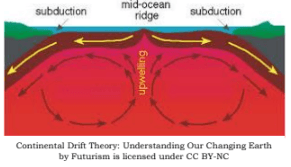
15. Convection currents in the mantle are thought to be the driving force behind the tectonic movement. Which is NOT an effect of convection current in tectonic plates?
1. Which type of evidence was NOT used by Alfred Wegener to support his continental drift theory?
2. The following continents contain glacial deposits which suggest that they were once connected EXCEPT:
3. According to Alfred Wegener, two continents seemed perfectly fit when placed near each other. Which continent fits with South America?
4. Any trace of preserved remains of an organism is called a ______________
5. How does fossil evidence support Wegener's hypothesis of continental drift?
6. All the statements support Wegener’s theory of continental drift EXCEPT
7. An evidence that supports Wegener’s theory of continental drift is that ____
8. It is an event in which the Earth’s magnetic field changes direction
9. Which is TRUE about the polarity of rocks that solidified from mid-ocean ridges?
10.How magnetic stripping on the seafloor does provide evidence of seafloorspreading?