Loading...

Sec 4 Express Science Chem TYS MCQ 2014 Set B
Quiz by HAO YI
Tag the questions with any skills you have. Your dashboard will track each student's mastery of each skill.
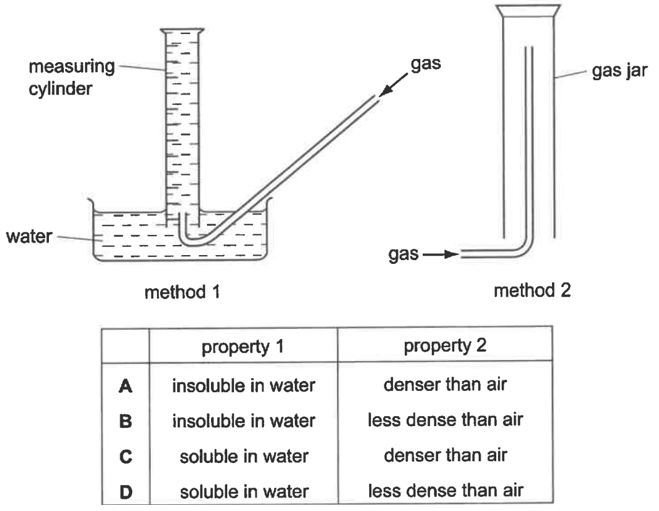
The diagram shows two methods of collecting gases.
Which row gives the properties of a gas which can be collected by both methods?
A
B
C
D
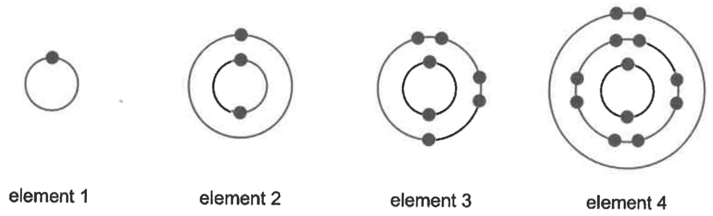
The diagrams show the electronic structures of four elements.
Which elements are metals?
1 and 3
1 and 2
3 and 4
2 and 4
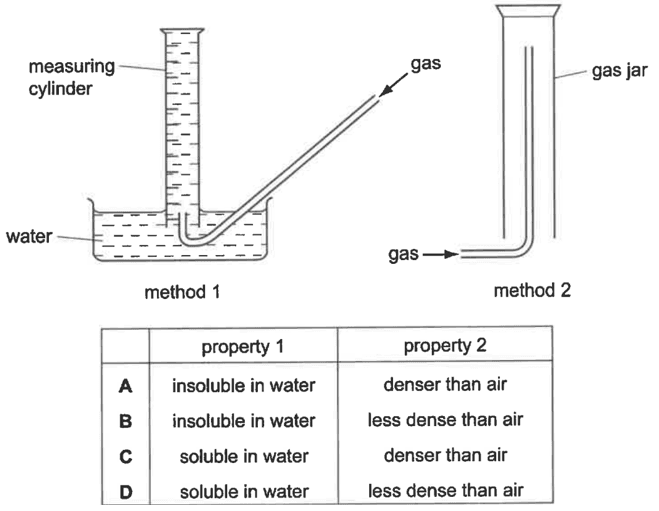
The diagram shows two methods of collecting gases.
Which row gives the properties of a gas which can be collected by both methods?
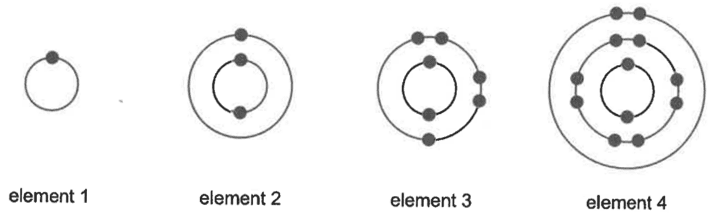
The diagrams show the electronic structures of four elements.
Which elements are metals?
The particles in substance Z are widely spaced and able to move freely.
Z changes to a state in which the particles are in contact but still able to move freely.
What is this change called?
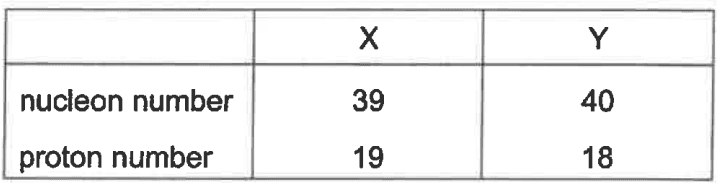
The nucleon number and proton number of an atom of X and an atom of Y are shown.
Which statement about X and Y is correct?
The electronic structures of two atoms X and Y are shown.
X and Y combine together to form a compound.
Which row describes the type of bonding and the formula of the compound?

Ethane, C2H6, and ammonia, NH3, are covalent compounds.
The dot and cross diagrams of these compounds are shown.
Which statement is correct?
1 A molecule of ethane contains twice as many hydrogen atoms as a molecule of ammonia.
2 An uncombined nitrogen atom has five outer electrons.
3 In a molecule of ethane, the bond between the carbon atoms is formed by sharing two electrons, one from each carbon atom.

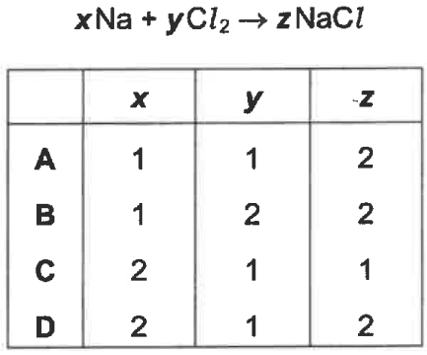
An equation is shown.
Which numbers will correctly balance this equation?
20 cm3 of ethene are reacted with 70 cm3 of oxygen.
The equation for the reaction is shown.
What is the total volume of gas remaining at the end of the reaction? (all volumes are measured at r.t.p.)

Aqueous sodium hydroxide and dilute hydrochloric acid are reacted together.
The reaction is exothermic.
Both the sodium hydroxide and the hydrochloric acid are initially at room temperature.
Which graph shows how the temperature changes when aqueous sodium hydroxide is added to the hydrochloric acid until the alkali is present in excess?
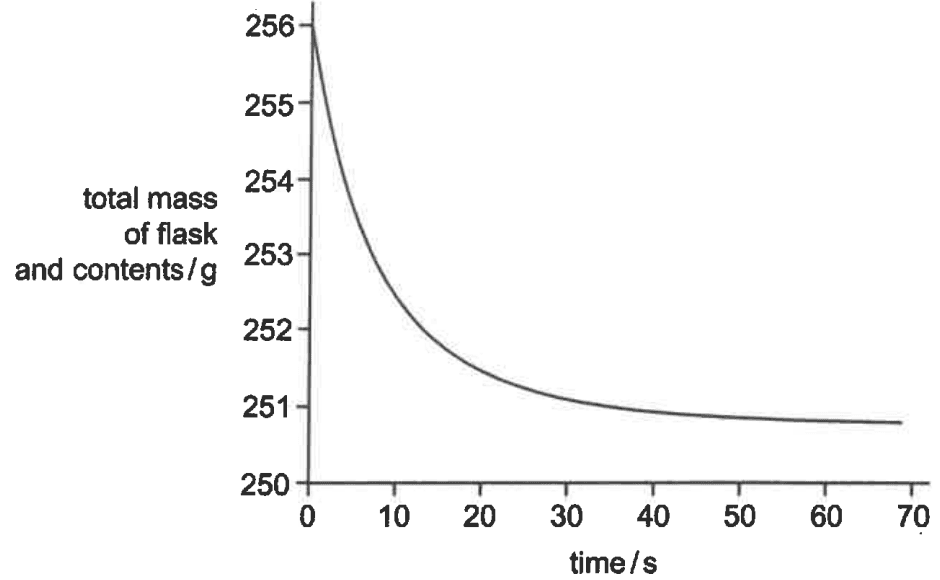
Calcium carbonate is placed in a flask on a top-pan balance and dilute hydrochloric acid is added. The total mass of the flask and its contents is recorded every ten seconds.
At which of the following times is the reaction fastest?
In which reaction is the underlined substance reduced?
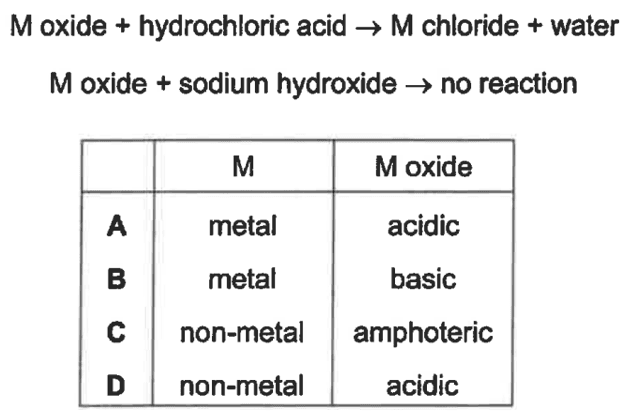
The oxide of an element M was added separately to hydrochloric acid and aqueous sodium hydroxide.
The word equations for the reactions are shown.
Which row describes M and its oxide?
What does not increase across a period of the Periodic Table?
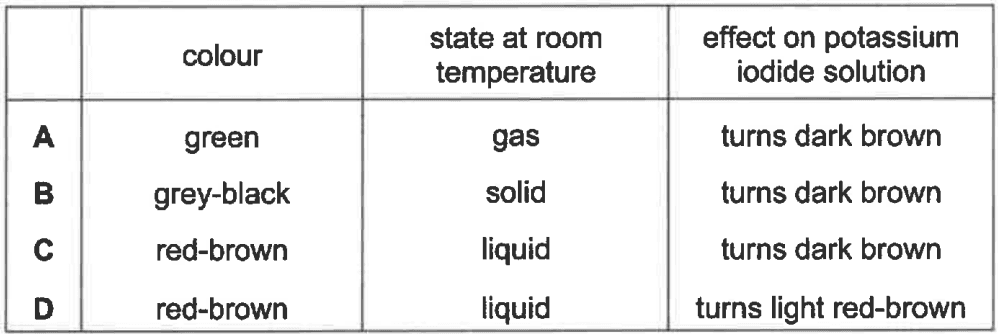
Which row shows the properties of the element bromine?
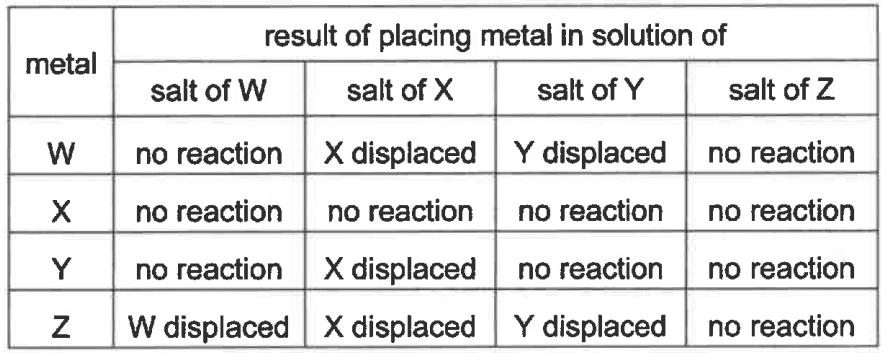
Metals W, X, Y and Z are placed in salt solutions as shown in the table.
What is the order of reactivity of the metals from most reactive to least reactive?
Which oxide is reduced to its metal by heating it in a stream of hydrogen gas?
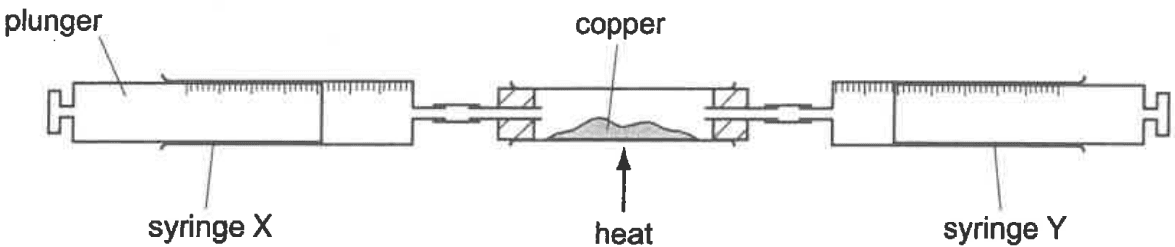
Heated copper reacts with oxygen to produce copper(II) oxide.
The percentage of oxygen in air can be found by passing air over heated copper.
In the apparatus shown, the plungers are alternately pushed so that air passes over the hot copper.
The original volume of air was 50 cm3.
Which graph shows how the volume of air changes during the experiment?
Petroleum is fractionally distilled to produce useful fractions.
Which row matches the fraction to its use?

Two gases, X and Y, have the following properties.
X dissolves in aqueous sodium hydroxide but Y is insoluble.
Y burns in excess oxygen to give X and water only.
Y does not decolourise aqueous bromine.
What are X and Y?

Which compound forms ethanoic acid when it is oxidised?
