Loading...

Sec 4 Normal Science Chem TYS MCQ 2014 Set B
Quiz by HAO YI
Tag the questions with any skills you have. Your dashboard will track each student's mastery of each skill.
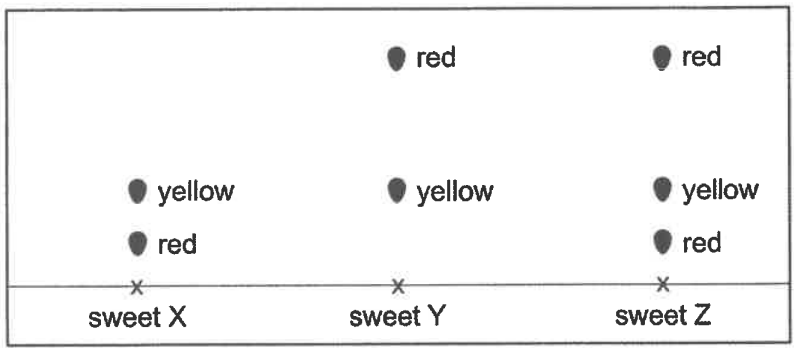
The diagram shows a chromatogram obtained from the colouring of three different sweets, X, Y and Z.
How many different red dyes are present in the sweets?
4
2
1
3
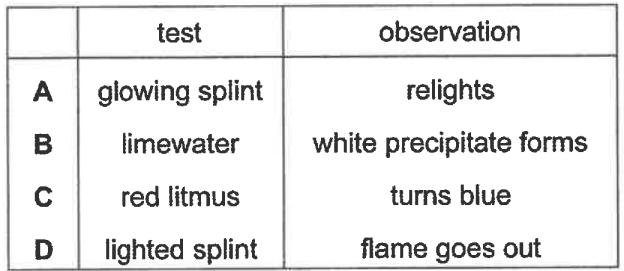
Which row describes the test for oxygen?
A
B
C
D
The diagram shows a chromatogram obtained from the colouring of three different sweets, X, Y and Z.
How many different red dyes are present in the sweets?

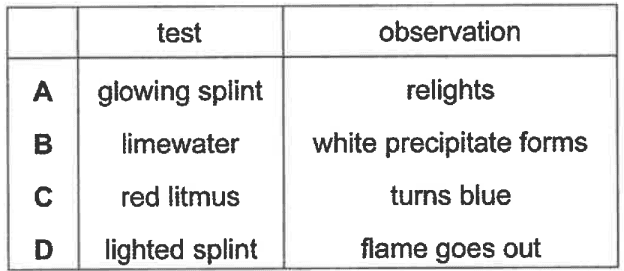
Which row describes the test for oxygen?
Which diagram represents a mixture of two elements?
The 'dot and cross' diagram shows a molecule of hydrogen chloride.
In the molecule of hydrogen chloride,

Which compound contains three different non-metallic elements?
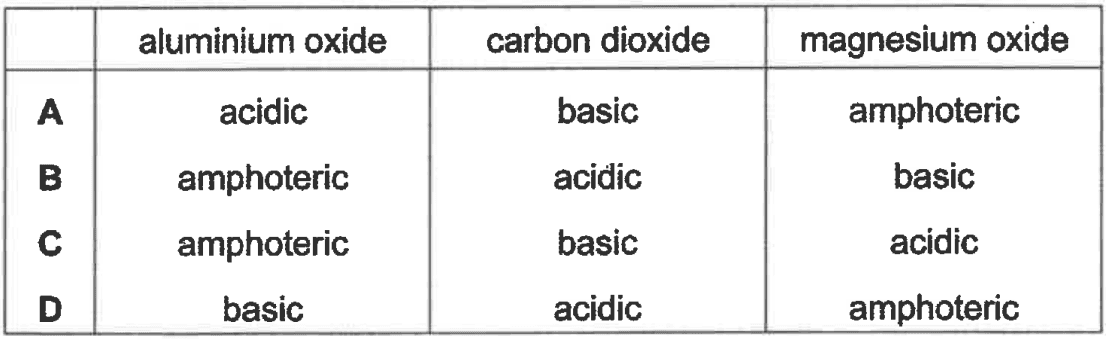
When aluminium, carbon and magnesium burn in oxygen, oxides are formed.
Which row identifies the type of oxide that is formed by each one of them?
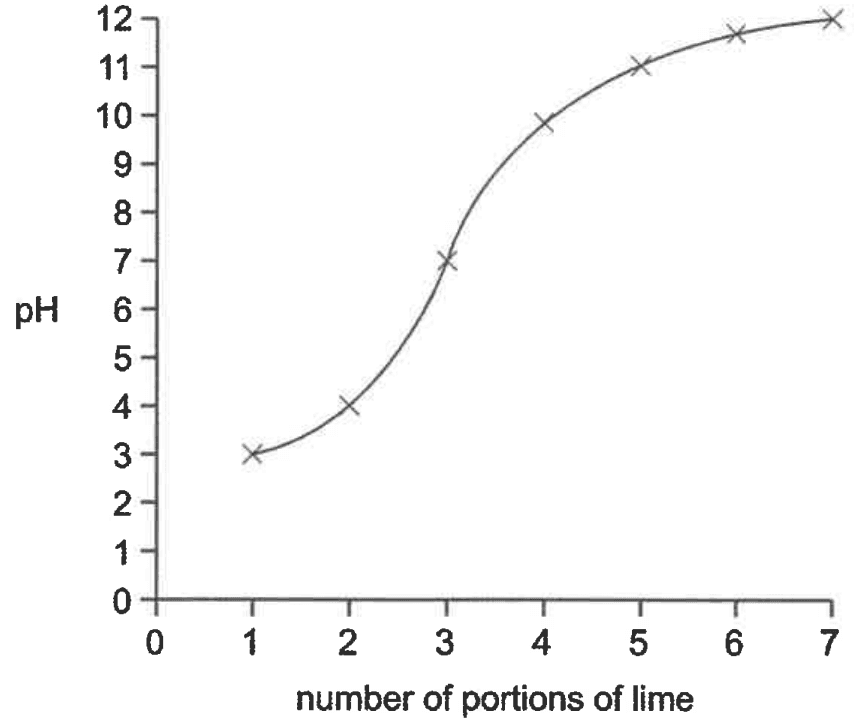
In an experiment, equal portions of lime are added to 20 cm3 of vinegar.
The graph shows the pH of the vinegar after each portion is added.
How many portions of lime are required to neutralize 40 cm3 of vinegar?
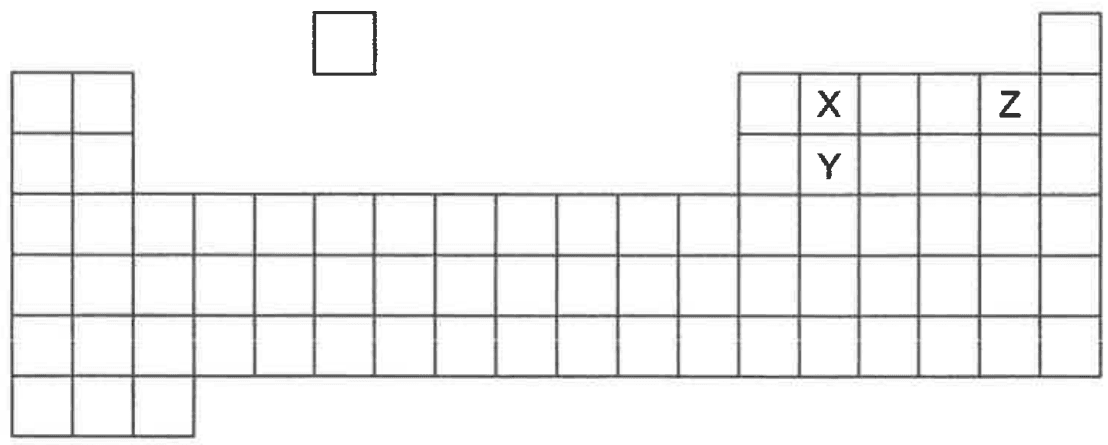
The diagram shows part of the Periodic Table of the Elements.
Which statement about the proton(atomic) number of X is correct?
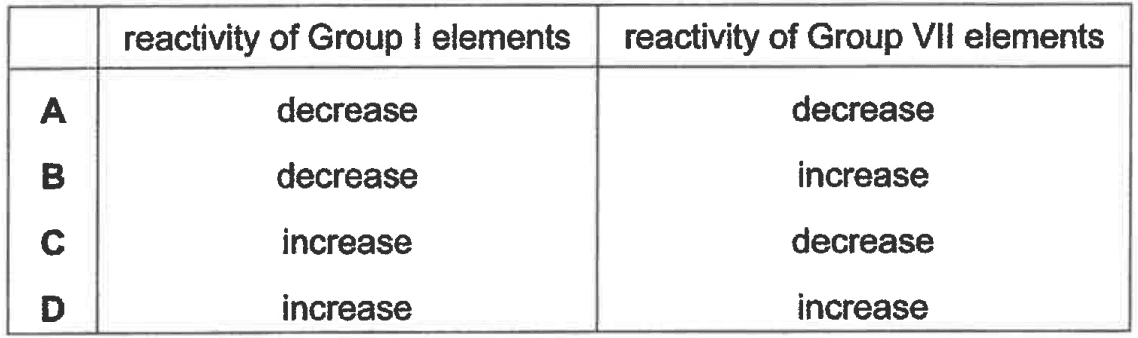
Which trend in reactivity occur when moving down Group 1 and Group 17 of the Periodic Table?
The properties of four elements are shown.
Suggest which element is used to make aircraft bodies?

Iron filings are placed in a damp test-tube containing air.
The test-tube is placed in water and left for a week.
The water rises up the test tube because the iron reacts with

Which substance has the properties of a metallic element?
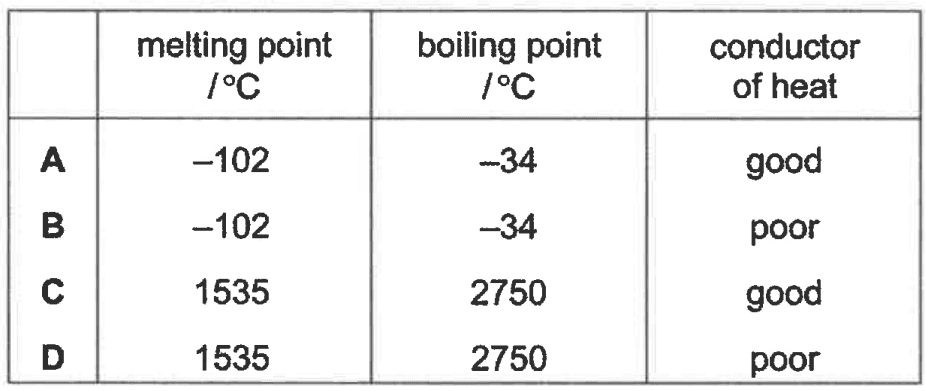
Which atmospheric pollutant is not produced in the combustion of fossil fuels?
What is the approximate volume of nitrogen in 200 cm3 of air?
A student makes three statements about molecules in food.
1 The molecules in food contain only carbon atoms.
2 The molecules in food are hydrocarbons.
3 The molecules in food contain carbon to carbon double bonds.
Which of these statements describe a polyunsaturated food?
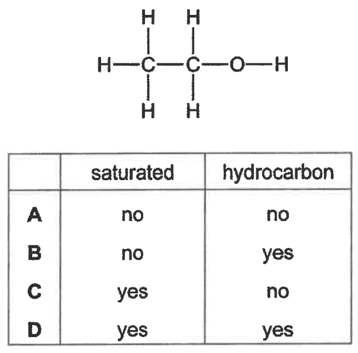
The structure of compound X is shown.
Which row describes X?
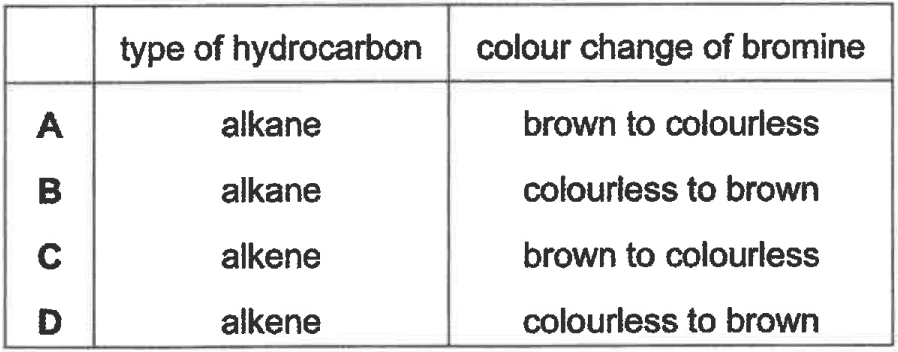
Which type of hydrocarbon reacts rapidly with bromine and what is the colour change of the bromine?