Shroder Biology High School Assessment #3 (Edulastic Practice #5)
Quiz by Tuere Wilder
High School - Biology
Science (2010) (Archived)
Texas Essential Knowledge and Skills (TEKS)
Feel free to use or edit a copy
includes Teacher and Student dashboards
Measures 17 skills from
Measures 17 skills from
Track each student's skills and progress in your Mastery dashboards
With a free account, teachers can
- edit the questions
- save a copy for later
- start a class game
- automatically assign follow-up activities based on students’ scores
- assign as homework
- share a link with colleagues
- print as a bubble sheet
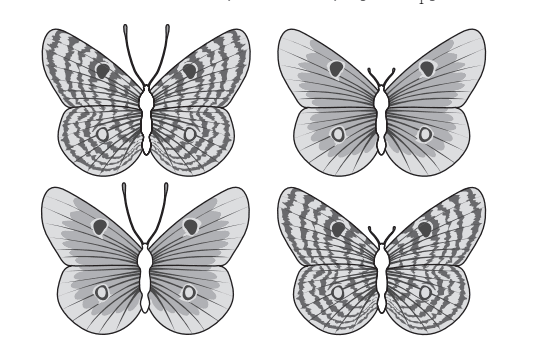
- Q 1/23Score 0The four butterflies in the illustrations represent the offspring in the F1 generation. Which statement is best supported by the phenotypes of these offspring?29The F1 generation is composed only of malesTwo of the offspring in the F1 generation will experience a spontaneous mutationThe F1 generation is the result of a dihybrid crossTwo of the offspring in the F1 generation will not be able to reproduce


23 questions
Show answers
- Q1The four butterflies in the illustrations represent the offspring in the F1 generation. Which statement is best supported by the phenotypes of these offspring?The F1 generation is composed only of malesTwo of the offspring in the F1 generation will experience a spontaneous mutationThe F1 generation is the result of a dihybrid crossTwo of the offspring in the F1 generation will not be able to reproduce120sB.6.F: Genetic Combinations
- Q2The 1918 influenza epidemic killed between 50 million and 100 million people worldwide. This epidemic happened near the end of World War I. More people died from the influenza epidemic than were killed in the war. Which of the following explains why this virus was so deadly worldwide?Infected soldiers returning from the war spread the virus when they coughedMedical personnel often became ill as a result of exposure to airborne virus particlesAll of the aboveFood was scarce because of the war, so people were undernourished, and their immune systems were weakened120sB.4.C: Viruses
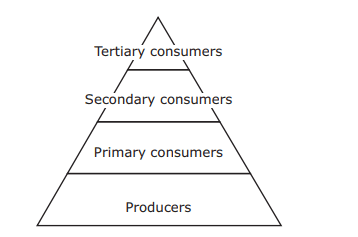
- Q3The amount of energy the producers in this energy pyramid provide the primary consumers is 54,000 joules. From this amount, 540 joules are provided to the tertiary consumers. Based on this model, how much of the energy was provided to secondary consumers?54 J540 J53,460 J5,400 J120sB.12.C: Flow Of Matter & Energy
- Q4The survival of a species depends on its ability to adapt to changes in the environment. A species must be capable of surviving and reproducing despite changes to food sources, climate, or threats from predators. Which statement correctly describes a way that mutations increase the likelihood that a species will survive in a changing environment?Mutations are the cause of disease in the speciesMutations are a source of variation in the speciesMutations are not harmful when they occur in somatic cells of the speciesMutations are always passed on to subsequent generations of the species120sB.6.E: Changes In DNA
- Q5Four different nucleotides are used as building blocks of DNA. Which of the following can be used to distinguish one nucleotide from another?The shape of the deoxyribose sugarThe length of the phosphate groupThe nitrogenous baseThe type of fatty acid120sB.9.A: Biomolecules
- Q6The green frog (Lithobates clamitans clamitans) is found in many parts of the United States. The table contains some information about this frog. Why does the ability to lay 1,000 to 5,000 eggs increase the fitness of the species L. clamitans clamitans?It increases the chance of the recombination of alleles, leading to genetic drift in the populationIt increases the probability that moving water will promote gene flow from one population to anotherIt increases the probability that some offspring will survive long enough to reproduceIt increases opportunities for offspring to compete for limited resources120sB.7.D: Differential Reproductive Success
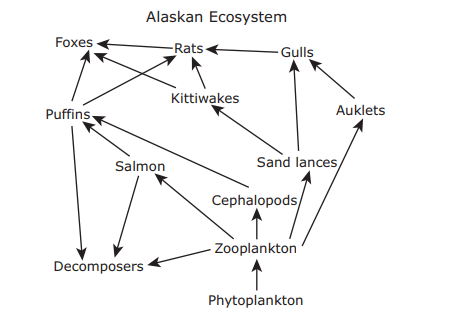
- Q7Food webs such as the one shown were first used in 1927 by the animal ecologist Charles Elton. The food web below represents the feeding relationships among organisms in an Alaskan ecosystem. An environmental change that removed which of these organisms from the ecosystem would cause the most instability in the ecosystem?AukletsFoxesZooplanktonSalmon120sB.12.F: Environmental Change
- Q8The photograph shows monarch butterflies landing on plants where there are thousands of other monarch butterflies. These butterflies feed on milkweed plants as they travel south for the winter, covering distances of 5,000 km or more each year. However, the population of these butterflies has been steadily declining over the last 20 years. What is the most likely reason the population of these butterflies has been declining?The butterflies are evolving to tolerate cold weather in the northern United States and southern CanadaThe number of milkweed plants along the butterflies’ migratory route has decreasedThe number of bird species evolving to prey on butterflies has increasedThe increase in yearly temperatures has warmed the northern habitats120sB.12.D: Long-Term Survival
- Q9Bactrian camels, dromedaries, llamas, and alpacas are all members of the same taxonomic family, Camelidae. Members of this family all have two toes, no hooves, true canine teeth, and a split upper lip. The family Camelidae originated in North America. The physical features of animals in this family and the family’s geographical origin provide evidence that all these animals —live in the same type of ecosystemhave a common ancestorexchanged DNA at some point in the pasthave slowly evolved to become herbivores120sB.7.A: Common Ancestry
- Q10Some relationships between different organisms are shown in the table. Which table correctly identifies each type of interaction described?120sB.12.A: Biological Relationships
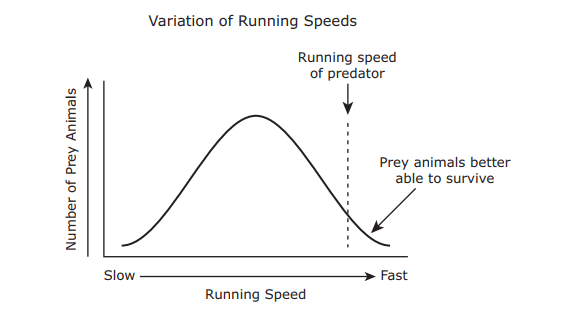
- Q11A prey population consists of individuals with a variety of running speeds. The adaptation that allows some of these animals to run fast would be an example of natural selection if it helps them —survive and undergo mutations in their DNAproduce offspring that run at average speedslower the mortality rates of the populationreproduce and increase the frequency of their genes in the population120sB.7.E: Adaptation & Diversity
- Q12The quiver tree grows in desert areas in southern Africa. In recent decades average temperatures have been rising in southern Africa. Scientists predict that this warming trend will continue. Quiver trees in the hottest parts of their range near the equator are dying, but quiver trees at high elevations or in parts of the range that are farther from the equator are growing and reproducing. Which of these best explains what is happening to the quiver tree population in southern Africa?Individual quiver trees can quickly adapt to rising temperatures. Individual trees will change their method of seed dispersal in cooler parts of the rangeThe quiver tree species is unable to survive rising temperatures throughout its range. The species is likely to undergo rapid extinctionIndividual quiver trees can quickly adapt to rising temperatures. Individual trees will change their method of seed dispersal in cooler parts of the rangeIndividual quiver trees are unable to adjust to the rising temperatures, and only those in cooler parts of the range will survive120sB.7.C: Natural Selection
- Q13Nitrogenous bases are located on both strands of the DNA double helix. What is the significance of the nitrogenous bases?The type of hydrogen bonding between the nitrogenous bases determines which amino acid will be added to the peptide chainThe number of adenines and cytosines determines the type of RNA that will be producedThe order of nitrogenous bases determines the order of amino acids in the proteins synthesizedThe amount of thymine and guanine in the DNA molecules determines the length of the genes120sB.6.A: DNA Components
- Q14In the early 1980s scientists were able to produce two biomolecules by splicing a human gene into the bacterium E. coli to make recombinant human insulin and growth hormone. Which statement best explains why this experiment was successful?Human cells are eukaryotic, and E. coli cells are prokaryoticThe genes for all organisms are composed of the same building blocksThe human body contains many types of bacteria, including E. coliAll living organisms share the same genome120sB.6.B: Genetic Code
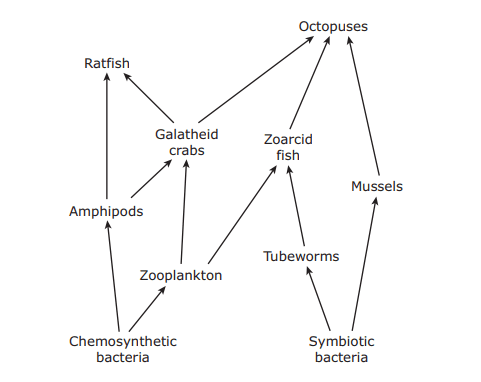
- Q15Part of a hydrothermal vent food web is represented in the diagram. Which organisms are both secondary and tertiary consumers in this food web?Chemosynthetic bacteria and amphipodsZooplankton and musselsRatfish and octopusesGalatheid crabs and zoarcid fish120sB.12.C: Flow Of Matter & Energy