Loading...

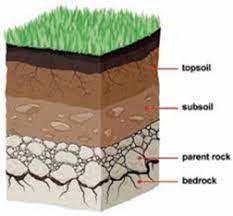
Soil Study Quiz
Quiz by Haley Ferreira
Customize this quiz to suit your class
Instantly translate to 100+ languages
Tag the questions with any skills you have. Your dashboard will track each student's mastery of each skill.
Give this quiz to my class
Do you need to use colored water to test how much water soil retains?
Yes, because you have to use colored water to see it.
No, because it doesn't matter if the water is colored.
When testing the retention of water in soil, the amount of water you put in each sample does NOT matter.
False, because each sample needs the same amount of water.
True, because you can use however much water you want for each one.
Do you need to use colored water to test how much water soil retains?
When testing the retention of water in soil, the amount of water you put in each sample does NOT matter.
If you are testing soil to see how much water it retains, do you need a filter or can you just put in a cup?
How do you determine the texture of soil?
How can a student tell if a soil sample is mostly sand?
Jason wants to find the best soil for planting pumpkin seeds. He has a choice of three different types of soil. He knows that the pumpkin seeds need water, but too much or too little water will not be best for the seeds. Using the chart, which soil type should he choose?
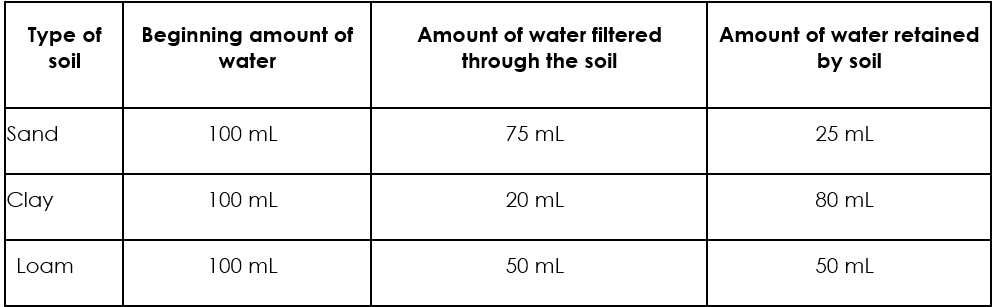
A student wants to grow sunflowers, but isn't sure which type of soil to use. Which investigation should she do to determine the best soil for the sunflower seeds to grow?
Which soil type has the largest particles?
Which type of soil has the smallest particles?
Which of these is the best way to determine what a soil is?
What does the word erosion mean?
What could be the cause of a mountain range having being round and short as opposed to tall and jagged?
How was the Grand Canyon formed?
 Create a quiz with the following questions and answersConvection is… The rising motion of warm air A large volume of air A boundary between two different air masses The weight of the Earth’s atmosphere over an area What are isobars? Storms with strong winds, heavy rains, lightning, and thunder Lines on a map to show high and low pressure The study of elevation This front is associated with thunderstorms, heavy rain, snow, and cooler temperatures. Warm front Stationary front Cold front Occluded front What is a barometer? A tool used to measure temperature An instrument used to measure wind speed An instrument used to measure humidity An instrument used to measure air pressure What is a tornado? Storms with strong winds, heavy rains, lightning, and thunder Large, rotating tropical weather systems A rapidly spinning column of air that has touched the ground What is topography? The study of elevation Lines on a map to show high and low pressure The condition of the atmosphere at a given place and time What are air masses? Large, rotating tropical weather systems The study of elevation A large volume of air with the same temperature What is transpiration? The process of a liquid’s surface changing into a gas The process of a gas changing into a liquid The movement of water through the soil The process of water vapor being released by plants. What is nitrification? The process bacteria use to convert nitrogen gas into ammonium ions The process of turning ammonium ions into nitrites and nitrates. The uptake of nitrates in the soil by the roots of plants. The process of turning nitrates into nitrogen gas Fun Fact: Carbon makes up ___ of your mass. 30% 18% 50% 6% What are the reactants of photosynthesis? Carbon dioxide and water Glucose and oxygen What are the reactants of cellular respiration? Carbon dioxide and water Glucose and oxygen What is a storm surge? Flooding caused by hurricanes Region of air where the air pressure is low Any product of the condensation of water vapor High pressure is… A region of air where the air pressure is greater than that of the surrounding area A region of air where the air pressure is lower than that of the surrounding area. Low pressure is… A region of air where the air pressure is greater than that of the surrounding area A region of air where the air pressure is lower than that of the surrounding area. What causes global winds? Photosynthesis The process carbon goes through Uneven heating of the Earth What can humans do to reduce carbon emissions? We can use renewable energy (ex. solar power) We can use non-renewable energy (ex. fossil fuels) Carbon can form stable bonds with many elements and and makes up the backbone of major macromolecules: carbohydrates, proteins, lipids, and ___ Nucliec acids Glucose Oxygen Nitrogen What weather is associated with low-pressure systems? Bad weather (ex. Cloudy weather) Good weather (ex. Sunny weather) What is fossilization? The burning of fossil fuels The process where fungi and bacteria decompose dead organisms Dead organisms form fossil fuels over thousands and millions of years What is the first step in the formation of tornadoes? Rising air from the ground pushes up on the swirling air and tips it over A large thunderstorm occurs in a cumulonimbus cloud The funnel grows longer and stretches towards the ground The funnel of swirling air begins to suck up more warm air from the ground What is the difference between thunderstorms and regular storms? Thunderstorms have thunder while regular storms don’t Regular storms have thunder while thunderstorms don’t There is no difference What are hurricanes? Rapidly spinning columns of air touch the ground Large, rotating tropical weather systems Storms with strong winds, heavy rains, lightning, and thunderstorms What is not a hurricane fact? They are the most powerful storms on earth They have an average wind speed of 120-180 km/h They lose their power when they travel over cooler waters or land Storm surges cause the most damages What is the difference between weather and climate? Weather is long-term while climate is short-term Climate is long-term while weather is short-term There is no difference Soil Study GuideSoil & The Rock Cycle Unit Test Study GuideUnderstanding the differences between bacteria and viruses is important because they affect our health differently. In this study guide, we'll explore the key distinctions between these two microorganisms. Section 1: Bacteria What are Bacteria? Bacteria are tiny, single-celled living organisms. They are found everywhere, including in soil, water, and inside our bodies. Shape and Structure: Bacteria have different shapes like rods, spheres, and spirals. They have a cell wall that surrounds their cell membrane. Reproduction: Bacteria reproduce by dividing in half, a process called binary fission. This allows them to multiply quickly. Living or Nonliving: Bacteria are considered living because they can grow, reproduce, and respond to their environment. Section 2: Viruses What are Viruses? Viruses are smaller than bacteria and are not considered living organisms. They are made up of genetic material (either DNA or RNA) surrounded by a protein coat. Shape and Structure: Viruses come in various shapes but are much simpler than bacteria. They lack the cell structures found in bacteria. Reproduction: Viruses cannot reproduce on their own. They need a host cell (like a human cell) to replicate and make more viruses. Living or Nonliving: Viruses are considered nonliving because they cannot perform life processes without a host cell. Section 3: Differences Now, let's compare bacteria and viruses: Size: Bacteria are larger than viruses. Living or Nonliving: Bacteria are living organisms. Viruses are non-living entities. Reproduction: Bacteria reproduce on their own through binary fission. Viruses need a host cell to replicate. Structure: Bacteria have complex structures with cell walls. Viruses are simpler, consisting of genetic material and a protein coat. Treatment: Bacterial infections are treated with antibiotics. Viral infections are typically managed with antiviral medications (if available) or through the body's immune response. Section 4: Examples Examples of bacteria-related and virus-related illnesses: Bacterial Infections: Strep throat, Urinary tract infections (UTIs), Tuberculosis Viral Infections: Influenza (Flu), Common cold, HIV/AIDS Conclusion: Understanding the differences between bacteria and viruses can help us stay healthy and make informed decisions about treatment. Remember that while bacteria can be both helpful and harmful, viruses rely on our cells to replicate and cause infections.Create a multiple choice test (10 questions with answers) from the following text: The Environment The environment is the combination of forces and conditions that surround and influence living and non-living things. Human beings’ environment includes such factors as temperature, food supply and other people that surround them. A plant’s environment may be made up of soil, sunlight, and animals that will eat the plant. A rock’s environment may be made up of seaweed, water and fish. Non-living environmental factors, such as temperature and sunlight, make up the abiotic (non-living) environment. Living organisms such as seaweed and food, make up the biotic environment. Both the abiotic and biotic environments interact to make up the total environment of living and non-living things. Ecology Ecology studies the relationships between living things and their environment. No living thing, plant or animal, lives alone. Every living thing depends in some way upon certain other living and non-living things to survive. The study of ecology increases our understanding of the world and all its creatures. This is crucial because humanity’s survival and well-being depend on relationships that exist on a world-wide basis: changes in distant parts of the world affect us and our environment. One concern of ecologists is the rate at which we are using up natural resources such as coal, gas, and oil. Along with scientists, they are searching for ways to use sunlight and atomic energy for fuel and power as alternative energy sources. Ecology also studies how many living organisms there are on Earth and how they are distributed. It also considers non-living physical factors of the environment, for example the presence of water, as these can influence where organisms decide to live. It is also important to know which organisms share the same environment, as they may need each other to survive. This kind of information helps ecologists to conserve our natural world, protecting the habitat of animals that are in danger of extinction, or trying to reduce pollution and global warming. Ecosystems Ecosystems are biological communities of all living things like plants, animals and organisms in a specific area that interact with each other and with the non-living forms present in their environment. They are the foundations of the biosphere and determine the health of the entire planet’s system. A biosphere is a global ecosystem, containing many different kinds of ecosystems.THE SOAR SYSTEM A solar system is a group of planets and other celestial bodies that revolve around a star. A solar nebula- a vast cloud of gas and dust, mostly hydrogen and helium. How the Solar System Form • COLLAPSE AND SPINNING DISK FORMATION - Gravity pulls material inward. The cloud flattens into a spinning disk due to conservation of angular momentum. • PROTOSTAR FORMATION- (BIRTH OF THE SUN). Material collects at the center, and begun to heat up. When it reaches to 10 million KELVIN, nuclear fusion begins. thus, SUN is born. • PLANETESIMALS AND PROTOPLANETS. Dust and gas in the disk stick together via static and gravitational forces. These form planetesimals, which grow into protoplanets collision and accretion. • PLANET FORMATION. Inner disk: too hot for gas rocky planets form Mercury, Venus, Earth, Mars. • PLANET FORMATION. Outer disk: gas and ice giants. Jupiter, Saturn, Uranus, Neptune • LEFTOVER DEBRIS. Remaining materials forms moon, asteroids, comets and dwarf planets. DIFFERENT HYPOTHESIS IN THE FORMATION OF SOLAR SYSTEM. 1. NEBULAR HYPOTHESIS- The Solar system formed from a rotating cloud of Gas and Dust (solar nebula). As it rotates conservation of angular momentum caused the cloud to flatten into a disk. the Sun formed at the center (DISK) while planets formed from the surrounding materials through acceleration. thus, it explains the coplanar and nearly circular orbit of the planets all planets orbits around the sun on the same flat, disk shaped plane. Proposed by Immanuel Kant in 1755 and Modified by Pierre Simon Laplace in 1756. PROTOPLANET HYPOTHESIS. The Solar system formed from a rotating cloud of Gas and Dust (solar nebula). As it rotates conservation of angular momentum caused the cloud to flatten into a disk. 2. Protoplanet hypothesis. Builds on the nebular model but focuses more on the role of planetesimals which then form into full planets. PROCESS: - Small solid particles stick together through collisions. As collisions takes place, it grows into kilometer-sized planetesimals. Gravitational interactions lead to the formation of planets. Lead to formation of steroids belts and varying planet sizes 3. Encounter hypothesis. States that the sun encountered a rogue star. The encounter led to the removal of hot gas from both stars due to their gravitational interaction. The hot gas then accumulated and formed the planets. The materials from the less dense rogue star formed the other planets, while that from the sun formed the inner planets. 4. TIDAL HYPOTHESIS. (also called the Tidal Theory) is an early scientific idea about how the solar system might have formed. Proposed by James Jeans and Harold Jeffreys. A massive star passed very close to the early Sun. The hot gas then accumulated and formed the planets. The materials from the less dense rogue star formed the other planets, while that from the sun formed the inner planets. Streams of hot gas were drawn out from the Sun in elongated shape. These streams eventually condensed and cooled, forming planets, moons, and other bodies in the solar system. 5. Not accepted theory. Later studies showed the streams of hot gas would disperse too quickly into space instead of condensing into planets. The theory also couldn’t explain the specific orbital patterns and compositions we see today. Modern science favors the Nebular Hypothesis, which explains solar system formation through the collapse of a rotating gas cloud. Earth as the only habitable planet 1. Right Distance from the Sun (The Goldilocks Zone). Not too hot, not too cold — just right for liquid water to exist. 2. Atmosphere with Oxygen. Earth has a mix of gases, especially oxygen, which most living things need to survive. 3. Liquid Water. Earth has oceans, rivers, and rain — water is essential for all life. 4. Magnetic Field. Earth’s magnetic field protects us from harmful solar radiation. 5. Stable Climate. The atmosphere and natural cycles keep temperatures and weather mostly stable over time. 6. Rich Resources. Earth has soil for growing food, minerals, and energy sources that support life and technology. Solar explorations 1. AUGUST 6, 2014. First space craft to orbit a comet (ROSETTA PROBE). Captures the comet photograph. -Comets have coma and tail as it approaches to the sun. 2. JULY 14, 2015. NASA’s New Horizons spacecraft made history by becoming the first spacecraft to fly by Pluto, giving us our first close-up look at the dwarf planet. First time visiting Pluto. Before this, Pluto was just a blurry dot in telescope images. Revealed a surprising world New Horizons showed mountains of ice, smooth plains, and a heart-shaped region called Tombaugh Regio. Changed what we knew. Scientists thought Pluto would be dull and frozen — instead, it turned out to be geologically active and incredibly complex. 3. SEPTEMBER 8, 2016. NASA launched OSIRIS-REx, the first U.S. mission to collect a sample from an asteroid and return it to Earth. Changed what we knew. Scientists thought Pluto would be dull and frozen — instead, it turned out to be geologically active and incredibly complex. OSIRIS-REx stands for: Origins, Spectral Interpretation, Resource Identification, Security–Regolith Explorer It was sent to study the asteroid Bennu, a near-Earth asteroid about 500 meters wide. Mission Goals: Collect a sample of surface material from Bennu Study the asteroid’s omposition, structure, and history. Mission Goals: Help scientists understand the origins of the solar system. Learn more about asteroids that could impact Earth. 4. August 12, 2018: Launch of NASA’s Parker Solar Probe, the first spacecraft to "touch" the Sun by flying through its outer atmosphere, called the corona. Mission Goal: To study the Sun up close and help scientists understand: How the solar wind (a stream of charged particles) is formed. Why the Sun’s corona is hotter than its surface. What causes solar storms that can affect Earth’s satellites and power grids. 5. November 26, 2018: NASA’s Insight Lander Touches Down on Mars. Its mission was focused on studying the interior of the Red Planet (crust, mantle, and core of the planet). Why the Sun’s corona is hotter than its surface. What causes solar storms that can affect Earth’s satellites and power grids 6. November 26, 2018: NASA’s Insight Lander Touches Down on Mars. Its mission was focused on studying the interior of the Red Planet (crust, mantle, and core of the planet) 7. JULY 30, 2020 PERSEVERANCE PROBE. Perseverance rover as part of the Mars 2020 mission aboard an Atlas V-541 rocket This marked a major step in Mars exploration. 8. DECEMBER 25, 2021-JAMES WEBB SPACE TELESCOPE. Investigate exoplanets’ atmospheres for signs of habitability. Observe the first galaxies formed after the Big Bang. Study the formation of stars and planetary systems. Look deeper into the infrared universe than ever before. RESULTS OF EXPLORATION • Evidence of Ancient Life-friendly Environment. • Sedimentary rocks formed in water-rich environments. • Signs of clay and carbonate minerals, which can preserve biosignatures (traces of past life). • Evidence of Ancient Life-friendly Environment. • Sedimentary rocks formed in water-rich environments. • Signs of clay and carbonate minerals, which can preserve biosignatures (traces of past life). • Evidence of Ancient Life-friendly Environment. • Sedimentary rocks formed in water-rich environments. • Signs of clay and carbonate minerals, which can preserve biosignatures (traces of past life).SOIL110.31.b.17.C