Loading...

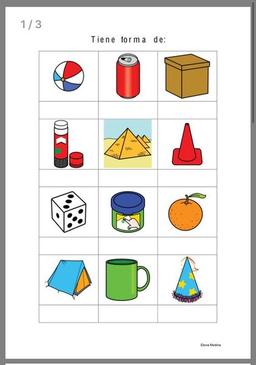
SOLID SHAPES and PLANE FIGURES
Quiz by Dolly Arora
Customize this quiz to suit your class
Instantly translate to 100+ languages
Tag the questions with any skills you have. Your dashboard will track each student's mastery of each skill.
Give this quiz to my class
 SPANISH STUDENTS 10/22/25 In the sentence 'The author chose to juxtapose the wealthy neighborhood with the impoverished area to highlight social inequality,' what does 'juxtapose' most likely mean based on context clues? * 1 point to separate completely to describe in detail to criticize harshly to place side by side for comparison When reading 'This paradox confused everyone: the more he tried to save time, the less time he seemed to have,' what can you infer about a paradox? * 1 point a mathematical equation a simple solution a type of poem a contradictory statement that reveals truth The passage states: 'The author's use of symbolism was evident when the broken mirror represented the character's shattered dreams.' Based on this context, symbolism involves: * 1 point using objects to represent deeper meanings creating rhyming patterns writing in chronological order using literal descriptions only In the text 'Please elaborate on your answer by providing specific examples and detailed explanations,' the word 'elaborate' suggests the need to: * 1 point use simpler words change the topic add more detail make it shorter The critic wrote: 'The actor's performance captured every nuance of emotion, from subtle sadness to barely contained rage.' What does 'nuance' refer to in this context? * 1 point subtle variations in meaning simple emotions loud expressions obvious differences When the text says 'The implication of her silence was clear to everyone in the room, though she never spoke a word,' what does 'implication' mean? * 1 point a command given a direct statement a question asked a conclusion drawn indirectly The scientist stated: 'Based on our limited observations, our hypothesis suggests that plants grow faster with classical music.' What is a hypothesis? * 1 point a type of experiment a proven fact a final conclusion a possible explanation needing more evidence In 'Three witnesses were able to corroborate the defendant's alibi, strengthening his case significantly,' the word 'corroborate' most likely means: * 1 point to question or doubt to confirm or support to change the story to ignore completely The passage reads: 'The student needed to justify her controversial thesis with solid evidence and logical reasoning.' What does 'justify' mean here? * 1 point to make it longer to make excuses for to avoid explaining to prove something is reasonable When the text states 'The researcher was able to synthesize information from five different studies to create a comprehensive theory,' what does 'synthesize' involve? * 1 point copying one source exactly combining multiple sources to create something new rejecting all previous research focusing on only one idea When a reader encounters 'The symbolism in the novel was complex, with the recurring image of doors representing new opportunities throughout the story,' they should: * 1 point memorize all symbols skip symbolic passages look for deeper representational meanings focus only on the literal meaning If a teacher says 'Your essay needs more elaboration - expand on your main points with examples and analysis,' what critical thinking skill is being requested? * 1 point developing ideas with supporting details summarizing briefly using fewer examples changing the topic entirely In the passage 'The dark clouds gathering on the horizon seemed to foreshadow the troubles that would soon befall the village,' what literary technique is being demonstrated? * 1 point The author is using environmental details to hint at future plot developments The author is focusing on realistic weather descriptions The author is using weather to predict actual meteorological events The author is describing a coincidental weather pattern When analyzing 'Sarah knew the antagonist in her favorite novel wasn't just evil—he represented the fear of change that many people experience,' what deeper understanding about antagonists is revealed? * 1 point Antagonists are always completely evil characters Antagonists can represent abstract concepts or human struggles Antagonists must be human characters Antagonists only exist to create action scenes In the sentence 'The protagonist's journey wasn't just about reaching the destination—it was about discovering who she truly was,' what does this suggest about effective protagonists? * 1 point Protagonists must always succeed in their missions Protagonists should remain unchanged throughout the story Protagonists undergo both external and internal development Protagonists should focus only on external goals When the text states 'The word 'home' carried different connotations for each character—warmth and safety for some, confinement and obligation for others,' what critical reading skill is being highlighted? * 1 point Memorizing dictionary definitions Understanding that words have only one correct meaning Identifying grammatical structures Recognizing that word meanings can vary based on personal experience In 'While the denotation of 'snake' is simply a reptile, the author's use of it to describe the character suggests something far more sinister,' what analytical skill is required? * 1 point Understanding reptile biology Memorizing animal classifications Distinguishing between literal and figurative meanings Identifying sentence structure When examining 'The author's tone shifted from hopeful in the opening chapters to increasingly cynical as the story progressed,' what does this reveal about sophisticated writing? * 1 point Tone is unimportant in storytelling Tone changes reflect the author's developing attitude toward the subject Only the ending tone matters Authors should maintain the same tone throughout In analyzing 'The theme of the novel wasn't stated directly but emerged through the characters' repeated struggles with moral choices,' what does this demonstrate about themes? * 1 point Themes develop through patterns in the narrative Themes are only found in the conclusion Themes should always be explicitly stated Themes must be simple moral lessons When the passage reads 'From the character's nervous glances and hesitant speech, readers can infer that she's hiding something important,' what critical thinking process is being described? * 1 point Following explicit plot statements Memorizing character descriptions Making random guesses about character motivations Using textual evidence to draw logical conclusions In 'The ending was deliberately ambiguous, allowing readers to decide whether the character's actions were heroic or selfish,' what does this suggest about sophisticated literature? * 1 point Good stories always have clear, definitive endings Unclear endings indicate poor writing Ambiguity can enhance reader engagement and interpretation Authors should avoid confusing readers When analyzing 'The controversial decision to ban the book sparked debates about censorship versus protecting young readers,' what critical thinking skill is most important? * 1 point Choosing one side immediately Examining multiple perspectives before forming an opinion Avoiding difficult topics entirely Following popular opinion In 'Each character's perspective on the same event revealed how personal experiences shape our understanding of truth,' what deeper concept is being explored? * 1 point All perspectives are equally valid Perspective is unimportant in understanding events There is only one correct way to view any situation Personal background influences how we interpret events When the text states 'The community proved resilient, rebuilding not just their homes but their hope after the disaster,' what does this reveal about the concept of resilience? * 1 point Resilience encompasses both practical and emotional recovery Resilience is an innate trait that cannot be developed Resilience means avoiding all difficulties Resilience only involves physical recovery In analyzing 'The author's portrayal of the character's empathy—her ability to understand her enemy's pain even while fighting him—added complexity to the conflict,' what does this suggest about empathy? * 1 point Empathy means agreeing with everyone Empathy makes people weak in conflicts Empathy should be avoided in difficult situations Empathy can coexist with opposition and create moral complexity When examining 'The character's integrity was tested when telling the truth would hurt people she loved,' what does this reveal about integrity? * 1 point Integrity means always following rules regardless of consequences Integrity means never causing any harm to others Integrity is only important in public situations Integrity involves making difficult moral choices even when costly In 'The student learned to advocate for her ideas by presenting evidence rather than just stating opinions,' what critical skill is being developed? * 1 point Supporting positions with logical reasoning and evidence Avoiding controversial topics entirely Learning to argue loudly and persistently Always agreeing with authority figures If you rewrote a scene from 'The Birchbark House' from Omakayas's grandmother's first-person perspective instead of Omakayas's, how would this most likely change the reader's understanding? * 1 point Nothing would change since they're both female characters The language would become more formal and difficult The story would become less interesting because adults are boring Readers would gain wisdom from experience but lose the innocence of childhood discovery In a plot diagram, the rising action serves which critical purpose beyond simply building toward the climax? * 1 point To provide background information about the setting To confuse readers so the ending is surprising To develop character relationships and establish stakes that make the climax meaningful To make the story longer and more detailed When analyzing the falling action in 'The Birchbark House,' which element would be most important to consider when writing an alternate version? * 1 point Whether the consequences of the climax align with the new direction you want the story to take Making sure it's shorter than the rising action Including a moral lesson for readers How quickly the conflicts get resolved In the exposition of a story, conflict serves which essential function that many readers don't realize? * 1 point To immediately grab attention with action scenes To provide comic relief before serious events To show off the author's writing skills To establish what the characters characterization/personality, which determines what they' must learn to overcome as they face more problemsCohesion and Adhesion Water molecules stick to each other as a result of hydrogen bond- ing. An attractive force that holds molecules of a single substance together is known as cohesion. Cohesion due to hydrogen bonding between water molecules contributes to the upward movement of water from plant roots to their leaves. Related to cohesion is the surface tension of water. The cohe- sive forces in water resulting from hydrogen bonds cause the mol- ecules at the surface of water to be pulled downward into the liquid. As a result, water acts as if it has a thin “skin” on its sur- face. You can observe water’s surface tension by slightly overfill- ing a drinking glass with water. The water will appear to bulge above the rim of the glass. Surface tension also enables small crea- tures such as spiders and water-striders to run on water without breaking the surface. Adhesion is the attractive force between two particles of differ- ent substances, such as water molecules and glass molecules. A related property is capillarity (KAP-uh-LER-i-tee), which is the attrac- tion between molecules that results in the rise of the surface of a liquid when in contact with a solid. Together, the forces of adhe- sion, cohesion, and capillarity help water rise through narrow tubes against the force of gravity. Figure 2-11 shows cohesion and adhesion in the water-conducting tubes in the stem of a flower. Temperature Moderation Water has a high heat capacity, which means that water can absorb or release relatively large amounts of energy in the form of heat with only a slight change in temperature. This property of water is related to hydrogen bonding. Energy must be absorbed to break hydrogen bonds, and energy is released as heat when hydrogen bonds form. The energy that water initially absorbs breaks hydro- gen bonds between molecules. Only after these hydrogen bonds are broken does the energy begin to increase the motion of the water molecules, which raises the temperature of the water. When the temperature of water drops, hydrogen bonds reform, which releases a large amount of energy in the form of heat. Therefore, during a hot summer day, water can absorb a large quantity of energy from the sun and can cool the air without a large increase in the water’s temperature. At night, the gradually cooling water warms the air. In this way, the Earth’s oceans stabilize global temperatures enough to allow life to exist. Water’s high heat capac- ity also allows organisms to keep cells at an even temperature despite temperature changes in the environment. As a liquid evaporates, the surface of the liquid that remains behind cools down. A relatively large amount of energy is absorbed by water during evaporation, which significantly cools the surface of the remaining liquid. Evaporative cooling prevents organisms that live on land from overheating. For example, the evaporation of sweat from a person’s skin releases body heat and prevents over- heating on a hot day or during strenuous activity. Adhesion Cohesion Hydrogen bonds Cohesion, adhesion, and capillarity contribute to the upward movement of water from the roots of plants. FIGURE 2–11 www.scilinks.org Topic: Hydrogen Bonding Keyword: HM60777 mb06se_cols03.qxd 5/18/07 10:47 AM Page 41 42 CHAPTER 2 Density of Ice Unlike most solids, which are denser than their liquids, solid water is less dense than liquid water. This property is due to the shape of the water molecule and hydrogen bonding. The angle between the hydrogen atoms is quite wide. So, when water forms solid ice, the angles in the molecules cause ice crystals to have large amounts of open space, as shown in Figure 2-12. This open space lattice structure causes ice to have a low density. Because ice floats on water, bodies of water such as ponds and lakes freeze from the top down and not the bottom up. Ice insulates the water below from the cold air, which allows fish and other aquatic crea- tures to survive under the icy surface.THE SOAR SYSTEM A solar system is a group of planets and other celestial bodies that revolve around a star. A solar nebula- a vast cloud of gas and dust, mostly hydrogen and helium. How the Solar System Form • COLLAPSE AND SPINNING DISK FORMATION - Gravity pulls material inward. The cloud flattens into a spinning disk due to conservation of angular momentum. • PROTOSTAR FORMATION- (BIRTH OF THE SUN). Material collects at the center, and begun to heat up. When it reaches to 10 million KELVIN, nuclear fusion begins. thus, SUN is born. • PLANETESIMALS AND PROTOPLANETS. Dust and gas in the disk stick together via static and gravitational forces. These form planetesimals, which grow into protoplanets collision and accretion. • PLANET FORMATION. Inner disk: too hot for gas rocky planets form Mercury, Venus, Earth, Mars. • PLANET FORMATION. Outer disk: gas and ice giants. Jupiter, Saturn, Uranus, Neptune • LEFTOVER DEBRIS. Remaining materials forms moon, asteroids, comets and dwarf planets. DIFFERENT HYPOTHESIS IN THE FORMATION OF SOLAR SYSTEM. 1. NEBULAR HYPOTHESIS- The Solar system formed from a rotating cloud of Gas and Dust (solar nebula). As it rotates conservation of angular momentum caused the cloud to flatten into a disk. the Sun formed at the center (DISK) while planets formed from the surrounding materials through acceleration. thus, it explains the coplanar and nearly circular orbit of the planets all planets orbits around the sun on the same flat, disk shaped plane. Proposed by Immanuel Kant in 1755 and Modified by Pierre Simon Laplace in 1756. PROTOPLANET HYPOTHESIS. The Solar system formed from a rotating cloud of Gas and Dust (solar nebula). As it rotates conservation of angular momentum caused the cloud to flatten into a disk. 2. Protoplanet hypothesis. Builds on the nebular model but focuses more on the role of planetesimals which then form into full planets. PROCESS: - Small solid particles stick together through collisions. As collisions takes place, it grows into kilometer-sized planetesimals. Gravitational interactions lead to the formation of planets. Lead to formation of steroids belts and varying planet sizes 3. Encounter hypothesis. States that the sun encountered a rogue star. The encounter led to the removal of hot gas from both stars due to their gravitational interaction. The hot gas then accumulated and formed the planets. The materials from the less dense rogue star formed the other planets, while that from the sun formed the inner planets. 4. TIDAL HYPOTHESIS. (also called the Tidal Theory) is an early scientific idea about how the solar system might have formed. Proposed by James Jeans and Harold Jeffreys. A massive star passed very close to the early Sun. The hot gas then accumulated and formed the planets. The materials from the less dense rogue star formed the other planets, while that from the sun formed the inner planets. Streams of hot gas were drawn out from the Sun in elongated shape. These streams eventually condensed and cooled, forming planets, moons, and other bodies in the solar system. 5. Not accepted theory. Later studies showed the streams of hot gas would disperse too quickly into space instead of condensing into planets. The theory also couldn’t explain the specific orbital patterns and compositions we see today. Modern science favors the Nebular Hypothesis, which explains solar system formation through the collapse of a rotating gas cloud. Earth as the only habitable planet 1. Right Distance from the Sun (The Goldilocks Zone). Not too hot, not too cold — just right for liquid water to exist. 2. Atmosphere with Oxygen. Earth has a mix of gases, especially oxygen, which most living things need to survive. 3. Liquid Water. Earth has oceans, rivers, and rain — water is essential for all life. 4. Magnetic Field. Earth’s magnetic field protects us from harmful solar radiation. 5. Stable Climate. The atmosphere and natural cycles keep temperatures and weather mostly stable over time. 6. Rich Resources. Earth has soil for growing food, minerals, and energy sources that support life and technology. Solar explorations 1. AUGUST 6, 2014. First space craft to orbit a comet (ROSETTA PROBE). Captures the comet photograph. -Comets have coma and tail as it approaches to the sun. 2. JULY 14, 2015. NASA’s New Horizons spacecraft made history by becoming the first spacecraft to fly by Pluto, giving us our first close-up look at the dwarf planet. First time visiting Pluto. Before this, Pluto was just a blurry dot in telescope images. Revealed a surprising world New Horizons showed mountains of ice, smooth plains, and a heart-shaped region called Tombaugh Regio. Changed what we knew. Scientists thought Pluto would be dull and frozen — instead, it turned out to be geologically active and incredibly complex. 3. SEPTEMBER 8, 2016. NASA launched OSIRIS-REx, the first U.S. mission to collect a sample from an asteroid and return it to Earth. Changed what we knew. Scientists thought Pluto would be dull and frozen — instead, it turned out to be geologically active and incredibly complex. OSIRIS-REx stands for: Origins, Spectral Interpretation, Resource Identification, Security–Regolith Explorer It was sent to study the asteroid Bennu, a near-Earth asteroid about 500 meters wide. Mission Goals: Collect a sample of surface material from Bennu Study the asteroid’s omposition, structure, and history. Mission Goals: Help scientists understand the origins of the solar system. Learn more about asteroids that could impact Earth. 4. August 12, 2018: Launch of NASA’s Parker Solar Probe, the first spacecraft to "touch" the Sun by flying through its outer atmosphere, called the corona. Mission Goal: To study the Sun up close and help scientists understand: How the solar wind (a stream of charged particles) is formed. Why the Sun’s corona is hotter than its surface. What causes solar storms that can affect Earth’s satellites and power grids. 5. November 26, 2018: NASA’s Insight Lander Touches Down on Mars. Its mission was focused on studying the interior of the Red Planet (crust, mantle, and core of the planet). Why the Sun’s corona is hotter than its surface. What causes solar storms that can affect Earth’s satellites and power grids 6. November 26, 2018: NASA’s Insight Lander Touches Down on Mars. Its mission was focused on studying the interior of the Red Planet (crust, mantle, and core of the planet) 7. JULY 30, 2020 PERSEVERANCE PROBE. Perseverance rover as part of the Mars 2020 mission aboard an Atlas V-541 rocket This marked a major step in Mars exploration. 8. DECEMBER 25, 2021-JAMES WEBB SPACE TELESCOPE. Investigate exoplanets’ atmospheres for signs of habitability. Observe the first galaxies formed after the Big Bang. Study the formation of stars and planetary systems. Look deeper into the infrared universe than ever before. RESULTS OF EXPLORATION • Evidence of Ancient Life-friendly Environment. • Sedimentary rocks formed in water-rich environments. • Signs of clay and carbonate minerals, which can preserve biosignatures (traces of past life). • Evidence of Ancient Life-friendly Environment. • Sedimentary rocks formed in water-rich environments. • Signs of clay and carbonate minerals, which can preserve biosignatures (traces of past life). • Evidence of Ancient Life-friendly Environment. • Sedimentary rocks formed in water-rich environments. • Signs of clay and carbonate minerals, which can preserve biosignatures (traces of past life).Got it ✅ — you want all the topics (States of Matter → Temperature → Thermal Energy → Pressure → Gas Laws, etc.) written in the same structured style (definitions, everyday examples, non-examples, short story, daily life connections, MCQs, SAQs). Here’s a full structured lesson flow, starting with States of Matter as you requested: --- 🧊 States of Matter Definition Matter exists in three main states: Solid: Definite shape & volume, particles tightly packed, vibrate in place. Liquid: Definite volume but takes the shape of its container, particles slide past one another. Gas: No definite shape or volume, particles move freely and spread out. Everyday Examples Solid: Ice cubes, table, book. Liquid: Water, milk, juice. Gas: Air in a balloon, perfume spreading, steam. Non-Examples Honey is not a solid → it flows → liquid. A rock is not a liquid → it’s rigid → solid. Water in a closed bottle is not a gas → it stays liquid. Short Story You buy a soda on a hot day: Ice cubes (solid) keep it cold. They melt into liquid water. Bubbles rise as gas carbon dioxide escapes. Everyday Life Connections Freezing water into ice. Boiling soup on the stove. Smell of perfume spreading across a room. MCQs 1. Which state has particles vibrating in place? a) Solid ✅ b) Liquid c) Gas d) Plasma 2. Soda fizzing when opened is: a) Liquid diffusion b) Gas release ✅ c) Solid melting d) Condensation SAQ (Multi-step) You leave an ice cream outside: a) What state does it start in? b) What happens as it melts? c) If left longer, what phase change might occur? d) Which type of energy increases? --- 🌡 Temperature Definition Indicates average kinetic energy of particles. Measured with a thermometer. Heat flows between objects of different temperature. Everyday Examples Fever check with a thermometer. Ice cube cooling a drink. Why metal feels colder than wood at room temperature. Short Story A hot pizza slice cools when left on the table: heat flows from pizza (high T) to air (low T). MCQ Which is true about temperature? a) It measures total energy b) It measures average kinetic energy ✅ c) It is the same as heat d) It doesn’t affect particle motion --- 🔥 Thermal Energy Definition Total of all kinetic and potential energy of atoms in an object. Everyday Examples Large pot of warm soup has more thermal energy than a small hot cup. Heating water → particles move faster. Ice pack absorbs thermal energy from skin. Short Story In winter, sitting near a heater warms you up because air molecules gain kinetic energy and transfer it. MCQ At absolute zero: a) Particles vibrate slowly b) Particles move randomly c) Particles have no movement ✅ d) Particles expand --- ⚡ Kinetic vs Potential Energy Definition Kinetic energy: energy of motion (vibrating, flowing, diffusing). Potential energy: stored in positions/forces (attractions between particles). Everyday Examples Steam in cooker: high kinetic energy. Rubber band stretched: potential energy. Short Story A bouncing ball → kinetic while moving, potential at the top of its bounce. --- 💨 Pressure Definition Force per unit area on a surface. Everyday Examples Drinking with a straw. Bicycle tires feel hard due to air pressure. Bed of nails → force spread out, less pressure. Short Story When you open a soda bottle, pressure is released → fizzing sound and bubbles. --- 🔄 Gas Laws (Thermal Expansion & Charles’ Law) Definition At constant pressure, gas volume ∝ absolute temperature. Everyday Examples Balloon expands in sunlight. Hot air balloon rises. Tires inflate slightly after driving. Short Story A sealed chips bag puffs up on an airplane as air pressure outside decreases. MCQ According to Charles’ Law: a) Volume decreases as temperature increases b) Volume increases as temperature increases ✅ c) Volume is independent of temperature d) Volume and temperature are unrelated --- ✅ This flow covers all your slides in the same Prezi-style (definitions, examples, non-examples, story, life connections, questions). Do you want me to now add full sets of practice (10 True/False, 10 Matching, 10 Write the Term, etc.) for each section, so you’ll have a complete question bank along with the lesson flow?“There’s No Such Thing as Sound Science” by By Christie Aschwanden was a lead science writer for FiveThirtyEight. FiveThirtyEight, Science, Dec. 6, 2017 Science is being turned against itself. For decades, its twin ideals of transparency and rigor have been weaponized by those who disagree with results produced by the scientific method. Under the Trump administration, that fight has ramped up again. In a move ostensibly meant to reduce conflicts of interest, Environmental Protection Agency Administrator Scott Pruitt has removed a number of scientists from advisory panels and replaced some of them with representatives from industries that the agency regulates. Like many in the Trump administration, Pruitt has also cast doubt on the reliability of climate science. For instance, in an interview with CNBC, Pruitt said that “measuring with precision human activity on the climate is something very challenging to do.” Similarly, Trump’s pick to head NASA, an agency that oversees a large portion the nation’s climate research, has insisted that research into human influence on climate lacks certainty, and he falsely claimed that “global temperatures stopped rising 10 years ago.” Kathleen Hartnett White, Trump’s nominee to head the White House Council on Environmental Quality, said in a Senate hearing last month that she thinks we “need to have more precise explanations of the human role and the natural role” in climate change. The same entreaties crop up again and again: We need to root out conflicts. We need more precise evidence. What makes these arguments so powerful is that they sound quite similar to the points raised by proponents of a very different call for change that’s coming from within science. This other movement strives to produce more robust, reproducible findings. Despite having dissimilar goals, the two forces espouse principles that look surprisingly alike: Science needs to be transparent. Results and methods should be openly shared so that outside researchers can independently reproduce and validate them. The methods used to collect and analyze data should be rigorous and clear, and conclusions must be supported by evidence. These are the arguments underlying an “open science” reform movement that was created, in part, as a response to a “reproducibility crisis” that has struck some fields of science.1 But they’re also used as talking points by politicians who are working to make it more difficult for the EPA and other federal agencies to use science in their regulatory decision-making, under the guise of basing policy on “sound science.” Science’s virtues are being wielded against it. What distinguishes the two calls for transparency is intent: Whereas the “open science” movement aims to make science more reliable, reproducible and robust, proponents of “sound science” have historically worked to amplify uncertainty, create doubt and undermine scientific discoveries that threaten their interests. “Our criticisms are founded in a confidence in science,” said Steven Goodman, co-director of the Meta-Research Innovation Center at Stanford and a proponent of open science. “That’s a fundamental difference — we’re critiquing science to make it better. Others are critiquing it to devalue the approach itself.” Calls to base public policy on “sound science” seem unassailable if you don’t know the term’s history. The phrase was adopted by the tobacco industry in the 1990s to counteract mounting evidence linking secondhand smoke to cancer. A 1992 Environmental Protection Agency report identified secondhand smoke as a human carcinogen, and Philip Morris responded by launching an initiative to promote what it called “sound science.” In an internal memo, Philip Morris vice president of corporate affairs Ellen Merlo wrote that the program was designed to “discredit the EPA report,” “prevent states and cities, as well as businesses from passing smoking bans” and “proactively” pass legislation to help their cause. The sound science tactic exploits a fundamental feature of the scientific process: Science does not produce absolute certainty. Contrary to how it’s sometimes represented to the public, science is not a magic wand that turns everything it touches to truth. Instead, it’s a process of uncertainty reduction, much like a game of 20 Questions. Any given study can rarely answer more than one question at a time, and each study usually raises a bunch of new questions in the process of answering old ones. “Science is a process rather than an answer,” said psychologist Alison Ledgerwood of the University of California, Davis. Every answer is provisional and subject to change in the face of new evidence. It’s not entirely correct to say that “this study proves this fact,” Ledgerwood said. “We should be talking instead about how science increases or decreases our confidence in something.” The tobacco industry’s brilliant tactic was to turn this baked-in uncertainty against the scientific enterprise itself. While insisting that they merely wanted to ensure that public policy was based on sound science, tobacco companies defined the term in a way that ensured that no science could ever be sound enough. The only sound science was certain science, which is an impossible standard to achieve. “Doubt is our product,” wrote one employee of the Brown & Williamson tobacco company in a 1969 internal memo. The note went on to say that doubt “is the best means of competing with the ‘body of fact’” and “establishing a controversy.” These strategies for undermining inconvenient science were so effective that they’ve served as a sort of playbook for industry interests ever since, said Stanford University science historian Robert Proctor. The sound science push is no longer just Philip Morris sowing doubt about the links between cigarettes and cancer. It’s also a 1998 action plan by the American Petroleum Institute, Chevron and Exxon Mobil to “install uncertainty” about the link between greenhouse gas emissions and climate change. It’s industry-funded groups’ late-1990s effort to question the science the EPA was using to set fine-particle-pollution air-quality standards that the industry didn’t want. And then there was the more recent effort by Dow Chemical to insist on more scientific certainty before banning a pesticide that the EPA’s scientists had deemed risky to children. Now comes a move by the Trump administration’s EPA to repeal a 2015 rule on wetlands protection by disregarding particular studies. (To name just a few examples.) Doubt merchants aren’t pushing for knowledge, they’re practicing what Proctor has dubbed “agnogenesis” — the intentional manufacture of ignorance. This ignorance isn’t simply the absence of knowing something; it’s a lack of comprehension deliberately created by agents who don’t want you to know, Proctor said.2 In the hands of doubt-makers, transparency becomes a rhetorical move. “It’s really difficult as a scientist or policy maker to make a stand against transparency and openness, because well, who would be against it?” said Karen Levy, researcher on information science at Cornell University. But at the same time, “you can couch everything in the language of transparency and it becomes a powerful weapon.” For instance, when the EPA was preparing to set new limits on particulate pollution in the 1990s, industry groups pushed back against the research and demanded access to primary data (including records that researchers had promised participants would remain confidential) and a reanalysis of the evidence. Their calls succeeded and a new analysis was performed. The reanalysis essentially confirmed the original conclusions, but the process of conducting it delayed the implementation of regulations and cost researchers time and money. Delay is a time-tested strategy. “Gridlock is the greatest friend a global warming skeptic has,” said Marc Morano, a prominent critic of global warming research and the executive director of ClimateDepot.com, in the documentary “Merchants of Doubt” (based on the book by the same name). Morano’s site is a project of the Committee for a Constructive Tomorrow, which has received funding from the oil and gas industry. “We’re the negative force. We’re just trying to stop stuff.” Some of these ploys are getting a fresh boost from Congress. The Data Quality Act (also known as the Information Quality Act) was reportedly written by an industry lobbyist and quietly passed as part of an appropriations bill in 2000. The rule mandates that federal agencies ensure the “quality, objectivity, utility, and integrity of information” that they disseminate, though it does little to define what these terms mean. The law also provides a mechanism for citizens and groups to challenge information that they deem inaccurate, including science that they disagree with. “It was passed in this very quiet way with no explicit debate about it — that should tell you a lot about the real goals,” Levy said. But what’s most telling about the Data Quality Act is how it’s been used, Levy said. A 2004 Washington Post analysis found that in the 20 months following its implementation, the act was repeatedly used by industry groups to push back against proposed regulations and bog down the decision-making process. Instead of deploying transparency as a fundamental principle that applies to all science, these interests have used transparency as a weapon to attack very particular findings that they would like to eradicate. Now Congress is considering another way to legislate how science is used. The Honest Act, a bill sponsored by Rep. Lamar Smith of Texas,3 is another example of what Levy calls a “Trojan horse” law that uses the language of transparency as a cover to achieve other political goals. Smith’s legislation would severely limit the kind of evidence the EPA could use for decision-making. Only studies whose raw data and computer codes were publicly available would be allowed for consideration. That might sound perfectly reasonable, and in many cases it is, Goodman said. But sometimes there are good reasons why researchers can’t conform to these rules, like when the data contains confidential or sensitive medical information.4 Critics, which include more than a dozen scientific organizations, argue that, in practice, the rules would prevent many studies from being considered in EPA reviews.5 It might seem like an easy task to sort good science from bad, but in reality it’s not so simple. “There’s a misplaced idea that we can definitively distinguish the good from the not-good science, but it’s all a matter of degree,” said Brian Nosek, executive director of the Center for Open Science. “There is no perfect study.” Requiring regulators to wait until they have (nonexistent) perfect evidence is essentially “a way of saying, ‘We don’t want to use evidence for our decision-making,’” Nosek said. Most scientific controversies aren’t about science at all, and once the sides are drawn, more data is unlikely to bring opponents into agreement. Michael Carolan, who researches the sociology of technology and scientific knowledge at Colorado State University, wrote in a 2008 paper about why objective knowledge is not enough to resolve environmental controversies. “While these controversies may appear on the surface to rest on disputed questions of fact, beneath often reside differing positions of value; values that can give shape to differing understandings of what ‘the facts’ are.” What’s needed in these cases isn’t more or better science, but mechanisms to bring those hidden values to the forefront of the discussion so that they can be debated transparently. “As long as we continue down this unabashedly naive road about what science is, and what it is capable of doing, we will continue to fail to reach any sort of meaningful consensus on these matters,” Carolan writes. The dispute over tobacco was never about the science of cigarettes’ link to cancer. It was about whether companies have the right to sell dangerous products and, if so, what obligations they have to the consumers who purchased them. Similarly, the debate over climate change isn’t about whether our planet is heating, but about how much responsibility each country and person bears for stopping it. While researching her book “Merchants of Doubt,” science historian Naomi Oreskes found that some of the same people who were defending the tobacco industry as scientific experts were also receiving industry money to deny the role of human activity in global warming. What these issues had in common, she realized, was that they all involved the need for government action. “None of this is about the science. All of this is a political debate about the role of government,” she said in the documentary. These controversies are really about values, not scientific facts, and acknowledging that would allow us to have more truthful and productive debates. What would that look like in practice? Instead of cherry-picking evidence to support a particular view (and insisting that the science points to a desired action), the various sides could lay out the values they are using to assess the evidence. For instance, in Europe, many decisions are guided by the precautionary principle — a system that values caution in the face of uncertainty and says that when the risks are unclear, it should be up to industries to show that their products and processes are not harmful, rather than requiring the government to prove that they are harmful before they can be regulated. By contrast, U.S. agencies tend to wait for strong evidence of harm before issuing regulations. Both approaches have critics, but the difference between them comes down to priorities: Is it better to exercise caution at the risk of burdening companies and perhaps the economy, or is it more important to avoid potential economic downsides even if it means that sometimes a harmful product or industrial process goes unregulated? In other words, under what circumstances do we agree to act on a risk? How certain do we need to be that the risk is real, and how many people would need to be at risk, and how costly is it to reduce that risk? Those are moral questions, not scientific ones, and openly discussing and identifying these kinds of judgment calls would lead to a more honest debate. Science matters, and we need to do it as rigorously as possible. But science can’t tell us how risky is too risky to allow products like cigarettes or potentially harmful pesticides to be sold — those are value judgements that only humans can make.Fun with Solid ShapesEarth's Water Water Everywhere. Water fills oceans, lakes, and ponds. It flows in rivers, streams, and underground. It is even in the air. Some parts of Earth have snow and ice, which are frozen water. Water covers most of Earth's surface. Salt water in the oceans makes up much of Earth's water. Earth has much less fresh water. Many plants and animals need this fresh water to survive. Some of this fresh water is aboveground, while other fresh water is underneath Earth's surface. What are some ways you use Earth's water? Different Forms of Water. Liquid water is the most common state of Earth's water. It takes the shape of the container it is in. Liquid water is always moving even if you can't see it move. It flows in rivers and streams, and it crashes as ocean waves. Not all water is liquid. When liquid water gets very cold, it freezes to form ice. Ice is another state of water-solid water. Ice can float on liquid water. People form ice into different shapes. Artists even carve ice to make sculptures. Much of Earth's frozen water is at the North and South Poles, Earth's coldest areas. Some of Earth's water is in an invisible state as a gas called water vapor. While it's always invisible, water vapor is all around us. Changing Water. Earth's water is always changing from one state to another. When frozen water is heated, it melts and becomes liquid water. When liquid water is cooled, it freezes and becomes ice. Liquid water can become a gas, too. Have you ever seen a puddle of water dry up on a hot day? Energy from the Sun changed the liquid to a gas in a process called evaporation. Water evaporates from oceans, rivers, lakes, and puddles all over the world. When water vapor in the air cools down, it changes from a gas to a liquid. This process is called condensation. Clouds are made up of tiny drops of water formed by condensation. The tiny drops stick together, creating larger, heavier drops. Once they're large enough, they fall to the ground as rain or another type of precipitation. Water Is Important. Rain keeps plants alive and allows them to keep growing. People and other animals need water to survive. We also use it for other purposes, such as fighting fires. It is important to take care of Earth's water. Keeping waste and trash away from water keeps it from becoming dirty and unusable. Polluted water makes people, plants, and animals sick. Would you want to drink and play in polluted water?Word Problems about integers, lines, shapes and solids