Loading...

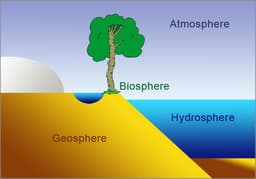
Sphere of Earth
Quiz by Aishwarya Sharma
Customize this quiz to suit your class
Instantly translate to 100+ languages
Tag the questions with any skills you have. Your dashboard will track each student's mastery of each skill.


Give this quiz to my class
 Create a multiple choice quiz with the following information: Earth’s Sphere Everything on Earth can be placed into one of four major subsystems: land, water, living things, and air. These four subsystems are called "spheres." Specifically, they are the "geosphere" (land), "hydrosphere" (water), "biosphere" (living things), and "atmosphere" (air). Geosphere All the rock, soil and sediments that makeup Earth’s land. It comes from the word “Geo” which means “Earth.” Hydrosphere All the oceans, rivers, lakes and water on Earth. It comes from the word “Hydro” which means “water.” Atmosphere All the gasses surrounding the earth. It comes from the word “Atmos” which means “air.” Biosphere All the living things on Earth. It comes from the word “Bio” which means “life.” Interact act in such a way as to have an effect on another; Freshwater naturally occurring water that is not salty, and is suitable for consumption if clean or processed. Groundwater water held underground in the soil or in pores and crevices in rock Recycling To reuse something that would have otherwise been thrown out or to turn it into something usable again instead of sending it to a landfill. Erosion After pieces of the earth are broken down through weathering, those pieces are moved through Erosion. Erosion is the process of moving things from one place to another. Mushroom Rocks Naturally occurring rocks that look like a mushroom. They can be formed when sand gets carried by wind and hits the rock. This weathers the bottom of the rock more than the top. Dry Ice A solid form of carbon dioxide that is very cold and turns directly from a solid to a gas.Spheres of Earth Set a multiple choice quiz about the three spheres of the earth - the geosfpeher, atmosphhere and hydrosphere and the inter relation between the spheres. Please translate all the questions into Afrikaans.Which one of Earth's spheres includes ALL of the living things? What do an ancient Greek philosopher and a 19th century Quaker have in common with Nobel Prize-winning scientists? Although they are separated over 2,400 years of history, each of them contributed to answering the eternal question: what is stuff made of? It was around 440 BCE that Democritus first proposed that everything in the world was made up of tiny particles surrounded by empty space. And he even speculated that they vary in size and shape depending on the substance they compose. He called these particles "atomos," Greek for indivisible. His ideas were opposed by the more popular philosophers of his day. Aristotle, for instance, disagreed completely, stating instead that matter was made of four elements: earth, wind, water and fire, and most later scientists followed suit. Atoms would remain all but forgotten until 1808, when a Quaker teacher named John Dalton sought to challenge Aristotelian theory. Whereas Democritus's atomism had been purely theoretical, Dalton showed that common substances always broke down into the same elements in the same proportions. He concluded that the various compounds were combinations of atoms of different elements, each of a particular size and mass that could neither be created nor destroyed. Though he received many honors for his work, as a Quaker, Dalton lived modestly until the end of his days. Atomic theory was now accepted by the scientific community, but the next major advancement would not come until nearly a century later with the physicist J.J. Thompson's 1897 discovery of the electron. In what we might call the chocolate chip cookie model of the atom, he showed atoms as uniformly packed spheres of positive matter filled with negatively charged electrons. Thompson won a Nobel Prize in 1906 for his electron discovery, but his model of the atom didn't stick around long. This was because he happened to have some pretty smart students, including a certain Ernest Rutherford, who would become known as the father of the nuclear age. While studying the effects of X-rays on gases, Rutherford decided to investigate atoms more closely by shooting small, positively charged alpha particles at a sheet of gold foil. Under Thompson's model, the atom's thinly dispersed positive charge would not be enough to deflect the particles in any one place. The effect would have been like a bunch of tennis balls punching through a thin paper screen. But while most of the particles did pass through, some bounced right back, suggesting that the foil was more like a thick net with a very large mesh. Rutherford concluded that atoms consisted largely of empty space with just a few electrons, while most of the mass was concentrated in the center, which he termed the nucleus. The alpha particles passed through the gaps but bounced back from the dense, positively charged nucleus. But the atomic theory wasn't complete just yet. In 1913, another of Thompson's students by the name of Niels Bohr expanded on Rutherford's nuclear model. Drawing on earlier work by Max Planck and Albert Einstein he stipulated that electrons orbit the nucleus at fixed energies and distances, able to jump from one level to another, but not to exist in the space between. Bohr's planetary model took center stage, but soon, it too encountered some complications. Experiments had shown that rather than simply being discrete particles, electrons simultaneously behaved like waves, not being confined to a particular point in space. And in formulating his famous uncertainty principle, Werner Heisenberg showed it was impossible to determine both the exact position and speed of electrons as they moved around an atom. The idea that electrons cannot be pinpointed but exist within a range of possible locations gave rise to the current quantum model of the atom, a fascinating theory with a whole new set of complexities whose implications have yet to be fully grasped. Even though our understanding of atoms keeps changing, the basic fact of atoms remains, so let's celebrate the triumph of atomic theory with some fireworks. As electrons circling an atom shift between energy levels, they absorb or release energy in the form of specific wavelengths of light, resulting in all the marvelous colors we see. And we can imagine Democritus watching from somewhere, satisfied that over two millennia later, he turned out to have been right all along.The interaction of Earth's 4 spheres06-2.4 Review (Structure of the Earth - Spheres)Trees These are also historical features. Some of these trees are historic because their existence dates back to ancient times. Some trees tell interesting stories about events in the community. Examples are Agia tree in the ancient town of Badagry, Iroko tree and Oji tree. Hills and Mountains These are also historical features. A hill is an area of land that is higher than the surrounding land. A mountain is any portion of the earth crust that rises above the surrounding surface. A mountain is higher than a hill. The Chappal Waddi mountain, popularly called Gangirwal mountain, is the highest mountain in Nigeria. It is also called the mountain of death and it is located in Taraba State. The following are some of the hills and mountains in Nigeria: 1. Tsaunin Kwaiki Mountain: It is located in Niger State. 2. Kumari Mountain: It is located in Borno State. 3. Mount Dimilang: It is located in Adamawa State. 4. Sankwala Mountain: It is located in Cross River State. 5. Shere Hills: It is located in Plateau State. 6. Idanre Hills: It is located in Ondo State.