Loading...


Spring Semester Exam Review part 1
Quiz by TIFFANY SOLOT
Tag the questions with any skills you have. Your dashboard will track each student's mastery of each skill.
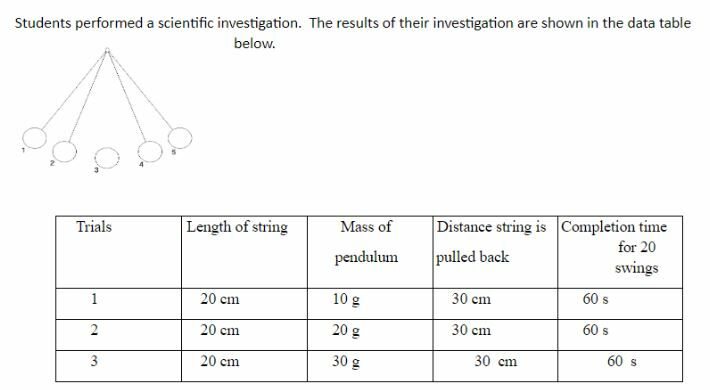
What is the problem or question being tested using the pendulum data above?
Nothing is being tested
Will the mass of the pendulum affect the time it will take it to swing 20 times?
Will the distance the string is pulled back affect the time it will take the pendulum to swing 20 times?
Will the length of the string affect the time it will take the pendulum to swing 20 times?
What is the problem or question being tested using the pendulum data above?

What force caused the player to scrape his arm on the floor?
A student wanted to know if mass of a pendulum affects the time it takes to complete 20 swings, What type of investigation (descriptive, comparative, experimental) is this pendulum investigation?

What is sea-floor spreading and what type of boundary would you find here?
Describe how the 3 types of plate boundaries form.
What is a chemical reaction?
What type of compound forms when a metal bonds with a nonmetal?
How is helium different from the other noble gasses in group 18?
At which point(s) on the diagram above will the roller coaster have the least potential energy?

What is weathering?
What is an exothermic reaction? Endothermic?
How many elements are in the chemical formula NaOH? How many atoms are in this formula?
What are valence electrons and why are they important?
Describe how the following are formed: folded mountains, fault-block mountains, volcanic mountains, subduction zones, mid-ocean ridges, trenches, and rift valleys.
If an element has 3 valence electrons, what group is it in? What will its charge be when it reacts to form an ion?
What does the atomic number of an atom represent?
Form and state a valid conclusion for this experiment based on the data in the table above. (Remember to refer directly to your hypothesis in you conclusion.)
What was Tom doing during the 100 to 120 second interval?

Every morning Tom walks along a straight road from his home to a bus stop, a distance of 160 meters. The graph above shows his journey on a particular day. During which time interval did he walk the fastest? How do you know?

What does a straight line on a graph reflect?

What are some examples of chemical reactions?
What is a coefficient? How many atoms are in the formula 6P2O5?
What is a subscript?
An isotope of Boron-10 has 5 protons. How many proton, neutrons, and electrons would Boron-11 have?
What is an isotope?
At which point does the pendulum have the least potential energy?

What are Wegener's three pieces of evidence for continental drift?
What does the law of conservation of mass have to do with balancing equations?
Two forces of 6N and 3N act upon an object in opposite directions. What is the new combined (net) force and direction of movement?
What areas of Earth would you find earthquakes?
What is the definition of an organic compound? What element will all organic compounds contain?
What is the law of conservation of mass?
What was Dalton's atomic theory?
The picture above shows a pulley moving a box. Which direction will the box move if a downward force is applied to the rope that is greater than the force of gravity on the box?

Which car is traveling fastest?

What are the characteristics of metals?
What group of elements are Halogens most likely to combine with?
A windmill sits quietly and still until it is hit with a gust of wind and begins turning. Explain how this is an example of Newton's first Law of Motion.
What are the characteristics of nonmetals?
Why do atoms in group 18 not react in nature?