Write and solve equations involving direct variation.
Determine the effects on the graph of the parent function f(x) = x2 when f(x) is replaced by af(x), f(x) + d, f(x - c), f(bx) for specific values of a, b, c, and d.
Add and subtract polynomials of degree one and degree two.
Write equations of quadratic functions given the vertex and another point on the graph, write the equation in vertex form (f(x) = a(x - h)2+ k), and rewrite the equation from vertex form to standard form (f(x) = ax2+ bx + c).
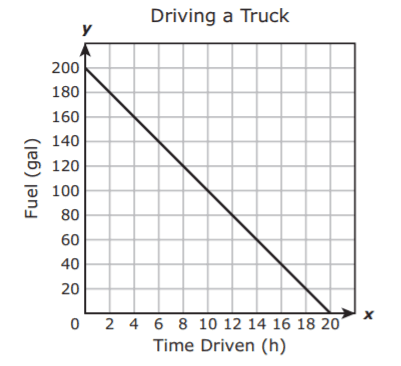
Calculate the rate of change of a linear function represented tabularly, graphically, or algebraically in context of mathematical and real-world problems.
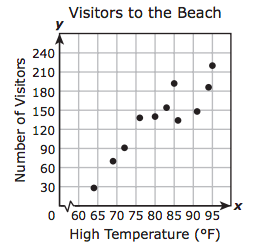
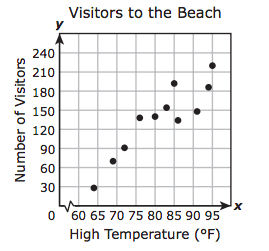
Write, using technology, quadratic functions that provide a reasonable fit to data to estimate solutions and make predictions for real-world problems.
Communicate mathematical ideas, reasoning, and their implications using multiple representations, including symbols, diagrams, graphs, and language as appropriate.
Determine the domain and range of quadratic functions and represent the domain and range using inequalities.
Create and use representations to organize, record, and communicate mathematical ideas.
Describe the relationship between the linear factors of quadratic expressions and the zeros of their associated quadratic functions.
Solve systems of two linear equations with two variables for mathematical and real-world problems.
Simplify numerical radical expressions involving square roots.
Write quadratic functions when given real solutions and graphs of their related equations.
Calculate, using technology, the correlation coefficient between two quantitative variables and interpret this quantity as a measure of the strength of the linear association.
Apply mathematics to problems arising in everyday life, society, and the workplace.
Write linear equations in two variables in various forms, including y = mx + b, Ax + By = C, and y - y1 = m(x - x1), given one point and the slope and given two points.
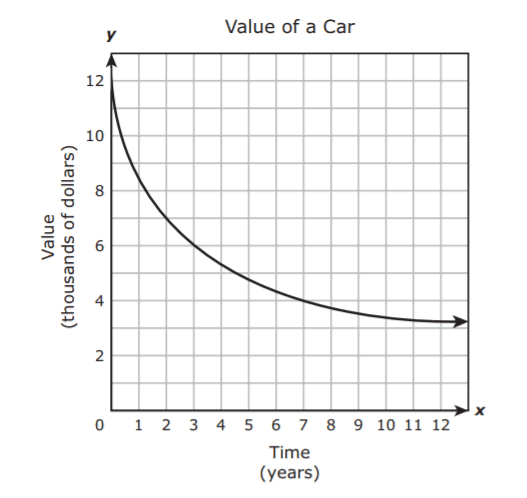
Graph exponential functions that model growth and decay and identify key features, including y-intercept and asymptote, in mathematical and real-world problems.
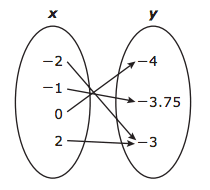
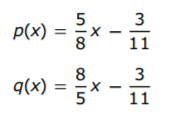
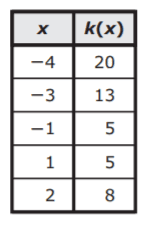
Evaluate functions, expressed in function notation, given one or more elements in their domains.
Compare and contrast association and causation in real-world problems.
Select tools, including real objects, manipulatives, paper and pencil, and technology as appropriate, and techniques, including mental math, estimation, and number sense as appropriate, to solve problems.
Write exponential functions in the form f(x) = abx (where b is a rational number) to describe problems arising from mathematical and real-world situations, including growth and decay.
Solve quadratic equations having real solutions by factoring, taking square roots, completing the square, and applying the quadratic formula.
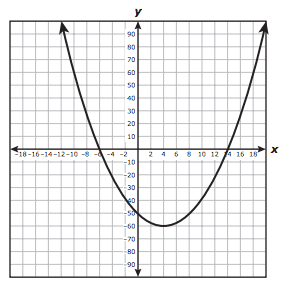
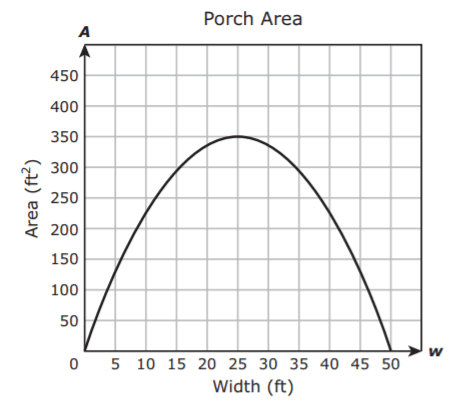
Graph quadratic functions on the coordinate plane and use the graph to identify key attributes, if possible, including x-intercept, y-intercept, zeros, maximum value, minimum values, vertex, and the equation of the axis of symmetry.
Solve linear inequalities in one variable, including those for which the application of the distributive property is necessary and for which variables are included on both sides.
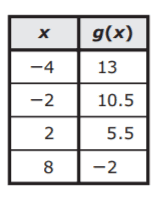
Write linear equations in two variables given a table of values, a graph, and a verbal description.
Use a problem-solving model that incorporates analyzing given information, formulating a plan or strategy, determining a solution, justifying the solution, and evaluating the problem-solving process and the reasonableness of the solution.
Simplify numeric and algebraic expressions using the laws of exponents, including integral and rational exponents.
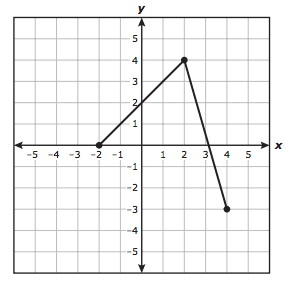
Determine the domain and range of a linear function in mathematical problems; determine reasonable domain and range values for real-world situations, both continuous and discrete; and represent domain and range using inequalities.
Track each student's skills and progress in your Mastery dashboards