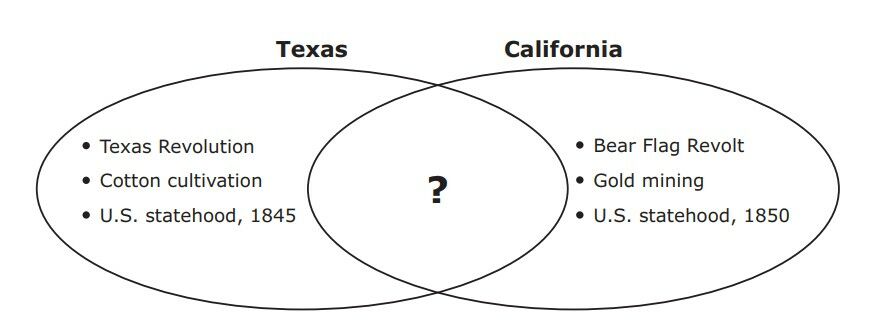
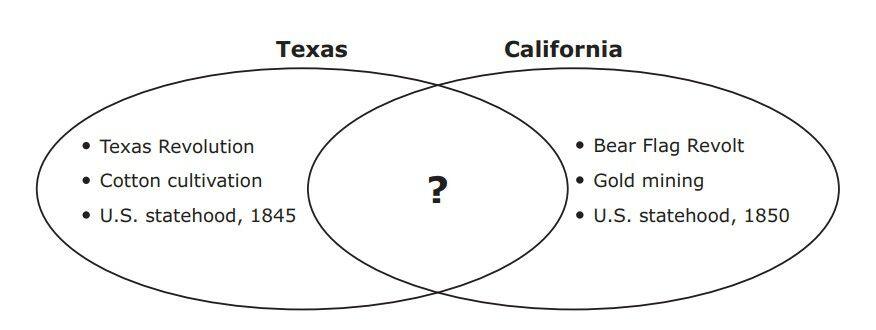
The student understands the location and characteristics of places and regions of the United States, past and present. Compare places and regions of the United States in terms of physical and human characteristics.
The student understands traditional historical points of reference in U.S. history through 1877. Identify the major eras in U.S. history through 1877, including colonization, revolution, creation and ratification of the Constitution, early republic, the Age of Jackson, westward expansion, reform movements, sectionalism, Civil War, and Reconstruction, and describe their causes and effects.
The student understands significant political and economic issues of the revolutionary and Constitutional eras. Analyze the issues of the Constitutional Convention of 1787, including the Great Compromise and the Three-Fifths Compromise.
The student understands the effects of Reconstruction on the political, economic, and social life of the nation. Explain the economic, political, and social problems during Reconstruction and evaluate their impact on different groups.
The student understands westward expansion and its effects on the political, economic, and social development of the nation. Analyze the westward growth of the nation, including the Louisiana Purchase and Manifest Destiny.
The student understands the challenges confronted by the government and its leaders in the early years of the republic and the Age of Jackson. Describe major domestic problems faced by the leaders of the new republic, including maintaining national security, creating a stable economic system, and setting up the court system.
The student understands the relationships between and among people from various groups, including racial, ethnic, and religious groups, during the 17th, 18th, and 19th centuries. Analyze the contributions of people of various racial, ethnic, and religious groups to our national identity.
The student understands the American beliefs and principles reflected in the Declaration of Independence, the U.S. Constitution, and other important historic documents.
The student understands westward expansion and its effects on the political, economic, and social development of the nation. Explain how the Northwest Ordinance established principles and procedures for orderly expansion of the United States.
The student understands the major reform movements of the 19th century. Describe and evaluate the historical development of the abolition movement, including activities that focused attention on the moral ills of slavery.
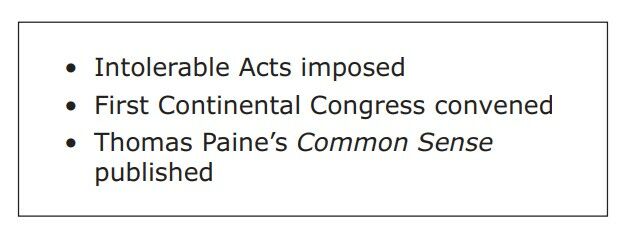
The student understands significant political and economic issues of the revolutionary and Constitutional eras. Analyze causes of the American Revolution, including the Proclamation of 1763, the Intolerable Acts, the Stamp Act, mercantilism, lack of representation in Parliament, and British economic policies following the French and Indian War.
The student understands the purpose of changing the U.S. Constitution and the impact of amendments on American society. Describe the impact of the 13th, 14th, and 15th amendments.
The student understands the relationships between and among people from various groups, including racial, ethnic, and religious groups, during the 17th, 18th, and 19th centuries. Identify ways conflicts between people from various racial, ethnic, and religious groups were addressed.
The student understands the rights and responsibilities of citizens of the United States. Summarize rights guaranteed in the Bill of Rights.
The student understands the impact of religion on the American way of life. Trace the development of religious freedom in the United States.
The student understands the dynamic nature of the powers of the national government and state governments in a federal system. Explain constitutional issues arising over the issue of states' rights, including the Nullification Crisis and the Civil War.
The student understands the relationships between and among people from various groups, including racial, ethnic, and religious groups, during the 17th, 18th, and 19th centuries. Identify racial, ethnic, and religious groups that settled in the United States and explain their reasons for immigration.
The student understands the impact of landmark Supreme Court cases. Identify the origin of judicial review.
The student understands westward expansion and its effects on the political, economic, and social development of the nation. Explain the causes and effects of the U.S.-Mexican War and their impact on the United States.
The student understands the impact of science and technology on the economic development of the United States. Analyze how technological innovations changed the way goods were manufactured and distributed, nationally and internationally.
The student understands the major reform movements of the 19th century. Evaluate the impact of reform movements, including educational reform, temperance, the women's rights movement, prison reform, the labor reform movement, and care of the disabled.
The student understands significant political and economic issues of the revolutionary and Constitutional eras. Explain the roles played by significant individuals during the American Revolution, including Abigail Adams, John Adams, Wentworth Cheswell, Samuel Adams, Mercy Otis Warren, James Armistead, Benjamin Franklin, Crispus Attucks, King George III, Patrick Henry, Thomas Jefferson, the Marquis de Lafayette, Thomas Paine, and George Washington.
The student understands the impact of scientific discoveries and technological innovations on daily life in the United States. Identify examples of how industrialization changed life in the United States.
The student understands how political, economic, and social factors led to the growth of sectionalism and the Civil War. Analyze the impact of the Fugitive Slave Act of 1850 on slavery, free Blacks, and abolitionists.
The student understands the impact of landmark Supreme Court cases. Summarize the issues, decisions, and significance of landmark Supreme Court cases, including Marbury v. Madison, McCulloch v. Maryland, and Gibbons v. Ogden.
The student understands individuals, issues, and events of the Civil War. Explain the central role of the expansion of slavery in causing sectionalism, disagreement over states' rights, and the Civil War.
The student understands the location and characteristics of places and regions of the United States, past and present. Locate places and regions directly related to major eras and turning points in the United States during the 17th, 18th, and 19th centuries.
The student understands the impact of religion on the American way of life. Analyze the impact of the First Amendment guarantees of religious freedom on the American way of life.
The student understands the relationship between the arts and the times during which they were created. Analyze the relationship between the arts and continuity and change in the American way of life.
The student understands traditional historical points of reference in U.S. history through 1877. Explain the significance of the following dates: 1607, founding of Jamestown; 1620, arrival of the Pilgrims and signing of the Mayflower Compact; 1776, adoption of the Declaration of Independence; 1787, writing of the U.S. Constitution; 1803, Louisiana Purchase; and 1861-1865, Civil War.
The student understands how various economic forces resulted in the Industrial Revolution in the 19th century. Identify the economic factors that brought about rapid industrialization and urbanization.
The student understands the rights and responsibilities of citizens of the United States. Define and give examples of unalienable rights.
The student understands the importance of effective leadership in a constitutional republic. Describe the contributions of significant political, social, and military leaders of the United States such as Frederick Douglass, John Paul Jones, Susan B. Anthony, and Elizabeth Cady Stanton.
The student understands individuals, issues, and events of the Civil War. Explain significant events of the Civil War, including the firing on Fort Sumter; the battles of Antietam, Gettysburg, and Vicksburg; the Emancipation Proclamation; Lee's surrender at Appomattox Court House; and the assassination of Abraham Lincoln.
The student understands the origins and development of the free enterprise system in the United States. Explain why a free enterprise system of economics developed in the new nation, including minimal government regulation, taxation, and property rights.
The student understands the impact of science and technology on the economic development of the United States. Analyze how technological innovations brought about economic growth such as the development of the factory system and the construction of the Transcontinental Railroad.
The student understands the challenges confronted by the government and its leaders in the early years of the republic and the Age of Jackson. Explain the origin and development of American political parties.
The student understands the foundations of representative government in the United States. Analyze the importance of the Mayflower Compact, the Fundamental Orders of Connecticut, and the Virginia House of Burgesses to the growth of representative government.
The student understands the dynamic nature of the powers of the national government and state governments in a federal system. Analyze the arguments of the Federalists and Anti-Federalists, including those of Alexander Hamilton, Patrick Henry, James Madison, and George Mason, and explain how their debates exemplify civil discourse.
The student understands the challenges confronted by the government and its leaders in the early years of the republic and the Age of Jackson. Summarize arguments regarding protective tariffs, taxation, and the banking system.
The student understands the importance of voluntary individual participation in the democratic process. Evaluate the contributions of the Founding Fathers as models of civic virtue.
The student understands the foundations of representative government in the United States. Explain the reasons for the growth of representative government and institutions during the colonial period.
The student understands significant political and economic issues of the revolutionary and Constitutional eras. Explain the issues surrounding important events of the American Revolution, including declaring independence; fighting the battles of Lexington and Concord, Saratoga, and Yorktown; enduring the winter at Valley Forge; and signing the Treaty of Paris of 1783.
The student understands the impact of science and technology on the economic development of the United States. Explain the effects of technological and scientific innovations such as the steamboat, the cotton gin, the telegraph, and interchangeable parts.
The student understands why various sections of the United States developed different patterns of economic activity through 1877. Explain reasons for the development of the plantation system, the transatlantic slave trade, and the spread of slavery.
Track each student's skills and progress in your Mastery dashboards