STAAR Test High School Biology
Quiz by STAAR Texas
Feel free to use or edit a copy
includes Teacher and Student dashboards
Measure skillsfrom any curriculum
Measure skills
from any curriculum
Tag the questions with any skills you have. Your dashboard will track each student's mastery of each skill.
With a free account, teachers can
- edit the questions
- save a copy for later
- start a class game
- automatically assign follow-up activities based on students’ scores
- assign as homework
- share a link with colleagues
- print as a bubble sheet
7 questions
Show answers
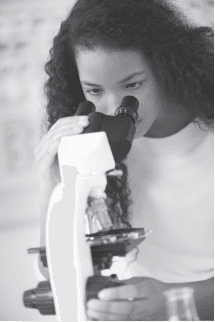
- Q1The picture shows a student using a microscope to study a prepared slide of a single-celled organism. A single-celled organism can be classified as a prokaryote based on the absence of —chromosomesribosomesa cell membranea nucleus30s
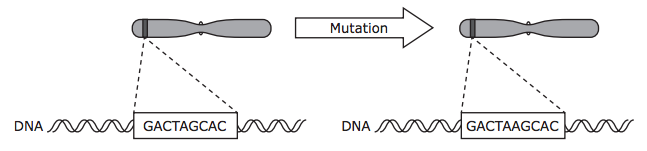
- Q2Different types of mutations can occur in DNA. The diagram represents a type of mutation. Which statement describes the mutation in the diagram?A substitution occurs with the adenine base.A base is inserted into one strand of the DNA.A deletion of a cytosine base occurs.A silent mutation results in the insertion of a different amino acid.30s
- Q3A remora is a fish that has an adhesive disk on the back of its head that it uses to attach itself to a large shark. When food floats away from the shark’s mouth as it feeds, the remora collects the scraps. Drawings of a shark with a remora attached and a remora’s adhesive disk are shown here. The relationship between the remora and the shark is an example of —predationparasitismcommensalismcompetition30s
- Q4Invasive plant species affect the interactions of living and nonliving components of an ecosystem, so the removal of invasive plants is often necessary. The goal of most plant-control methods is to disrupt or inhibit the function of different plant systems. For example, insects can be used to chew through roots in order to reduce a plant’s ability to absorb water. Which of these functions would be most immediately affected by a reduction in water uptake by roots?Disease resistanceSunlight absorptionPhotosynthesisSeed dispersal30s
- Q5Part of the cell cycle is shown in this simplified model. This part of the cell cycle is best described as the process that —maintains genetic homeostasisduplicates the DNAsynthesizes new moleculescompletes cell division30s
- Q6The human immunodeficiency virus (HIV) often infects and destroys CD4 T cells. These CD4 T cells are one of many kinds of white blood cells that are an important part of the immune system. The most common danger related to the destruction of CD4 T cells is —an increase in the threat of diseases caused by microorganisms and virusesa decrease in the flow of blood to vital organsan increase in the risk of high blood pressurea decrease in the amount of oxygen being transported to tissues30s
- Q7Common baboons live on the savanna in breeding groups called troops. While females tend to stay with the troop, younger or less dominant males may leave to join a neighboring troop. Which of these is a likely outcome of movement by young males?Gene flow occurs between populations.Intermediate phenotypes increase in the species.Allele frequencies suddenly change.Relative genotypic frequencies reach a constant state.30s