Tag the questions with any skills you have. Your dashboard will track each student's mastery of each skill.
Give this quiz to my class
Q 1/10
Score 0
What will most likely be the result if all of the mitochondria are removed from a plant cell?
300
It will be unable to carry out respiration.
It will break down the ribosomes in the cell.
It will lose water through osmosis.
It will be unable to photosynthesize.
Q 2/10
Score 0
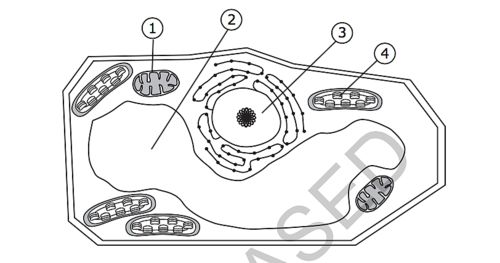
This diagram shows a plant cell. Which structure is found in a plant cell but is absent in an animal cell?
300
1
3
2
4
10 questions
Q.
What will most likely be the result if all of the mitochondria are removed from a plant cell?
1
300 sec
Q.
This diagram shows a plant cell. Which structure is found in a plant cell but is absent in an animal cell?
2
300 sec
Q.
Which best explains why muscle cells are different from blood cells?
3
300 sec
Q.
These diagrams represent a Euglena and a Paramecium. Which function do structures X and Y have in common?
4
300 sec
Q.
This diagram represents a cell. Which organelle is the site where amino acids are synthesized into proteins?
5
300 sec
Q.
This diagram shows a red blood cell in a beaker that contains a solution with a higher salt concentration than that inside the red blood cell. What will happen to the red blood cell in this environment?
6
300 sec
Q.
These diagrams show a variety of cells from the same organism. How can cells from the same organism have such different shapes and functions?
7
300 sec
Q.
Which of these cells in the human body is specialized to transport oxygen throughout the body?
8
300 sec
Q.
What would most likely be produced when a cell with eight chromosomes undergoes mitosis?
9
300 sec
Q.
This diagram shows a Paramecium a unicellular protist. When a chemical is added to the pond water in which the Paramecium lives the Paramecium stops moving. Which structure is most likely affected?