Loading...


States, Properties, and Changes of Matter
Quiz by Janice Bixler
Track each student's skills and progress in your Mastery dashboards
In cold climates, the amount of snow on the ground may decrease even if the temperature stays below zero degrees Celsius. The process that best explains this event is
A shrinking puddle is an example of _______, or vaporization that takes place only on the surface of a liquid.
An uncovered pot of soup is simmering on a stove, and there are water droplets on the wall above the back of the stove. What sequence can you infer has occurred?
A truck's tires have the correct air pressure at room temperature (about 20oC). During long trips, the tire of a truck may reach extremely high temperatures. Why are the tires more likely to explode when the truck is driven in hot weather than in cold weather?
As matter changes state from gas to liquid, which of these statements is true?
The task in science lab: discover which solid substance, without tasting, is sugar. Donna and Dave have five substances to test, and unfortunately, two are white! "Let's heat them!" suggested Donna. Did Donna have a reasonable solution to their problem?

As temperature rises from 25°C to 60°C, the material _______ heat and its kinetic energy _________ as the material goes through vaporization to become a gas.
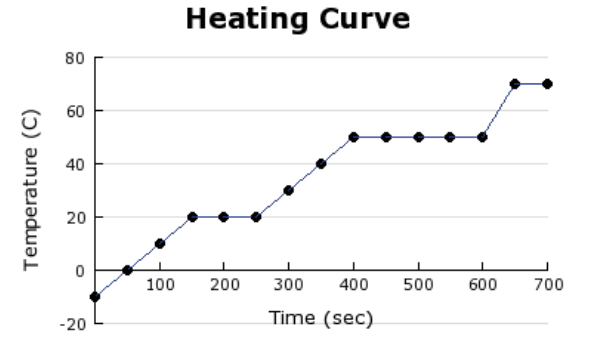
Relate the temperature of a gas to the kinetic energy of its particles.
Maria and Carla were hiking when Maria tripped, fell, and sprained her ankle. Carla took out the first-aid kit and unwrapped a cold pack. Carla popped a vial that was inside the cold pack. The pack began to get icy cold and Carla applied the pack to Maria's ankle. What kind of reaction occurred in the cold pack? What evidence supports your answer?
Maria and Miguel were enjoying the fireworks when they got into a chemistry argument. Maria insisted that the fireworks were the result of a chemical reaction. Miguel disagreed. What would you tell them to solve this argument?
Silver is a white metal that is an excellent conductor. Silver tarnishes when exposed to air and light. The density of silver is 10.49 g/cm3. The melting point is 962oC and the boiling point is 2000oC. A chemical property of silver is
Which of the following represents ONLY physical properties?
A piece of copper has a volume of 100 mL. If the mass of the copper is 890g, what is the density of copper?
Match each property to the correct example.
Which statement correctly describes one of the changes in the image?

There is a bucket of dirt. Dirt or soil is a mixture of many particles. Each kind of particle in the bucket of soil has unique properties. Here are four particles that make up soil. What property would you use to separate the four particles?

Students were given three graduated cylinders containing three different liquids: oil, water, and syrup. They were asked to predict what would happen when the three liquids were poured into one container. The majority of students said that the liquids would form a mixture. The liquids were poured into a jar and the results can be seen here. Explain what happened to the three liquids.
The students conducted a second experiment. They measured 100 ml of water, density 1 g/cm3 and 100 ml of mineral oil, density 0.8 g/cm3. They poured the water into Cup A and the oil in to Cup B. Next they added an ice cube to each cube. All BUT ONE statement is a valid conclusion.
If oil and water are combined in one cup, the oil will float on top of the water.
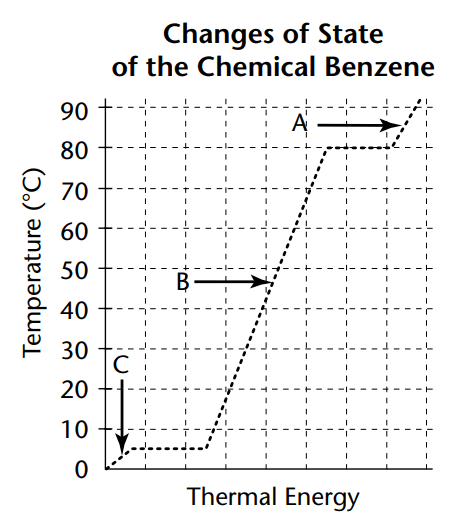
The graph shows the changes in temperature of a sample of benzene as its thermal energy is increases. What does label C represent?