Loading...


SUMMATIVE ASSESSMENT (Second Quarter)
Quiz by Jenny Dela Vega
Tag the questions with any skills you have. Your dashboard will track each student's mastery of each skill.
Who was the scientist who examined bacteria, blood cells, yeasts and protozoansusing the microscope that he invented?
Which part of the microscope should be manipulated if the Low Power Objective (LPO)needs to be adjusted?
In carrying the microscope, which parts should be handled carefully?
What is the function of a light source in the compound light microscope?
Which of the following statements is the correct way of preparing a specimen?
How does the development of the microscope expand our knowledge about microorganisms?
How did Robert Hooke discover the cell in his experiment using a single lens microscope?
Scientists use a highly advanced type of microscope to study the structure ofSARS-CoV-2, the virus that causes COVID-19. Which of the following microscopes canbe used in viewing the image of this virus?
Allen examines a specimen of onion under the microscope. He observes that theimage of the onion cells is slightly dim. Which of the following parts of the microscopeshould he adjust to change the intensity of light?
Jim observes the pollens from a plant under a compound light microscope.Which mechanical part should he adjust if he wants to change the objective fromLow Power Objective (LPO) to High Power Objective (HPO)?
Which part of the microscope contains a magnifying lenswhere you look through to observe the specimen?
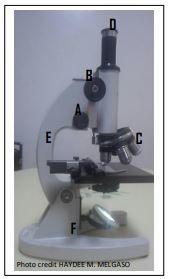
Which letter represents the coarse adjustment knob?
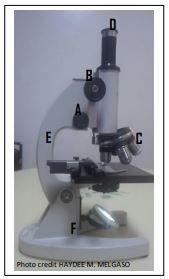
Which part will you adjust while viewing under HPO if the cut out small letter “e” you are observing is not clear?
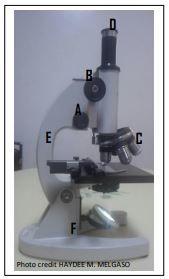
Which part supports the entire weight of the microscope?
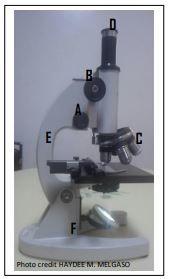
If a microscope has a 4x ocular lens and a 10x objective, what is the total magnification of the object being viewed?
Which of the following shows letter “e” as seen under the microscope?
Why is it necessary for the specimen to be thinly sliced so it can be observed under the microscope?
Which sequence of biological levels of organization is correctly arranged frommost complex to simplest?
Which level of organization in an organism is the basic unit of life?
The compositions of human blood are whole blood cells and the liquid portion called plasma. Which level of biological organization does blood belongs to?
Which of the following sequence of biological levels of organization from organism to biosphere is correctly arranged?
What level of biological organization refers to a group of organisms of similar species found within a specific area at a given time?
Which of the following statements correctly describe the organ system of plants?
Which of the following examples describe a population?
How is each biological level of organization interconnected?
At which level of biological organization is a group of organs that work together to perform a specific physiological process found?
Which of the following pairs is NOT correctly matched?
Which of the following cannot be performed by a plant if its chloroplasts are damaged?
How do you compare the shape of a plant cell with an animal cell?
Which structures are common to both plants and animals?
Which parts of the cell are unique to species of plants?
Which features support each other in supplying energy to control the activities of the cell?
Which part of this cell serves as the brain that controls the other parts of the cell?

Which part of this cell provides strength and support to the entire cell?

How is a plant cell similar to an animal cell?
The following contributed to the development of the cell theory except__
Which of the following processes involve replication of the cell’s DNA through cellulardivision?
The cell breaks down biomolecules into smaller parts that the cell can utilize with the help of enzymes. What kind of process is being described?
Which of the following statements is NOT TRUE about the cell?
What type of asexual reproduction occurs in bacteria?
How does the DNA of the daughter’s cell compare to the DNA of the parent cell in asexual reproduction?
How many parents are required for asexual reproduction?
How can you describe fertilization?
A sperm cell unites with an egg cell to form a zygote. Which process is taking place?
In sexual reproduction, what is the source of the genetic material in a zygote?
Which of the following reproduces by regeneration?
Which of the following is NOT involved in asexual reproduction?
Which of the following is the male reproductive organ of a flower?
How can you differentiate asexual reproduction from sexual reproduction?
Trees are an essential part of the ecosystem. Which of the following is NOT its function?
Which of the following DOES NOT belong to the group?
What is the role of an earthworm in the soil?
An ecosystem is made up of biotic and abiotic factors. The following are Abiotic factors except
A mutualistic relationship is one where both organisms benefit. Which of the following is an example of a mutualistic relationship?
What is it called when two or more organisms rely on the same environmental resource?
What do you call a symbiotic relationship where one organism benefits while the other neither benefits nor harmed?
Which organism would most likely have a predator-prey relationship?
A flea in the fur of a mouse benefits at the mouse’s expense. This type of relationship is known as ___
In predation, an organism that is “hunted” and “eaten” is known as the
A bird hitches a free, safe ride on the back of an elephant. The elephant doesn’t mind and barely notices the bird. What type of relationship is this?