Loading...


Summative Test: Science G10 2Q Module 1-6
Quiz by Jerald U. Carilla
Tag the questions with any skills you have. Your dashboard will track each student's mastery of each skill.
1. Which electromagnetic wave has the highest energy?
2. How does an increase in frequency affect electromagnetic waves?
3. What happens to the frequency and wavelength if the energy of the wave decreases?
4. Which electromagnetic wave has the longest wavelength?
5. What color in the visible spectrum carries the highest energy?
6. Which shows the correct arrangement of the types of electromagnetic waves in increasing frequency?
7. Radio waves, X-ray waves, and microwaves are detected to be travelling in a vacuum. If the waves have a wavelength of 2 x 10³ m, 2 x 10⁻⁹ m, 2 x 10⁻¹ m respectively, which of the three travels the fastest?
8. Which is the center of transmitting and receiving radio waves towards television and radio communication?
9. What will happen if the antenna of the analog television is placed inside the house?
10. Which is NOT included in the group for radio communication?
11. Which causes sugar, water, and fat to vibrate at extremely high frequencies?
12. Which item must NOT be placed inside the microwave oven?
13. Identify the type of electromagnetic wave used in TV Remote Control
14. Identify the type of electromagnetic wave used in Food Irradiation
15. What form of electromagnetic radiation has the most energy?
16. What is the difference between ionizing and non-ionizing radiation?
17. Which is NOT a probable result of the human tissue’s exposure to ionizing radiation?
18. What does ionizing radiation remove from atoms?
19. How can we protect ourselves from harmful electromagnetic radiation?
20. Which is the example of non-ionizing radiation?
21. Which describes a non-ionizing radiation?
22. In the Law of Reflection, the incident ray, the reflected ray, and the normal line _________________________________.
23. A ray of light is incident on a surface at 33o from the normal. What will be the angle of reflected ray from the normal?
24. An incident light travels on a path shown in
Figure 1. Which of the following paths is most
likely to be taken by the reflected light?
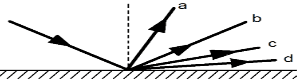
25. If you placed a number chart in front of a plane mirror, what numbers will you read properly in the mirror?
26. Is it TRUE that (I) convex mirror always forms upright, reduced, and virtual images and (II) most department stores use concave mirrors because they give a wider range of view?
27. It is a position where an object should be placed when in front of a concave mirror so that it reflects the image with the same size as the object.
28. What type of lens produces smaller and upright images?
29.What kind of eyepiece is used in are flecting telescope?
30.What is the orientation of the image produced by a Galilean telescope with respect to the object?
31.Why do astronomers prefer to use are reflecting telescope in viewing astronomical objects?
32. Which optical instrument offers the widest field of view?
33. What is the purpose of prisms in a binocular?
34. Which shows the correct sequence of image formation in reflecting telescopes?
I. The light rays refract on the eyepiece producing an enlarged image.
II. Light from the distant object enters the telescope.
III. Light converges after hitting the parabolic mirror.
IV. A plane mirror catches and redirects the light.
35. Which are TRUE about an electric motor?
I. It uses magnets to create a circular motion.
II. It uses magnets to create rotational motion.
III. It converts electrical energy into mechanical energy
IV. It depends on the interaction of magnetic and electric fields.
36. An electric generator converts energy from_______________ to ________________.
37. Which principle works with an electric motor and generator respectively?
38. In which part of an electric motor is electric current supplied to create
magnetic force?
39. In which part of an electric generator is an electric current produced due to
the induced electromotive force (emf) or voltage?
40. Which part of an electric motor provides a magnetic field, allowing the inner
coil wire within to rotate as the electric current passes through.