TEKS Biology High School - B.10.B: Plant Systems
Quiz by TEKS Biology High School
High School
Biology(2017)(ARCHIVED)
Texas Essential Knowledge and Skills (TEKS)
Feel free to use or edit a copy
includes Teacher and Student dashboards
Measures 3 skills from
Measures 3 skills from
With a free account, teachers can
- edit the questions
- save a copy for later
- start a class game
- automatically assign follow-up activities based on students’ scores
- assign as homework
- share a link with colleagues
- print as a bubble sheet

19 questions
Show answers
- Q1Invasive plant species affect the interactions of living and nonliving components of an ecosystem, so the removal of invasive plants is often necessary. The goal of most plant-control methods is to disrupt or inhibit the function of different plant systems. For example, insects can be used to chew through roots in order to reduce a plant’s ability to absorb water. Which of these functions would be most immediately affected by a reduction in water uptake by roots?Sunlight absorptionSeed dispersalPhotosynthesisDisease resistance30sBIOL.10b
- Q2Cytokinins are a class of plant hormones that help regulate growth by promoting cell division. Cytokinins are produced mainly in meristematic tissue, where most plant growth occurs. Which system carries cytokinins produced in the roots to the rest of the plant?Reproductive systemVascular systemNone of theseDermal system30sBIOL.10b
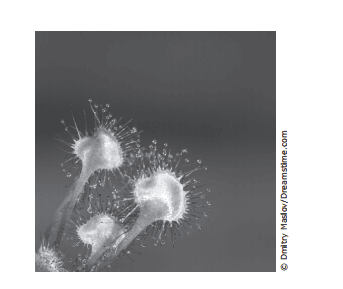
- Q3Plants called sundews have rounded green leaves with many hair-like structures. The ends of these structures contain enzymes in a sticky liquid that looks like nectar or moisture, as shown in the picture. The hairs do not react to dust or nonliving material but will bend inward when insects get caught in the sticky liquid. Sundews digest trapped insects over a period of a few days. Based on this information, what functions do the specialized leaves of sundews perform?Provide water to the plant and perform photosynthesisRespond to stimuli and anchor the plantProvide nutrients to the plant and respond to stimuliRelease pollen to insects and perform photosynthesis30sBIOL.10b
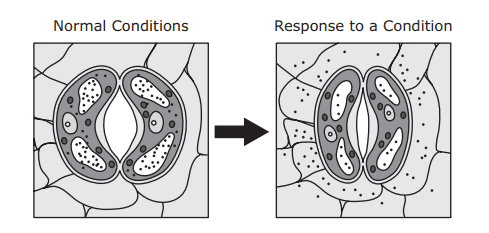
- Q4Structures represented in the illustration below are found in the lower epidermis of a plant leaf. The illustration at right shows the response to a certain environmental condition. The response represented in the illustration would most likely be caused by —long periods of rainfalllittle available watera reduced supply of oxygenhigh concentrations of glucose30sBIOL.10b
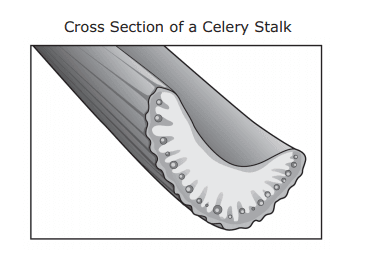
- Q5Some students are instructed to put a celery stalk in a red dye solution for a lab activity. First the students carefully cut the bottom of the stalk with a scalpel. Then they put the stalk in the beaker with the solution and place the beaker on a shelf in the lab room. The next day they check the stalk and make observations. The students note that the leaves at the end of the stalk have changed color from green to red. The students cut across the celery stalk and use a hand lens to see that the small tube openings along the edge of the celery stalk are also red. The cross section is shown below. How do the plant systems work together to make this movement of liquid possible?The roots anchor the plant in the soil, and the stem holds the leaves upThe roots absorb their own water and minerals, while the stem absorbs its water and minerals through the leavesThe roots lose water vapor to the soil, and the stem loses water vapor through the leavesThe roots absorb water and minerals and move them up to the stem, while the stem moves food produced in the leaves down to the roots in tiny tubes30sBIOL.10b
- Q6Plants transport nutrients dissolved in water via their xylem and phloem. The stomata on the surface of their leaves allow gas exchange. The xylem, phloem, and stomata have functions similar to those of which two human body systems?Cardiovascular and integumentarySkeletal and respiratoryCirculatory and respiratoryCardiovascular and skeletal30sBIOL.10b
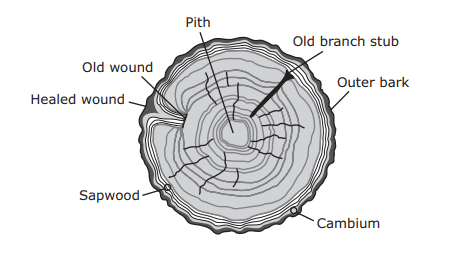
- Q7An animal can wound a tree by scratching away the bark. The tree can respond to the wound in many ways. Usually sap quickly covers the wound, and then the tree covers the wound with new growth. The diagram shows a cross section of a tree with a healed wound. What process worked most directly with the transport system to heal the wound?Water intakeCarbohydrate storageMitosisPhotosynthesis30sBIOL.5a
- Q8Leaves are part of a plant’s shoot system. The xylem tissue in leaves transports —the wax required to coat the surface of actively growing tissuethe water and minerals that are absorbed by the rootsthe oxygen that regulates the rate of carbohydrate productionthe bacteria needed for nitrogen fixation in root nodules30sBIOL.5a
- Q9Copper is a micronutrient that can be found in soil. Copper is important for reproductive growth in plants and plays an indirect role in chlorophyll production. Which statement correctly describes the interaction that occurs between the root and the shoot systems of plants to allow reproduction to occur?The shoot system transports copper to the roots after it is taken in through stomata in the leavesCopper that is absorbed by the roots is transported to reproductive tissues by the shoot systemCopper is produced in the roots when copper-containing compounds are hydrolyzedThe shoot system stores copper for later use by the roots and the reproductive structures30sBIOL.5a
- Q10If water molecules were not polar, the immediate effect would be:Water molecules would neither freeze nor boilWater molecules would become toxicOnly saltwater, not freshwater, would exist on earthWater molecules could not bind to each other via cohesion30sBIOL.4b
- Q11Water is known as the universal solvent; which statement supports this claim?Water is found everywhereWater dissolves many other substancesWater can be dissolved into many other substancesWater is needed by all organisms for life30sBIOL.4b
- Q12What is one effect of water's ability to stick to other molecules, or adhesion?the surface tension that forms on lakes and pondsall of thesethe capacity to store heat that results in slower evaporation of water than substances like alcoholthe capillary action that allows water to 'climb up' a plant stem30sBIOL.4b
- Q13The hot-water knob turns on a pipe that comes straight from the water heater, which is why the faucet releases hot water. The cold-water knob actually turns on a pipe that comes straight from a storage tank, but there is no refrigeration involved! What property of water means that the water from the 'cold water' knob feels colder than the room's air temperature?specific heatcohesiondensityadhesion30sBIOL.4b
- Q14When you dropped water on the penny, the water stuck on the surface of the penny because of the force ofcapillary actioncohesionadhesiontranspiration30sBIOL.4b
- Q15When you dropped water on the penny, the water stuck to the other water droplets because of the force oftranspirationcohesioncapillary actionadhesion30sBIOL.4b