


TEKS Biology High School - B.7.B: Fossil Records
Quiz by TEKS Biology High School
High School - Biology
Science (2010) (Archived)
Texas Essential Knowledge and Skills (TEKS)
Feel free to use or edit a copy
includes Teacher and Student dashboards
Track each student's skills and progress in your Mastery dashboards
With a free account, teachers can
- edit the questions
- save a copy for later
- start a class game
- automatically assign follow-up activities based on students’ scores
- assign as homework
- share a link with colleagues
- print as a bubble sheet
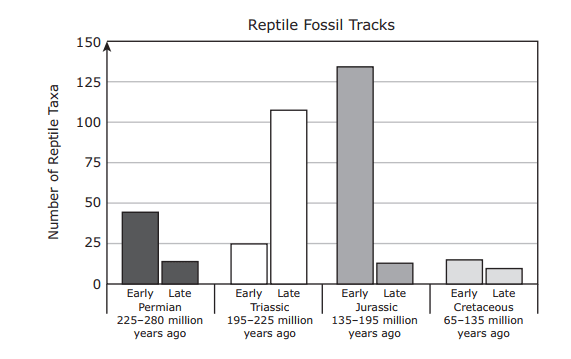
- Q 1/5Score 0The graph shows the number of taxa of reptiles whose fossilized tracks have been found. Which statement is best supported by these data?29Environmental conditions for speciation were most favorable for reptiles during the Permian periodA great extinction occurred during the Jurassic periodCompetition for food and shelter among reptile species was very low during the Triassic periodReptiles adapted to a terrestrial environment during the Cretaceous period


5 questions
Show answers
- Q1The graph shows the number of taxa of reptiles whose fossilized tracks have been found. Which statement is best supported by these data?Environmental conditions for speciation were most favorable for reptiles during the Permian periodA great extinction occurred during the Jurassic periodCompetition for food and shelter among reptile species was very low during the Triassic periodReptiles adapted to a terrestrial environment during the Cretaceous period30sB.7.B: Fossil Records
- Q2This diagram of the fossil record represents changes in mollusks over millions of years. How can the pattern of change in the fossil record best be explained?The mollusks were well adapted to their stable environment. The mollusks hybridized with a smaller species of mollusk. A new species of mollusk with a bigger shell resultedThe mollusks were not well adapted to their environment. The length of the mollusks’ shells changed gradually over time. The mollusks in the original population that had small shells died over a period of many yearsThe mollusks were well adapted to their stable environment. A large, sudden change occurred in their environment. After the change the mollusks with the bigger shells were better adapted for the new environmentThe mollusks were well adapted to their environment. Humans introduced a new species of mollusk that was not adapted to this environment. The introduced mollusk outcompeted the native mollusk species30sB.7.B: Fossil Records
- Q3The cladogram shows the evolution of land plants as indicated by fossil records.Which discovery would challenge the validity of this cladogram?A species of algae that has existed for less than one million yearsA fossil of a fern more than 425 million years oldA large aquatic vascular plant about 200 million years oldA moss species that has existed for less than 380 million years30sB.7.B: Fossil Records
- Q4After examining the fossil record, scientists have determined that scorpions today are much smaller than their extinct ancestors. For example, Jaekelopterus rhenaniae, a giant scorpion species that lived 255 million to 460 million years ago, was 2.5 meters long. Which of the following conclusions is supported by this information?Scorpions living today have increased their numbers since they first appearedScorpions do not appear in their original state in the fossil recordScorpions in the fossil record are smaller than their descendants areScorpions have changed as a result of natural selection30sB.7.B: Fossil Records
- Q5Niles Eldredge and Stephen Jay Gould researched the lenses of the eyes of fossil trilobites of different species. In 1972 they published a paper in which they described the tendency of a species to remain the same until a sudden change in the environment causes a new related species to appear. Which hypothesis was most challenged by the work of Eldredge and Gould?Wallace's hypothesis that geography affects the distribution of speciesDarwin's hypothesis that the development of species is a slow, gradual processRedi's hypothesis that spontaneous generation does not occurHaeckel's hypothesis that embryological development mimics the evolution of species60sB.7.B: Fossil Records

