TEKS Grade 7 Science - 7.11.C Natural Selection And Selective Breeding
Quiz by Grade 7 Science - Texas Education Agency
Grade 7
Science (2017)
Texas Essential Knowledge and Skills (TEKS)
Feel free to use or edit a copy
includes Teacher and Student dashboards
Measures 1 skill from
Track each student's skills and progress in your Mastery dashboards
With a free account, teachers can
- edit the questions
- save a copy for later
- start a class game
- automatically assign follow-up activities based on students’ scores
- assign as homework
- share a link with colleagues
- print as a bubble sheet
5 questions
Show answers
- Q1Some dairy farmers want to increase the amount of milk produced by their cows. How can the farmers use selective breeding to increase milk production?By choosing cows that are high milk producersBy choosing cows that can produce milk after eating the most foodBy limiting the number of offspring per cowBy increasing the age of the cows that are bred60s7.11c
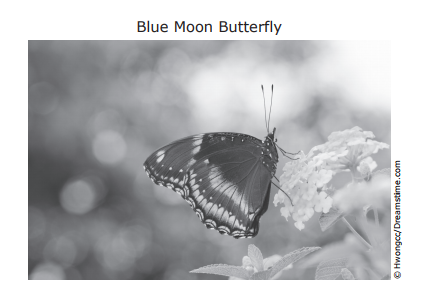
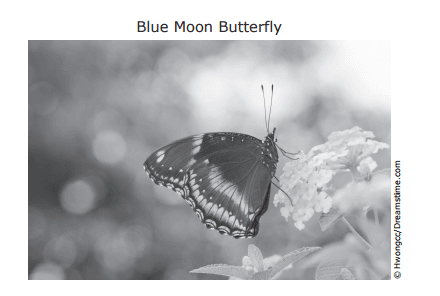
- Q2A few years ago the population of male blue moon butterflies on the island of Samoa declined. One hypothesis for the decline of the male butterflies is that a parasite infected the cells of female butterflies. The parasite was passed to offspring through the females’ eggs and killed the male butterfly embryos. At one point during the decline, nearly all the butterflies in the population were females, but after five years the number of males in the population increased significantly. Which explanation most likely accounts for the increase in the number of male butterflies in the five years after the initial parasite problem?Male butterflies in the population that survived had a gene that made them resistant to the parasite, and they passed the gene on to their offspring.Female butterflies in the population that survived had a genetic adaptation that allowed them to transform into male butterflies.Female butterflies in the population that survived were able to protect the male eggs from the parasite and provide extra care for the male offspring.Male butterflies in the population that survived were able to prey on the parasites living in the females’ egg cells.60s7.11c
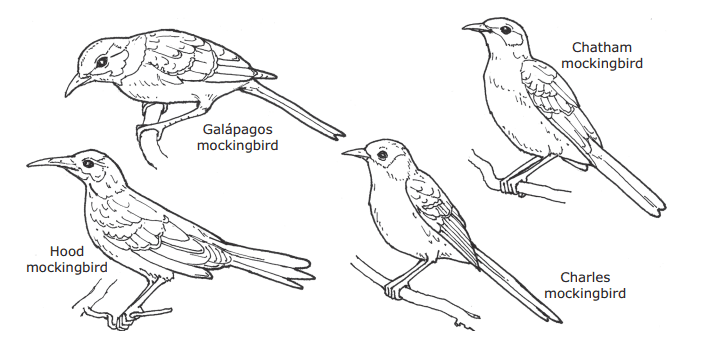
- Q3When Charles Darwin visited the Galápagos Islands in the 1800s, he observed many types of organisms that were similar but lived on different islands. The four species of mockingbirds found on the Galápagos Islands are shown below. Each species lives on a different island. These species are very similar, but the Hood mockingbird has a longer beak than the other three species. Which of the following best explains this difference?The Hood mockingbird’s longer beak is an adaptation to the food available in the bird’shabitat.The Hood mockingbird needs a longer beak for defense against predators.The Hood mockingbird’s beak stretched to reach its food, and the longer beak was passed down to its offspring.The Hood mockingbird originated from a different type of bird than the other species.60s7.11c
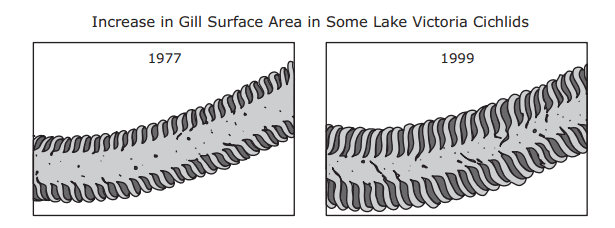
- Q4Lake Victoria in East Africa is home to many species of fish called cichlids. In 1954 the predatory Nile perch was introduced to Lake Victoria. The Nile perch became the dominant fish species in the lake by the mid-1980s. The number of cichlid species in the lake decreased as the Nile perch population increased. The perch preyed heavily on cichlid species that fed on algae and debris on the bottom of the lake. Algae in the lake increased, and oxygen levels decreased. The surface area of the gills of some cichlid species has increased in just over 20 years. Which statement explains the increase in gill surface area seen in some of Lake Victoria’s cichlids?Increased gill surface area has allowed the cichlids to change their diet and avoid competing with the Nile perch.Increased gill surface area has allowed the cichlids to be camouflaged and avoid being eaten by the Nile perch.Increased gill surface area has allowed the cichlids to better absorb the limited oxygen in the water.Increased gill surface area has allowed the cichlids to leave Lake Victoria and establish populations in nearby bodies of water.60s7.11c
- Q5Wheat was one of the first plant crops that humans domesticated. In the process of domestication, the wild form of wheat was eventually changed into a form more suited to human agricultural practice. Early farmers most likely used seeds only from wheat plants with —thinner stems that could endure heavy windslarger grains that could produce more food per plantlarger flowers that could be sold for additional incometaller stems that could block sunlight from weeds growing at ground level60s7.11c