Loading...


Telling Time on an Analog Clock
Quiz by Michael Stephens
Customize this quiz to suit your class
Instantly translate to 100+ languages
Tag the questions with any skills you have. Your dashboard will track each student's mastery of each skill.
Give this quiz to my class
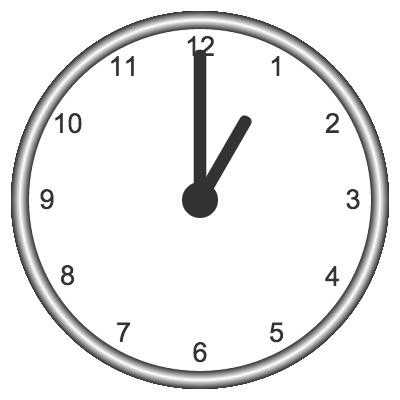
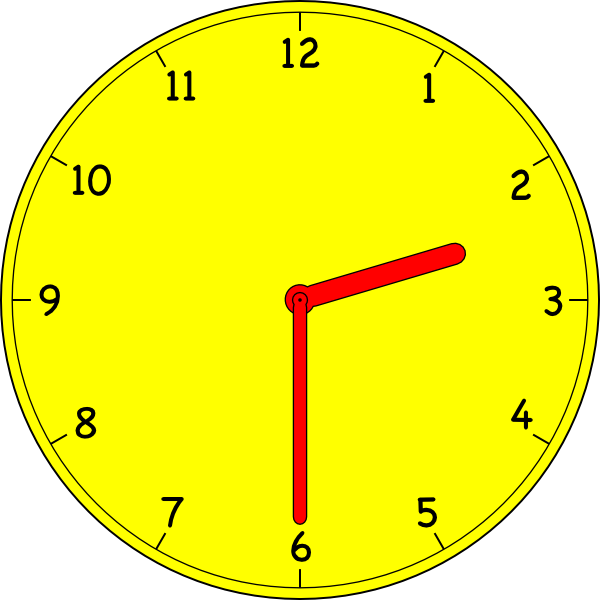
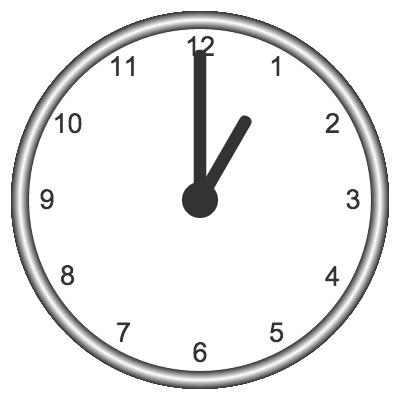
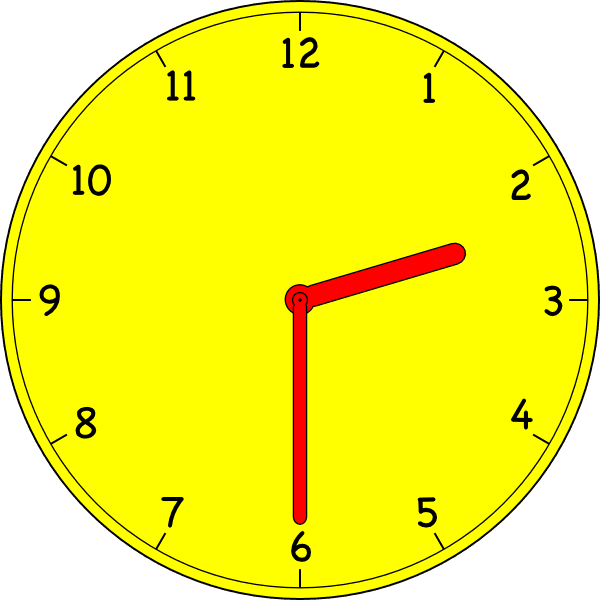
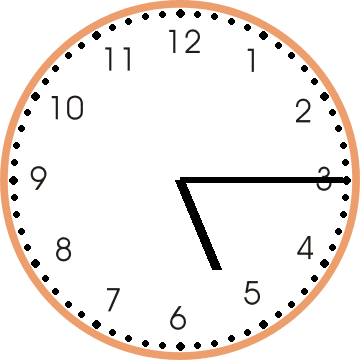
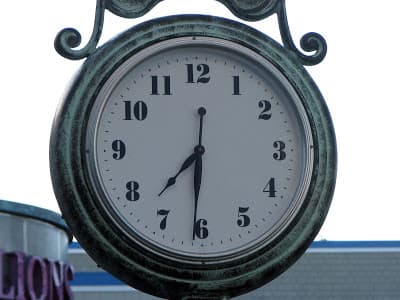




 Time-Telling Quiz: Half Past the Hour Name: ______________________ Date: ______________ What does "half past" specifically mean on an analog clock? A) 15 minutes have passed B) 30 minutes have passed C) 45 minutes have passed D) The hour has just begun When the minute hand points to 6, what position represents "half past"? A) The start of the hour B) Exactly halfway through the hour C) The end of the hour D) A quarter of the way through the hour If the hour hand is between 4 and 5, and the minute hand is on 6, what time is it? A) 4:15 B) 4:45 C) 4:30 D) 5:00 Which statement best describes how the hour hand moves? A) It moves quickly between numbers B) It moves slowly between numbers C) It stays in one place all the time D) It moves only at the top of each hour How many minutes are in a complete circle on a clock? A) 12 minutes B) 24 minutes C) 60 minutes D) 30 minutes When reading an analog clock for "half past", which hand should you look at first? A) The hour hand B) The second hand C) The minute hand D) The decorative hand What is the most important position of the minute hand when identifying "half past"? A) Pointing to 3 B) Pointing to 12 C) Pointing to 6 D) Pointing to 9 If a clock shows half past 7, how would this be written numerically? A) 7:15 B) 7:45 C) 7:30 D) 8:00 Which of the following is TRUE about clock hands? A) The shorter hand always shows minutes B) The longer hand always shows hours C) The longer hand shows minutes, the shorter hand shows hours D) Both hands move at exactly the same speed What is the primary challenge when learning to read "half past" times? A) Remembering the minute hand must be on 6 B) Counting all the numbers on the clock C) Understanding what an hour is D) Knowing the difference between AM and PM Answer Key: B B C B C C C C C ATelling the time on an analogue clockCreate multiple choice questions using the following information: In November, Mrs. Baker has Holling read The Tempest. Despite his preconceptions, Holling is captivated by all the "good stuff" in the play, especially the cussing, which he decides to learn by heart. He figures that Mrs. Baker could not have read the play herself; if she had, she certainly would not have let him have it. Holling is amazed when he discovers that his teacher not only has read the play, but she knows the bad parts as well. Mrs. Baker gives Holling a one-hundred-and-fifty question test on The Tempest, and assigns him to read the play again, telling him "there is a lot more to (it) than a list of colorful curses." The deadline set by Holling's classmates for him to bring them cream puffs arrives, but although Holling's father's company has won the Baker's Sporting Emporium contract, he refuses to extend an advance on his son's allowance. Desperate, Holling goes to Goldman's Best Bakery, offering to work for the money he lacks to buy the cream puffs. Coincidentally, Mr. Goldman, who is active in Long Island's Shakespeare Company, needs a boy to perform in their upcoming Extravaganza, and because of his work with Mrs. Baker, Holling fits the bill. Mr. Goldman gives Holling the required number of cream puffs in exchange, but sadly, while the students are at recess, Caliban and Sycorax, the escaped rats who inhabit the classroom walls and ceiling, come out and decimate the treats. Somehow, the disaster is blamed on Holling; he must clean up the mess, and his classmates decree that he still owes them cream puffs. The next Wednesday, Holling brings five cream puffs to school, which is all he can afford. In addition to facing his classmates' ire, he has to deal with the fact that, in the Shakespeare Company Holiday Extravaganza, he must play the part of Ariel, who is a fairy, and wear yellow tights with white feathers on an unmentionable part of his anatomy; "not a good thing for a boy from Camillo Junior High." To Holling's surprise, just when things are at their darkest, Mrs. Baker comes through for him, bringing cream puffs for the students on his behalf. That afternoon, Mrs. Baker and Holling discuss The Tempest, and whether or not Caliban, the "monster," deserves a happy ending. Holling argues that, as the antagonist, he does not, but Mrs. Baker muses whether Shakespeare might have shown, even in a monster, the capacity of humankind to use defeat to grow. Mrs. Bigio stumbles into the classroom at this point, emitting sounds of indescribable sadness; she has just learned that her husband has been killed in a futile reconnaissance mission in Vietnam. Two nights after his funeral, the Catholic Relief Agency, which houses Vietnamese refugees, including Holling's classmate Mai Thi, is the target of a hate crime. Holling reflects that Shakespeare, with his happy endings for nearly everyone in The Tempest, is wrong. He says, "sometimes, there isn't a Prospero to make everything fine...and...the quality of mercy is strained." In December, Camillo Junior High is awash in "signs of the season." Mrs. Baker, however, does not share the holiday spirit, but Holling is too absorbed with his problems with the Shakespeare Holiday Extravaganza to wonder why. As always, Holling seeks help from his family, but to no avail; his mother comments insipidly that his embarrassing costume is cute, his father tells him to wear it to please Mr. Goldman, who might one day need an architect, and his sister warns him that if news of his role gets to the high school, no one better find out they are related. The only thing that prevents December from being a total disaster is Mrs. Baker's announcement that Mickey Mantle will be signing autographs at the Baker Sporting Emporium. Unfortunately, Mrs. Baker also tells the class about Holling and the Shakespeare Extravaganza, and encourages the students to attend both events. Holling's classmates are intensely curious about his role as Ariel, whom he euphemistically describes as "a warrior." Mr. Goldman tells Mrs. Baker that Holling needs "some practice on interpretation", and she practices with him, playing the part of Prospero. Mrs. Baker is a terrific reader, and when she and Holling rehearse the part where Prospero releases Ariel from bondage, Holling is inspired, realizing what it means to be free "to create his own happy ending." On the night of the performance, Mrs. Baker, Mrs. Bigio, Danny Hupfer and his parents, Meryl Lee, and Mai Thi are in the audience to support Holling, unlike his own parents, who do not want to miss the Bing Crosby Christmas Special on television. Holling executes his part with such passion that his classmates are moved to tears, and do not even notice what he is wearing. When the show is over, Holling, finding the dressing room locked, rushes outside, still in costume, where his father is supposed to be waiting to take him to Baker's Sporting Emporium to see Mickey Mantle. Typically, his father is not there, and Holling, frantic, flags down a bus and begs the driver to take him to the Emporium. The driver takes pity on him and complies, getting him to the Emporium just in time, but when Holling approaches Mickey Mantle for an autograph, the famous player looks derisively at his costume and snaps rudely, "I don't sign baseballs for kids in yellow tights." Danny Hupfer witnesses this snub, and loyally returns his own autographed baseball to Mickey Mantle, saying, "I guess I don't need this after all." Holling and Danny leave together in silence, smarting because "when gods die, they die hard." During the days remaining until holiday break, Mrs. Bigio is especially cantankerous; her cafeteria cooking is unappetizing at best, and her comments to the students are impatient and unkind. Holling, remembering Mrs. Bigio's sadness when she received the news of her husband's death, does not complain, but he is bewildered at the sheer desolation he witnesses when Mrs. Bigio bitterly tells Mai Thi that she "shouldn't even be here...a queen in a refugee home while American boys are sitting in swamps on Christmas Day." After school on the last day before break, Mrs. Baker gives Holling, Danny Hupfer, and Doug Swieteck each a new baseball and mitt, and sends them to the gym, where, to their delight, they meet Joe Pepitone and Horace Clark in their Yankee uniforms, and receive tickets to Opening Day at the Stadium. Mrs. Baker's family knows what happened with Mickey Mantle, and wants to make it up to the boys. The next day, President Johnson declares a Christmas ceasefire in Vietnam, and the holiday season begins in earnest.MYTH The British helped the Jews displace the native Arab population of Palestine. FACT Herbert Samuel, a British Jew who served as the first High Commissioner of Palestine, placed restrictions on Jewish immigration “in the ‘interests of the present population’ and the ‘absorptive capacity’ of the country.”1 The influx of Jewish settlers was said to force the Arab fellahin (native peasants) from their land. This was when less than a million people lived in an area that now supports more than nine million. The British limited the absorptive capacity of Palestine when, in 1921, Colonial Secretary Winston Churchill severed nearly four-fifths of Palestine—some thirty-five thousand square miles—to create a new Arab entity, Transjordan. As a consolation prize for the Hejaz and Arabia (which are both now Saudi Arabia) going to the Saud family, Churchill rewarded Sharif Hussein’s son Abdullah for his contribution to the war against Turkey by installing him as Transjordan’s emir. The British went further and placed restrictions on Jewish land purchases in what remained of Palestine. By 1949, the British had allotted 87,500 acres of the 187,500 acres of cultivable land to Arabs and only 4,250 acres to Jews. This contradicted Article 6 of the Mandate which stated that “the Administration of Palestine…shall encourage, in cooperation with the Jewish Agency…close settlement by Jews on the land, including State lands and waste lands not acquired for public purposes.”2 Ultimately, the British admitted that the argument about the country’s absorptive capacity was specious. The Peel Commission said, “The heavy immigration in the years 1933–36 would seem to show that the Jews have been able to enlarge the absorptive capacity of the country for Jews.”3 MYTH The British allowed Jews to flood Palestine while Arab immigration was tightly controlled. FACT The British response to Jewish immigration set a precedent of appeasing the Arabs, which was followed for the duration of the Mandate. The British restricted Jewish immigration while allowing Arabs to enter the country freely. Apparently, London did not feel that a flood of Arab immigrants would affect the country’s “absorptive capacity.” During World War I, the Jewish population in Palestine declined because of the war, famine, disease, and expulsion by the Turks. In 1915, approximately 83,000 Jews lived in Palestine among 590,000 Muslim and Christian Arabs. According to the 1922 census, the Jewish population was 83,000, while the Arabs numbered 643,000.4 Thus, the Arab population grew exponentially while that of the Jews stagnated. In the mid-1920s, Jewish immigration to Palestine increased primarily because of anti-Jewish economic legislation in Poland and Washington’s imposition of restrictive quotas.5 The record number of immigrants in 1935 (see table) was a response to the growing persecution of Jews in Nazi Germany. The British administration considered this number too large, however, so the Jewish Agency was informed that less than one-third of the quota it asked for would be approved in 1936.6 The British gave in further to Arab demands by announcing in the 1939 White Paper that an independent Arab state would be created within ten years and that Jewish immigration was to be limited to 75,000 for the next five years, after which it was to cease altogether. It also forbade land sales to Jews in 95% of the territory of Palestine. The Arabs, nevertheless, rejected the proposal. Jewish Immigration to Palestine7 1919 1,806 1931 4,075 1920 8,223 1932 12,533 1921 8,294 1933 37,337 1922 8,685 1934 45,267 1923 8,175 1935 66,472 1924 13,892 1936 29,595 1925 34,386 1937 10,629 1926 13,855 1938 14,675 1927 3,034 1939 31,195 1928 2,178 1940 10,643 1929 5,249 1941 4,592 1930 4,944 By contrast, throughout the Mandatory period, Arab immigration was unrestricted. In 1930, the Hope Simpson Commission, sent from London to investigate the 1929 Arab riots, said the British practice of ignoring the uncontrolled illegal Arab immigration from Egypt, Transjordan, and Syria had the effect of displacing the prospective Jewish immigrants.8 The British governor of the Sinai from 1922 to 1936 observed, “This illegal immigration was not only going on from the Sinai, but also from Transjordan and Syria, and it is very difficult to make a case out for the misery of the Arabs if at the same time their compatriots from adjoining states could not be kept from going in to share that misery.”9 The Peel Commission reported in 1937 that the “shortfall of land is…due less to the amount of land acquired by Jews than to the increase in the Arab population.”10 MYTH The British changed their policy to allow Holocaust survivors to settle in Palestine. FACT The gates of Palestine remained closed for the duration of the war, stranding hundreds of thousands of Jews in Europe, many of whom became victims of Hitler’s “Final Solution.” After the war, the British refused to allow the survivors of the Nazi nightmare to find sanctuary in Palestine. On June 6, 1946, President Truman urged the British government to relieve the suffering of the Jews confined to displaced persons camps in Europe by immediately accepting 100,000 Jewish immigrants. Britain’s foreign minister Ernest Bevin replied sarcastically that the United States wanted displaced Jews to immigrate to Palestine “because they did not want too many of them in New York.”11 Some Jews reached Palestine, many smuggled in on dilapidated ships organized by the Haganah. Between August 1945 and the establishment of the State of Israel in May 1948, sixty-five “illegal” immigrant ships, carrying 69,878 people, arrived from European shores. In August 1946, however, the British began to intern those they caught in camps on Cyprus. Approximately 50,000 people were detained in the camps, and 28,000 remained imprisoned when Israel declared independence.12 MYTH As the Jewish population grew, the plight of the Palestinian Arabs worsened. FACT In July 1921, Hasan Shukri, the mayor of Haifa and president of the Muslim National Associations, sent a telegram to the British government in reaction to a delegation of Palestinians that went to London to try to stop the implementation of the Balfour Declaration. Shukri wrote: We are certain that without Jewish immigration and financial assistance there will be no future development of our country as may be judged from the fact that the towns inhabited in part by Jews such as Jerusalem, Jaffa, Haifa, and Tiberias are making steady progress while Nablus, Acre, and Nazareth where no Jews reside are steadily declining.13 The Jewish population increased by 470,000 between World War I and World War II, while the non-Jewish population rose by 588,000.14 The permanent Arab population increased by 120% between 1922 and 1947.15 This rapid growth of the Arab population was a result of several factors. One was immigration from neighboring states—constituting 37% of the total immigration to pre-state Israel—by Arabs who wanted to take advantage of the higher standard of living the Jews had made possible.16 The Arab population also grew because of the improved living conditions created by the Jews as they drained malarial swamps and brought improved sanitation and health care to the region. Thus, for example, the Muslim infant mortality rate fell from 201 per thousand in 1925 to 94 per thousand in 1945, and life expectancy rose from 37 years in 1926 to 49 in 1943.17 The Arab population increased the most in cities where large Jewish populations had created new economic opportunities. From 1922–1947, the non-Jewish population increased by 290% in Haifa, 131% in Jerusalem, and 158% in Jaffa. The growth in Arab towns was more modest: 42% in Nablus, 78% in Jenin, and 37% in Bethlehem.18 MYTH Jews stole Arab land. FACT Despite the growth in their population, the Arabs continued to assert they were being displaced. From the beginning of World War I, however, part of Palestine’s land was owned by absentee landlords who lived in Cairo, Damascus, and Beirut. About 80% of the Palestinian Arabs were debt-ridden peasants, semi-nomads, and Bedouins.19 Jews went out of their way to avoid purchasing land in areas where Arabs might be displaced. They sought land that was largely uncultivated, swampy, cheap, and—most important—without tenants. In 1920, Labor Zionist leader David Ben-Gurion expressed his concern about the Arab fellahin, whom he viewed as “the most important asset of the native population.” He insisted that “under no circumstances must we touch land belonging to fellahs or worked by them.” Instead, he advocated helping liberate them from their oppressors. “Only if a fellah leaves his place of settlement,” Ben-Gurion added, “should we offer to buy his land, at an appropriate price.”20 Jews only began to purchase cultivated land after buying all the uncultivated territory. Many Arabs were willing to sell because of the migration to coastal towns and because they needed money to invest in the citrus industry.21 When John Hope Simpson arrived in Palestine in May 1930, he observed, “They [the Jews] paid high prices for the land and, in addition, they paid to certain of the occupants of those lands a considerable amount of money which they were not legally bound to pay.”22 In 1931, Lewis French conducted a survey of landlessness for the British government and offered new plots to any Arabs who had been “dispossessed.” British officials received more than 3,000 applications, of which 80% were ruled invalid by the government’s legal adviser because the applicants were not landless Arabs. This left only about 600 landless Arabs, 100 of whom accepted the government land offer.23 In April 1936, a new outbreak of Arab attacks on Jews was instigated by local Palestinian leaders who were later joined by Arab volunteers led by a Syrian guerrilla named Fawzi al-Qawuqji, the commander of the Arab Liberation Army. By November, when the British finally sent a new commission headed by Lord Peel to investigate, 89 Jews had been killed and more than 300 wounded.24 The Peel Commission’s report found that Arab complaints about Jewish land acquisition were baseless. It pointed out that “much of the land now carrying orange groves was sand dunes or swamp and uncultivated when it was purchased…There was at the time of the earlier sales little evidence that the owners possessed either the resources or training needed to develop the land.”25 Moreover, the Commission found the shortage was “due less to the amount of land acquired by Jews than to the increase in the Arab population.” The report concluded that the presence of Jews in Palestine, along with the work of the British administration, had resulted in higher wages, an improved standard of living, and ample employment opportunities.26 It is made quite clear to all, both by the map drawn up by the Simpson Commission and by another compiled by the Peel Commission, that the Arabs are as prodigal in selling their land as they are in useless wailing and weeping (emphasis in the original). —Transjordan’s king Abdullah27 Even at the height of the Arab revolt in 1938 (which began in April 1936 with the murder of two Jews by Arabs and the subsequent murder of two Arab workers by members of the Jewish underground28), the British high commissioner to Palestine believed the Arab landowners were complaining about sales to Jews to drive up prices for lands they wished to sell. Many Arab landowners had been so terrorized by Arab rebels they decided to leave Palestine and sell their property to the Jews.29 The Jews paid exorbitant prices to wealthy landowners for small tracts of arid land. “In 1944, Jews paid between $1,000 and $1,100 per acre in Palestine, mostly for arid or semiarid land; in the same year, rich black soil in Iowa was selling for about $110 per acre.”30 By 1947, Jewish holdings in Palestine amounted to about 463,000 acres. Approximately 45,000 were acquired from the mandatory government, 30,000 were bought from various churches, and 387,500 were purchased from Arabs. Analyses of land purchases from 1880 to 1948 show that 73% of Jewish plots were purchased from large landowners, not poor fellahin.31 Many leaders of the Arab nationalist movement, including members of the Muslim Supreme Council, and the mayors of Gaza, Jerusalem, and s sold land to the Jews. As’ad el-Shuqeiri, a Muslim religious scholar and father of Palestine Liberation Organization chairman Ahmed Shuqeiri, took Jewish money for his land. Even King Abdullah leased land to the Jews.32 MYTH The British helped the Palestinians to live peacefully with the Jews. FACT In 1921, Haj Amin el-Husseini first began to organize fedayeen (“one who sacrifices himself”) to terrorize Jews. El-Husseini hoped to duplicate the success of Kemal Atatürk in Turkey by driving the Jews out of Palestine just as Kemal had driven the invading Greeks from his country.33 Arab radicals gained influence because the British administration was unwilling to take effective action against them until they began a revolt against British rule. Colonel Richard Meinertzhagen, former head of British military intelligence in Cairo, and later chief political officer for Palestine and Syria, wrote in his diary that British officials “incline towards the exclusion of Zionism in Palestine.” The British encouraged the Palestinians to attack the Jews. According to Meinertzhagen, Col. Bertie Harry Waters-Taylor (financial adviser to the military administration in Palestine 1919–23) met with el-Husseini in 1920, a few days before Easter, and told him that “he had a great opportunity at Easter to show the world…that Zionism was unpopular not only with the Palestine administration but in Whitehall.” He added that “if disturbances of sufficient violence occurred in Jerusalem at Easter, both General [Louis] Bols [chief administrator in Palestine, 1919–20] and General [Edmund] Allenby [commander of the Egyptian force, 1917–19, then high commissioner of Egypt] would advocate the abandonment of the Jewish Home. Waters-Taylor explained that freedom could only be attained through violence.”34 El-Husseini took the colonel’s advice and instigated a riot. The British withdrew their troops and the Jewish police from Jerusalem, allowing the Arab mob to attack Jews and loot their shops. Because of el-Husseini’s overt role in instigating the pogrom, the British decided to arrest him. He escaped, however, and was sentenced to ten years in absentia. A year later, some British Arabists convinced High Commissioner Herbert Samuel to pardon el-Husseini and to appoint him Mufti (a cleric in charge of Jerusalem’s Islamic holy places). By contrast, Vladimir Jabotinsky and several followers, who had formed a Jewish defense organization during the unrest, were sentenced to 15 years. They were released a few months later.35 Samuel met with el-Husseini on April 11, 1921, and was assured “that the influences of his family and himself would be devoted to tranquility.” Three weeks later, riots in Jaffa and elsewhere left forty-three Jews dead.36 El-Husseini consolidated his power and took control of all Muslim religious funds in Palestine. He used his authority to gain control over the mosques, the schools, and the courts. No Arab could reach an influential position without being loyal to the Mufti. His power was so absolute that “no Muslim in Palestine could be born or die without being beholden to Haj Amin.”37 The Mufti’s henchmen also ensured he would have no opposition by systematically killing Palestinians who discussed cooperation with the Jews from rival clans. As the spokesman for Palestinian Arabs, el-Husseini did not ask that Britain grant them independence. On the contrary, in a letter to Churchill in 1921, he demanded that Palestine be reunited with Syria and Transjordan.38 The Arabs found rioting an effective political tool because of the lax British response toward violence against Jews. In handling each riot, the British prevented Jews from protecting themselves but made little effort to prevent the Arabs from attacking them. After each outbreak, a British commission of inquiry would try to establish the cause of the violence. The conclusion was always the same: The Arabs feared being displaced by the Jews. To stop the rioting, the commissions would recommend that restrictions be placed on Jewish immigration. Thus, the Arabs learned they could always stop the influx of Jews by staging riots. This cycle began after a series of riots in May 1921. After failing to protect the Jewish community from Arab mobs, the British appointed the Haycraft Commission to investigate the cause of the violence. Although the panel concluded the Arabs had been the aggressors, it rationalized the cause of the attack: “The fundamental cause of the riots was a feeling among the Arabs of discontent with, and hostility to, the Jews, due to political and economic causes, and connected with Jewish immigration, and with their conception of Zionist policy.”39 One consequence of the violence was the institution of a temporary ban on Jewish immigration. The Arab fear of being “displaced” or “dominated” was an excuse for their attacks on Jewish settlers. Note, too, that these riots were not inspired by nationalistic fervor—nationalists would have rebelled against their British overlords—they were motivated by economics, the radical Islamic views of the Mufti, and misunderstanding. In 1929, Arab provocateurs convinced the masses that the Jews had designs on the Temple Mount (a tactic still used today to incite violence). A Jewish religious observance at the Western Wall, which forms a part of the Temple Mount, served as a pretext for rioting by Arabs against Jews, which spilled out of Jerusalem into other villages and towns, including Safed and Hebron. Again, the British administration made no effort to prevent the violence, and, after it began, the British did nothing to protect the Jewish population. After six days of mayhem, the British finally brought troops in to quell the disturbance. By this time, most of Hebron’s Jews had fled or been killed. In all, 133 Jews were killed and 399 wounded in the pogroms.40 After the riots, the British ordered an investigation, resulting in the Passfield White Paper. It said the “immigration, land purchase and settlement policies of the Zionist Organization were already or were likely to become, prejudicial to Arab interests. It understood the mandatory government’s obligation to the non-Jewish community to mean that Palestine’s resources must be primarily reserved for the growing Arab economy.”41 This meant it was necessary to restrict Jewish immigration and land purchases. MYTH The Mufti was not a Nazi collaborator. FACT In 1941, Haj Amin al-Husseini, the Mufti of Jerusalem, fled to Germany and met with Adolf Hitler, Heinrich Himmler, Joachim Von Ribbentrop, and other Nazi leaders. He wanted to persuade them to extend the Nazis’ anti-Jewish program to the Arab world. The Mufti sent Hitler fifteen drafts of declarations he wanted Germany and Italy to make concerning the Middle East. One called on the two countries to declare the illegality of the Jewish home in Palestine. He also asked the Axis powers to “accord to Palestine and to other Arab countries the right to solve the problem of the Jewish elements in Palestine and other Arab countries in accordance with the interest of the Arabs, and by the same method that the question is now being settled in the Axis countries.”42 In November 1941, the Mufti met with Hitler, who told him the Jews were his foremost enemy. The Nazi dictator rebuffed the Mufti’s requests for a declaration in support of the Arabs, however, telling him the time was not right. The Mufti offered Hitler his “thanks for the sympathy which he had always shown for the Arab and especially Palestinian cause, and to which he had given clear expression in his public speeches.” He added, “The Arabs were Germany’s natural friends because they had the same enemies as had Germany, namely…the Jews.” Hitler told the Mufti he opposed the creation of a Jewish state and that Germany’s objective was destroying the Jewish element in the Arab sphere.43 In 1945, Yugoslavia sought to indict the Mufti as a war criminal for his role in recruiting twenty thousand Muslim volunteers for the SS, who participated in the killing of Jews in Croatia and Hungary. He escaped French detention in 1946, however, and continued his fight against the Jews from Cairo and later Beirut where he died in 1974. MYTH The bombing of the King David Hotel was part of a deliberate terror campaign against civilians. FACT British troops seized the Jewish Agency compound on June 29, 1946, and confiscated large quantities of documents. At about the same time, more than 2,500 Jews from all over Palestine were arrested. A week later, news of a massacre of 40 Jews in a pogrom in Poland reminded the Jews of Palestine how Britain’s restrictive immigration policy had condemned thousands to death. In response to the British provocations, and a desire to demonstrate that the Jews’ spirit could not be broken, the United Resistance Movement planned to bomb the King David Hotel, which housed the British military command and the Criminal Investigation Division in addition to hotel guests. The Haganah pulled out of the plot and left it up to the Irgun. Irgun leader Menachem Begin stressed his desire to avoid civilian casualties and the plan was to warn the British so they would evacuate the building before it was blown up. Three telephone calls were placed on July 22, 1946, one to the hotel, another to the French Consulate, and a third to the Palestine Post warning that explosives in the King David Hotel would soon be detonated. The call to the hotel was received and ignored. Begin quotes one British official who supposedly refused to evacuate the building, saying, “We don’t take orders from the Jews.”44 As a result, when the bombs exploded, the casualty toll was high: 91 killed and 45 injured. Among the casualties were 15 Jews. Few people in the main part of the hotel were injured.45 For decades, the British denied they had been warned. In 1979, however, a member of the British Parliament provided the testimony of a British officer who heard other officers in the King David Hotel bar joking about a Zionist threat to the headquarters. The officer who overheard the conversation immediately left the hotel and survived.46 In contrast to Arab attacks against Jews, which Arab leaders hailed as heroic actions, the Jewish National Council denounced the bombing of the King David.47 1 Aharon Cohen, Israel and the Arab World, (NY: Funk and Wagnalls, 1970), p. 172ANN: Look, Gary! That policeman's waving to you. He wants you to stop. POLICEMAN: Where do you think you are? On a race track? You must have been driving at seventy miles an hour. GARY: I can't have been. POLICEMAN: I was doing eighty when I overtook you. POLICEMAN: Didn't you see the speed limit? GARY: I'm afraid I didn't, officer. I must have been dreaming. ANN: He wasn't dreaming, officer. I was telling him to drive slowly. GARY: That's why I didn't see the sign. POLICEMAN: Let me see your driving licence. POLICEMAN: I won't charge you this time. But you'd better not do it again! GARY: Thank you. I'll certainly be more careful. ANN: I told you to drive slowly, Gary. GARY: You always tell me to drive slowly, darling. ANN: Well, next time you'd better take my advice!Nowadays, millions of us are turning to chatbots for emotional support. But can AI ever be capable of empathy? What about the consequences of people seeking emotional support from machines that can only pretend to care? Can the rise of so-called empathetic AI change the way we understand empathy and interact with one another? The researchers found that the empathiser must first be able to perceive how the other person is feeling. They must also be affected by those emotions, feel them to some degree themselves, and differentiate between themselves and the other person. On the first point, in recent years, AI-powered chatbots have made progress in their ability to read human emotions. Most chatbots are powered by large language models (LLMs) that work by predicting which words are most likely to appear together based on training data. In this way, LLMs like ChatGPT can seemingly identify our feelings and respond appropriately most of the time. But when it comes to the other criteria, AI still misses the mark in many ways. Empathy is interpersonal, with continued cues and feedback helping to strengthen the empathiser’s response. It also requires some degree of intuitive awareness of an individual and their situation. Consider someone who cries while telling a doctor she is pregnant. If we know her history of trying for years to be pregnant, we can imagine that her tears mean something different than, say, if she didn’t want to have kids. Current AIs are incapable of understanding that kind of slight difference in emotion . The big question is whether AI can truly feel human emotions. Some think AIs might one day share our feelings. One approach is to continue enlarging LLMs with ever vaster and more diverse data and integrate multimodal data like facial expressions and voice. By doing this, AI may develop emotional capabilities. Currently, simple versions of these emotion-reading robots already exist. Yet, some scholars argue that you can’t really know what sadness is unless you have felt sad. “You need to have emotions to experience empathy,” says psychologist Michael Inzlicht at the University of Toronto in Canada. Genuine empathy emerges from social interactions and recognizing other minds - a complete phenomenon requiring consciousness , something AI lacks now and likely always will.SPANISH STUDENTS 10/22/25 In the sentence 'The author chose to juxtapose the wealthy neighborhood with the impoverished area to highlight social inequality,' what does 'juxtapose' most likely mean based on context clues? * 1 point to separate completely to describe in detail to criticize harshly to place side by side for comparison When reading 'This paradox confused everyone: the more he tried to save time, the less time he seemed to have,' what can you infer about a paradox? * 1 point a mathematical equation a simple solution a type of poem a contradictory statement that reveals truth The passage states: 'The author's use of symbolism was evident when the broken mirror represented the character's shattered dreams.' Based on this context, symbolism involves: * 1 point using objects to represent deeper meanings creating rhyming patterns writing in chronological order using literal descriptions only In the text 'Please elaborate on your answer by providing specific examples and detailed explanations,' the word 'elaborate' suggests the need to: * 1 point use simpler words change the topic add more detail make it shorter The critic wrote: 'The actor's performance captured every nuance of emotion, from subtle sadness to barely contained rage.' What does 'nuance' refer to in this context? * 1 point subtle variations in meaning simple emotions loud expressions obvious differences When the text says 'The implication of her silence was clear to everyone in the room, though she never spoke a word,' what does 'implication' mean? * 1 point a command given a direct statement a question asked a conclusion drawn indirectly The scientist stated: 'Based on our limited observations, our hypothesis suggests that plants grow faster with classical music.' What is a hypothesis? * 1 point a type of experiment a proven fact a final conclusion a possible explanation needing more evidence In 'Three witnesses were able to corroborate the defendant's alibi, strengthening his case significantly,' the word 'corroborate' most likely means: * 1 point to question or doubt to confirm or support to change the story to ignore completely The passage reads: 'The student needed to justify her controversial thesis with solid evidence and logical reasoning.' What does 'justify' mean here? * 1 point to make it longer to make excuses for to avoid explaining to prove something is reasonable When the text states 'The researcher was able to synthesize information from five different studies to create a comprehensive theory,' what does 'synthesize' involve? * 1 point copying one source exactly combining multiple sources to create something new rejecting all previous research focusing on only one idea When a reader encounters 'The symbolism in the novel was complex, with the recurring image of doors representing new opportunities throughout the story,' they should: * 1 point memorize all symbols skip symbolic passages look for deeper representational meanings focus only on the literal meaning If a teacher says 'Your essay needs more elaboration - expand on your main points with examples and analysis,' what critical thinking skill is being requested? * 1 point developing ideas with supporting details summarizing briefly using fewer examples changing the topic entirely In the passage 'The dark clouds gathering on the horizon seemed to foreshadow the troubles that would soon befall the village,' what literary technique is being demonstrated? * 1 point The author is using environmental details to hint at future plot developments The author is focusing on realistic weather descriptions The author is using weather to predict actual meteorological events The author is describing a coincidental weather pattern When analyzing 'Sarah knew the antagonist in her favorite novel wasn't just evil—he represented the fear of change that many people experience,' what deeper understanding about antagonists is revealed? * 1 point Antagonists are always completely evil characters Antagonists can represent abstract concepts or human struggles Antagonists must be human characters Antagonists only exist to create action scenes In the sentence 'The protagonist's journey wasn't just about reaching the destination—it was about discovering who she truly was,' what does this suggest about effective protagonists? * 1 point Protagonists must always succeed in their missions Protagonists should remain unchanged throughout the story Protagonists undergo both external and internal development Protagonists should focus only on external goals When the text states 'The word 'home' carried different connotations for each character—warmth and safety for some, confinement and obligation for others,' what critical reading skill is being highlighted? * 1 point Memorizing dictionary definitions Understanding that words have only one correct meaning Identifying grammatical structures Recognizing that word meanings can vary based on personal experience In 'While the denotation of 'snake' is simply a reptile, the author's use of it to describe the character suggests something far more sinister,' what analytical skill is required? * 1 point Understanding reptile biology Memorizing animal classifications Distinguishing between literal and figurative meanings Identifying sentence structure When examining 'The author's tone shifted from hopeful in the opening chapters to increasingly cynical as the story progressed,' what does this reveal about sophisticated writing? * 1 point Tone is unimportant in storytelling Tone changes reflect the author's developing attitude toward the subject Only the ending tone matters Authors should maintain the same tone throughout In analyzing 'The theme of the novel wasn't stated directly but emerged through the characters' repeated struggles with moral choices,' what does this demonstrate about themes? * 1 point Themes develop through patterns in the narrative Themes are only found in the conclusion Themes should always be explicitly stated Themes must be simple moral lessons When the passage reads 'From the character's nervous glances and hesitant speech, readers can infer that she's hiding something important,' what critical thinking process is being described? * 1 point Following explicit plot statements Memorizing character descriptions Making random guesses about character motivations Using textual evidence to draw logical conclusions In 'The ending was deliberately ambiguous, allowing readers to decide whether the character's actions were heroic or selfish,' what does this suggest about sophisticated literature? * 1 point Good stories always have clear, definitive endings Unclear endings indicate poor writing Ambiguity can enhance reader engagement and interpretation Authors should avoid confusing readers When analyzing 'The controversial decision to ban the book sparked debates about censorship versus protecting young readers,' what critical thinking skill is most important? * 1 point Choosing one side immediately Examining multiple perspectives before forming an opinion Avoiding difficult topics entirely Following popular opinion In 'Each character's perspective on the same event revealed how personal experiences shape our understanding of truth,' what deeper concept is being explored? * 1 point All perspectives are equally valid Perspective is unimportant in understanding events There is only one correct way to view any situation Personal background influences how we interpret events When the text states 'The community proved resilient, rebuilding not just their homes but their hope after the disaster,' what does this reveal about the concept of resilience? * 1 point Resilience encompasses both practical and emotional recovery Resilience is an innate trait that cannot be developed Resilience means avoiding all difficulties Resilience only involves physical recovery In analyzing 'The author's portrayal of the character's empathy—her ability to understand her enemy's pain even while fighting him—added complexity to the conflict,' what does this suggest about empathy? * 1 point Empathy means agreeing with everyone Empathy makes people weak in conflicts Empathy should be avoided in difficult situations Empathy can coexist with opposition and create moral complexity When examining 'The character's integrity was tested when telling the truth would hurt people she loved,' what does this reveal about integrity? * 1 point Integrity means always following rules regardless of consequences Integrity means never causing any harm to others Integrity is only important in public situations Integrity involves making difficult moral choices even when costly In 'The student learned to advocate for her ideas by presenting evidence rather than just stating opinions,' what critical skill is being developed? * 1 point Supporting positions with logical reasoning and evidence Avoiding controversial topics entirely Learning to argue loudly and persistently Always agreeing with authority figures If you rewrote a scene from 'The Birchbark House' from Omakayas's grandmother's first-person perspective instead of Omakayas's, how would this most likely change the reader's understanding? * 1 point Nothing would change since they're both female characters The language would become more formal and difficult The story would become less interesting because adults are boring Readers would gain wisdom from experience but lose the innocence of childhood discovery In a plot diagram, the rising action serves which critical purpose beyond simply building toward the climax? * 1 point To provide background information about the setting To confuse readers so the ending is surprising To develop character relationships and establish stakes that make the climax meaningful To make the story longer and more detailed When analyzing the falling action in 'The Birchbark House,' which element would be most important to consider when writing an alternate version? * 1 point Whether the consequences of the climax align with the new direction you want the story to take Making sure it's shorter than the rising action Including a moral lesson for readers How quickly the conflicts get resolved In the exposition of a story, conflict serves which essential function that many readers don't realize? * 1 point To immediately grab attention with action scenes To provide comic relief before serious events To show off the author's writing skills To establish what the characters characterization/personality, which determines what they' must learn to overcome as they face more problemsHere is a transcript of a video about Narrative Writing. Generate 25 questions. Intro to Narrative Writing What is Narrative Writing? You today, I want to introduce you to the basics of narrative writing. Narrative writing is writing that tells a story. It can be real or imagined, that is, nonfiction or fiction. It has a beginning, middle, and end. That is, it includes the basic elements of a plot exposition, rising action, conflict, climax, falling action, and resolution. And it's full of interesting details. The author's purpose in writing a narrative is to entertain the reader. There are three main types of narrative writing. The first is a personal narrative when a writer shares a true story from his or her own life. We could also say this type of narrative is autobiographical. The second type of narrative is biographical when a writer shares a true story from another person's life. The third type of narrative is fictional. When a writer tells an invented story, short stories, and novels are fictional narratives. The Process of Writing a Narrative While we could add to this list, there are five important parts of a narrative that I especially want you to remember as you write your own narrative. These parts of a narrative include setting, characters, plot, point of view, and dialogue. The first part of a narrative is the setting , where, and when the narrative takes place. The setting affects both the plot and characters in your narrative, so it's important to spend some time brainstorming where, when, and in what conditions your story takes place. The second part of a narrative is the characters , the people, animals or creatures involved in a story. Remember that your story must have a protagonist, the character facing the problem, and an antagonist the character or force causing the problem. Take some time while planning your narrative to focus on your characters beyond the characters names and roles they play in the story. Think about whether you'd like them to be flat with very few character traits or round with many character traits. Also think about which characters in your story will remain static or unchanged, and which characters will be dynamic, undergoing an important change in your narrative. The third part of a narrative is the plot , the sequence of events in a narrative. Take some time to think carefully through your story's plot. How will it begin and how will it end? What conflicts will your characters encounter? What is the climax or turning point of your story? How will the problems be solved? Creating a storyboard or labeling a plot diagram are both good tools for planning your story's plot. The fourth part of a narrative is the point of view , which is the perspective from which a narrative is told. You can choose to write your narrative in first person, writing a personal narrative from your own point of view, or you can choose a character in a fictional narrative to tell your story. Another option is to write your narrative in the third person point of view, telling the story from the perspective of an unseen narrator that is not a character in the story. Finally, the fifth part of a narrative is dialogue. The words the characters speak in your story dialogue can establish the setting, show characterization, foreshadow events, or advance the action in a narrative. Dialogue brings your narrative to life. It's important to review how to punctuate dialogue, following grammatical rules for using quotation marks, commas, and other N marks such as periods and question marks. As you begin writing your narrative, I'll help you break down each step of the process. But hopefully this introduction gives you a basic understanding of what narrative writing is, and hopefully it sparks some ideas for you to begin planning your own narrative.