Loading...

The Constitution: Structure & Principles
Quiz by Natalie Thompson
Tag the questions with any skills you have. Your dashboard will track each student's mastery of each skill.
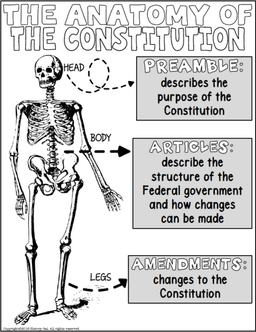
This section in the Constitution lists the 6 purposes/goals of government
This section of the Constitution sets up the structure of our government into 3 branches and how to amend (change) the Constitution.
These are changes and additions to the Constitution; includes the Bill of Rights
These are the first ten amendments to the Constitution.
"We the People of the United States of America, in order to form a more perfect union, establish justice, ensure domestic tranquility(EEEEE), provide for the common defense, promote the general welfare, ah-hand, secure the blessing of liberty to ourselves and our posterity do ordain and establish THIS Constitution for the United States of America. What did you just sing in your head?
Which principle of American government is best reflected in the phrase "WE THE PEOPLE"?
Article I describes the Legislative Branch; Article II describes the Executive Branch, Article III describes the Judicial Branch; Article IV describes how states interact with other states and the national government (federalism); Article V gives directions on how to change the Constitution; Article 6 includes the Supremacy Clause; Article 7 explains how to ratify the Constitution.
As stated in Article 5 of the Constitution, 2/3 of Congress must approve the proposal of a new amendment; 3/4 of the 50 state legislatures must ratify for it to be added to the Constitution
Article I of the Constitution creates this branch of government that include Congress, which makes the laws at the U.S. Capitol in Washington D.C.
Article 2 of the Constitution creates this branch of government which is the BIGGEST of all the branches today. It includes the president, vice president, cabinet, military and all the departments and agencies. Together they execute/carry out the laws made by the legislative branch.
Article 3 of the Constitution creates this branch, which includes the U.S. Supreme Court and lower federal courts. Together they interpret the laws.
Made up of the House of Representatives (435 members) and the Senate (100 members). All are elected by popular vote.
Article 1 of the Constitution gives _______ the power to declare war, coin money, approve appointments and treaties made by the president, make laws, and impeach elected federal officials.
Must be at least 25 years old to be elected, be a citizen for at least 7 years, elected to a 2-year term. Who am I describing?
Must be at least 30 years old to be elected, at least 9 years a US citizen, elected to a 6-year term. Who am I describing?
Article 2 of the Constitution says the ______ must be at least 35 years old to be elected, must be born in the U.S. (by must have lived at least 14 years on U.S. territory), serves a 4-year term, and is elected by the Electoral College.
Powers include: commander in chief, chief diplomat, veto laws made by Congress
There is no age requirement mentioned in the Constitution; appointed by the President and approved by the Senate; may serve a life term. Who is this describing?
This term means refers to a law or action that is not permitted by the Constitution.
This phrase is found in Article VI (6) of the Constitution, which makes the Constitution, national laws, and treaties superior over state and local laws.
This French political philosopher had the idea of the separation of powers between the 3 branches of government.
Who demanded a Bill of Rights be added to the Constitution?
Which phrase in the Constitution means the job of government is to ensure peace inside the USA?
Which Article of the Constitution establishes the executive branch?
Which group of people meets at the Capitol Building in Washington DC?
How much of Congress is needed to override a presidential veto?
This amendment to the U.S. Constitution can be found in the Bill of Rights and gives states its reserved powers?
