Loading...


The Earth's Surface - Continents
Quiz by Sulaihiyah Ali
Customize this quiz to suit your class
Instantly translate to 100+ languages
Tag the questions with any skills you have. Your dashboard will track each student's mastery of each skill.


Give this quiz to my class
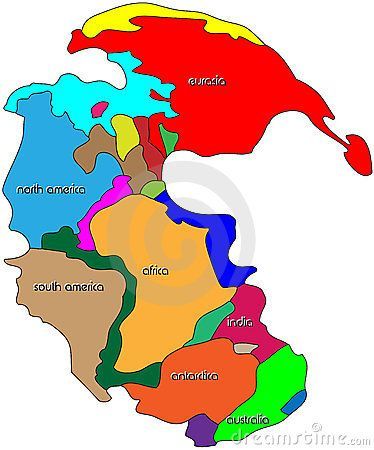
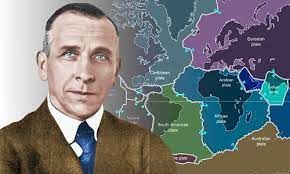
 Continental Drift Theory. From the discussion of the rock cycle, it has been pointed out that through Earth's external and internal processes. Earth's surface is constantly changing. However, this idea of a changing environment did not conform with the belief of earlier scientists. Rather, they thought that the geographic positions of ocean basins and continents have been static since the beginning of time. It was around the 1500s when Leonardo da Vinci, upon his discovery of fossil seashells found at the high mountains of Italy, first thought of the idea that the areas where mountains are located may have been oceans in the past. Through time, other fossils of marine organisms found far above the current sea level further supported the idea that mountains were uplifted and weathering wore them down. At around the 1800s, most scientists have accepted the idea that Earth's crust is undergoing large vertical movements or uplifting. There was also evidence of possible horizontal movements, but the scientists then were not convinced about it. Alfred Wegener showed evidence of horizontal or lateral movement of the continents in his continental drift theory. According to him, the continents have drifted around the world and have once formed a giant landmass or supercontinent called Pangaea. To support his theory, Alfred Wegener presented a set of geographical, biological, and climatic evidence.Wegener's geographical evidence included the jigsaw puzzle fit of the current continents. He pointed out that the coastlines of South America and Africa seem to fit together. He also pointed the presence of mountain ranges having similar rock types and age but separated by vast oceans, like that of the folded rocks of the Caledonian mountains. The same folded rocks run through West Africa, North America, Newfoundland, Ireland, Wales, Scotland, Greenland, and Norway, all of which are now separated by the Atlantic Ocean. A geographical evidence on the similar rock types in West Africa, North America, Greenland, and Europe is found. The biological evidence came in the discovery of similar plant and animal fossils in different continents separated by oceans. The animal fossils of Mesosaurus and Lystrosaurus indicate that they were not capable of crossing the oceans to reach the other continents. If they were, the fossils should have been more widely distributed Africa, Australia, India, and South America were too large to be carried by wind. This indicates that the areas where the fossils were found were closely linked. It has also been found out that the plant only grew in areas with subpolar climate, which would indicate that the landmasses were located near the South Pole.Lastly, for his climatic evidence, Wegener discovered that a glacial period occurred during the late Paleozoic era in Southern Africa, South America, Australia, and India. The initial explanation for this event was global cooling, but it was rejected because large tropical swamps with so much vegetation were found at the same time in the Northern Hemisphere. This further supported the idea that the supercontinent was indeed near the South Pole, and the continents in Northern Hemisphere were once near the equator. The glacial period also left glacial striations, or the scratches glaciers make as they move across on the underlying bedrock, on the aforementioned continents. For such an event to happen, the continents would have to be connected. SCIENCE PIONEER. Alfred Wegener (1880-1930). Alfred Wegener was a German polar researcher, geophysicist, and meteorologist. He was known for his work on the continental drift theory. In his effort to defend his work, he went to the Greenland ice sheet where he died.Even with all the compelling evidence, the continental drift theory hardly convinced the scientific community at that time because Wegener was unable to identify a credible mechanism that drives the continental drift. He was unable to clearly explain how the continents moved and how the larger continents broke through the ocean floor. Eventually, critics of the continental drift began to accept the theory when new evidence supporting the theory was discovered. The new evidence led to a more encompassing theory the theory of plate tectonics. This theory provided a more convincing explanation as to how the continents moved. The evidence that paved the way for the theory of plate tectonics was the idea of wandering poles. Scientists began studying volcanic rocks to determine the location of the magnetic poles. When volcanic rocks crystallize, the minerals with magnetic properties align themselves parallel to Earth's magnetic field at the time the minerals were formed. This finding allowed scientists to determine the polarity of Earth's magnetic field and the magnetic inclination that showed the location of the poles. Upon studying the paleomagnetism of the rocks, geophysicists found out that rocks from various locations point to different magnetic north poles, suggesting that the poles have wandered. Since movement of magnetic poles is very unlikely, scientists have accepted the idea that the continents are indeed moving. And if the continents are moving, scientists thought that maybe the ocean basins are moving too. They also discovered that some rocks showed magnetic reversals, which led them to believe that the magnetic north pole now was not always the magnetic north pole. Seafloor Spreading. After World War II, exploration on the ocean floor became the focus of many geologic studies. It was only then that the ocean ridge system was discovered. A geologist in Princeton University named Harry Hess, along with other scientists, studied this ocean ridge system and hypothesized that the oceanic crust was moving away from the ridge. His hypothesis, known as seafloor spreading, showed that the ocean floor is split along the ridge where the magma rises to form the new ocean floor.Because of this, rocks located near the ridge are younger than those that are located magnetic polarity of Earth is also preserved in those rocks. Withe ridge scientists were able to see the magnetic reversals in the ocean floor, and they were able to make use of information to determine that the ocean floor is moving at a rate of about 10 cm per year. Plate Tectonics. Confirmation of the seafloor spreading hypothesis proved that continents are not moving above the ocean floor. Rather, it is the fragments of the lithosphere. The lithosphere is the rigid layer that is composed of the uppermost mantle and the crust that carry the continents and the ocean basins along. These fragments of the lithosphere are called plates. Underneath the lithosphere is a weaker region in the mantle known as asthenosphere that behaves like a fluid. Thus, the lithosphere floats above the asthenosphere, making it detached and free to move. This became the basis of the theory of plate tectonics. Now that it has been made clear that it is the plates which are moving, the question as to how they move remained. Sir Arthur Holmes proposed the driving force for this plate movement in 1919. He suggested that the movement in the mantle carries the plates along. It was previously discussed that Earth's interior is very hot due to the heat produced by radioactive decay. Convection takes place in the mantle, keeping the asthenosphere hot and weak. The convection currents produced in the asthenosphere are the ones carrying the lithospheric plates and making them move. However, convection currents are not enough. Mechanisms such as ridge push and slab pull aid the convection currents to slowly move the lithospheric plates. Ridge push occurs at mid ocean ridges which are higher in elevation than the surrounding trenches and abyssal plains. The new ocean floor from the ridge is hot and relatively thin. As it moves away from the ridge, it cools down and gets denser, heavier, and thicker. Below this cooling ocean floor is the asthenosphere, which is less dense. This area becomes a massive shear zone and the new ocean floor will effectively slide down the slope of the asthenosphere. When the plate collides with another plate with lesser density, the denser plate sinks and a subduction zone is formed. When the subducting plate sinks, it pulls on the rest of the plate behind it. These mechanisms explain the movement of the plates.Earth has seven major lithospheric plates that account for 94% of Earth's surface. These are the North American Plate, South American Plate, Pacific Plate, African Plate, Eurasian Plate, Indo-Australian Plate, and Antarctic Plate. These plates are constantly moving relative to the other plates. Thus, the interaction of plates occurs mostly along the boundaries. These movements are plotted using information from earthquakes and volcanic activities. There are three main types of plate boundaries: convergent, divergent, and transform boundaries Convergent boundaries are boundaries where two plates move towards each other A convergent boundary is also known as destructive margin since this is where the collision between two plates occhins. There are three types of convergence-oceanic oceanic, oceanic-continental, and continental-continental. Trenches are features of the ocean floor that are present in both oceanic-oceanic boundary and oceanic-continental boundary. Subduction occurs at the trenches, therefore, these are characterized as the deepest parts of Earth. A divergent boundary is the opposite of convergent boundary: two plates move away from each other. Divergent boundaries create new crust; thus, they are also known as constructive margins. The ocean ridge system is a divergent boundary where new ocean floor is produced as magma rises, pushing the older rocks aside.Transform boundary is also known as conservative plate margin since two plates just move past one another, neither creating nor destroying land. Earthquake epicenters are usually detected at transform boundaries because the rocks tend to break and not fold or sink, like in convergent boundaries. Evolution of the Ocean Basins. Both the movement of the plates and seafloor are responsible for the evolution of ocean basins. Along the divergent boundary where ocean ridge systems are found, magma is released and new ocean floor is created. Along convergent boundaries, the ocean floor is being destroyed. The evolution of the ocean basins started during the time when Pangaea was still present and was surrounded by the vast ocean or superocean known as Panthalassa, also called Paleo-Pacific or "old Pacific." Upon the initial break up of Pangaea into Laurasia and Gondwanaland, the Tethys Sea began to form. Then, the Eurasian and North about, forming the North Atlantic. The South Atlantic only started to form when the African Plate and South American Plate separated. The continued movement of the plates created the Himalayas at one side and separated the Pacific Ocean and Atlantic Ocean at the other side, which consequently formed the current ocean basins. Both the movement of the plates and seafloor are responsible for the evolution of ocean basins. Along the divergent boundary where ocean ridge systems are found, magma is released and new ocean floor is created. Along convergent boundaries, the ocean floor is being destroyed. The evolution of the ocean basins started during the time when Pangaea was still present and was surrounded by the vast ocean or superocean known as Panthalassa, also called Paleo-Pacific or "old Pacific." Upon the initial break up of Pangaea into Laurasia and Gondwanaland, the Tethys Sea began to form. Then, the Eurasian and North about, forming the North Atlantic. The South Atlantic only started to form when the African Plate and South American Plate separated. The continued movement of the plates created the Himalayas at one side and separated the Pacific Ocean and Atlantic Ocean at the other side, which consequently formed the current ocean basins.Continents do not immediately end at the point where the ocean meets the land. They may extend slightly into the oceans. The portion of the continent that is submerged is called continental margin. There are two types of continental margin: passive margin and active margin. A passive continental margin consists of a continental shelf, continental slope, and continental rise. It is not associated with plate boundaries; thus, there are very little tectonic activities. An active continental margin only has a continental shelf and a continental slope. It is associated with plate boundaries; thus, a main feature of this boundary is a trench. The different features of a continental margin are the following: 1. The continental shelf is the gently-sloping submerged portion of the continent. 2. The continental slope is the steep slope after the continental shelf. It is still part of the continent. 3. The continental rise is the gently-sloping area after the continental slope and before the ocean floor. 4. The trenches are the deepest parts of the ocean. These are narrow depressions caused by the subduction of the ocean floor along the convergent boundaries. 5. The mid-oceanic ridge is the mountain range system in the ocean. It is responsible for the production of new ocean floor. This is the region where new magma constantly emerges from. SCIENCE CAREER. A scientific illustrator uses art to inform and communicate complex details and concepts of science. He/She makes use of scientifically informed observations and research along with his/her technical art and aesthetic skills to make accurate representations. In Natural History, the scientific illustrators recreate how the extinct species look like by working with scientists and fossil records. Moreover, with the advances in technology, illustrators are now into 3D modelling, animation, and video making. Earth's History. All the processes that have been discussed require long periods of time to create a noticeable change on Earth's surface. You can just imagine how long it would take to create an oceanas vast as the Pacific Ocean if the ocean floor moves only at about 10 cm/year. It is then important to know the history of Earth to learn the complexities of its past and be able to use it to understand the present. Just like learning the history of a country that requires one to read a lot of books, learning the history of Earth involves studying a lot of rocks. Rocks, especially sedimentary rocks, contain a lot of information about Earth's past. It holds the key to most of the geologic processes that happened on Earth and the key to uncovering how life on Earth evolved. But these discoveries are worthless if there is no time perspective. Thus, one of the most important contributions of geologists to mankind is the geologic time scale, which holds a history that is exceedingly long. Lesson 2: Plate Tectonics There are a few handfuls of major plates and dozens of smaller, or minor, plates. Six of the majors are named for the continents embedded within them, such as the North American, African, and Antarctic plates. Though smaller in size, the minors are no less important when it comes to shaping the Earth. The tiny Juan de Fuca plate is largely responsible for the volcanoes that dot the Pacific Northwest of the United States. The plates make up Earth's outer shell, called the lithosphere. (This includes the crust and uppermost part of the mantle.) Churning currents in the molten rocks below propel them along like a jumble of conveyor belts in disrepair. Most geologic activity stems from the interplay where the plates meet or divide. The movement of the plates creates three types of tectonic boundaries: convergent, where plates move into one another; divergent, where plates move apart; and transform, where plates move sideways in relation to each other. They move at a rate of one to two inches (three to five centimeters) per year. Convergent BoundariesWhere plates serving landmasses collide, the crust crumples and buckles into mountain ranges. India and Asia crashed about 55 million years ago, slowly giving rise to the Himalaya, the highest mountain system on Earth. As the mash-up continues, the mountains get higher. Mount Everest, the highest point on Earth, may be a tiny bit taller tomorrow than it is today. These convergent boundaries also occur where a plate of ocean dives, in a process called subduction, under a landmass. As the overlying plate lifts up, it also forms mountain ranges. In addition, the diving plate melts and is often spewed out in volcanic eruptions such as those that formed some of the mountains in the Andes of South America. At ocean-ocean convergences, one plate usually dives beneath the other, forming deep trenches like the Mariana Trench in the North Pacific Ocean, the deepest point on Earth. These types of collisions can also lead to underwater volcanoes that eventually build up into island arcs like Japan. Divergent Boundaries At divergent boundaries in the oceans, magma from deep in the Earth's mantle rises toward the surface and pushes apart two or more plates. Mountains and volcanoes rise along the seam. The process renews the ocean floor and widens the giant basins. A single mid-ocean ridge system connects the world's oceans, making the ridge the longest mountain range in the world. On land, giant troughs such as the Great Rift Valley in Africa form where plates are tugged apart. If the plates there continue to diverge, millions of years from now eastern Africa will split from the continent to form a new landmass. A mid-ocean ridge would then mark the boundary between the plates. Transform Boundaries The San Andreas Fault in California is an example of a transform boundary, where two plates grind past each other along what are called strike-slip faults. These boundaries don't produce spectacular features like mountains or oceans, but the halting motion often triggers large earthquakes, such as the 1906 one that devastated San Francisco.LESSON 1 Origin of Life on Earth Learning Objectives • Describe how Earth was formed. • Describe the events that happened during Earth's formation. When and where did life possibly start? Many cultures develop different versions about the origin of life. However, modern scientists are still exploring the works of some well-known experts in the history of science in search of the true origin of life. Earth is said to be a little over 4.5 billion years (Gigaannum or Ga) old. The oldest material found on Earth that is estimated to be 4.3 billion years old is a zircon crystal. No one witnessed how Earth was formed and what exactly happened during that moment, but there are evidence that show how it all started. Earth's earliest times were geologically violent. There were continuous bombardment from meteorites. As Earth cooled and the surface solidified, the first solid rocks formed. Continents were not yet present; only a huge ocean with scattered small islands. Events such as erosion, sedimentation, and volcanic activities that were assisted by possible meteor impacts, gradually created the oceanic plates, which later evolved into continents. About 3.8 Ga, life on Earth initially began with single-celled organisms called prokaryotes. Over a billion year later, multicellular life evolved. Some studies show that life-forms began to evolve around 570 million years ago (Ma). This evolution started with early arthropods, followed by the fish (530 Ma), and land plants and forests (475 Ma and 385 Ma, respectively). It was only at around 200 Ma that early mammals emerged. Homo sapiens is believed to have evolved about 200000 years ago. Many things were revealed using fossil evidence, yet many questions remain unanswered about the origin of life. Science is continuously searching for answers on what was in the beginning.Geography: the study of Earth’s physical and cultural features Landforms: the natural features of the land’s surface Climate: the average weather conditions in a certain area over a long period of time Environment: All the living and nonliving things that affect life in an area Region: An area with one or more features that make it different from other surrounding areas Map Key / Map Legend: box that explains the meaning of different symbols used on the map Map Scale: tool that measures the relationship between the distance of locations on the map and the distance of locations in real life Compass Rose: a circle that shows the key directions on a map Hemispheres: halves of the Earth Continent: one of seven large landmasses on Earth Oceans: large bodies of water that cover 71% of the Earth’s surface Latitude: imaginary horizontal lines that measure distance north and south of the Equator Equator: central line of latitude that is measured at 0° Longitude: imaginary vertical lines that measure distance east and west of the Prime Meridian Prime Meridian: the central line of longitude, which is measured at 0° and runs through Greenwich, United Kingdom Map: illustration of a specific area on Earth that is often portrayed on a flat surface Physical Map: a type of map that shows the natural landforms and terrain of a location Political Map: a type of map that identifies cities, states, and countries Globe: a spherical model that is the most accurate representation of EarthMS-ESS1-4: Geological Time Scale - Construct a scientific explanation based on evidence from rock strata for how the geologic time scale is used to organize Earth's 4.6 billion-year-old history. MS-ESS2-1: Convection of Magma - Develop a model to describe the cycling of Earth's materials and the flow of energy that drives this process. MS-ESS2-2: Plate Movement Types - Construct an explanation based on evidence for how geoscience processes have changed Earth's surface at varying times and spatial scales. MS-ESS2-3: Determine Past Plate Movement - Analyze and interpret data on the distribution of fossils and rocks, continental shapes, and seafloor structures to provide evidence of the past plate motions.A. The continental plate remains above, while the oceanic plate subducts. The older and denser oceanic plate subducts beneath the younger plate. A subduction is the process by which an oceanic plate slide under a less dense plate, can be a continental or another oceanic plate. In this process, the plates involved are oceanic plate and continental plate. Oceanic Plate is thinner plate, Dense,generally, slides under into the mantle; and especially when it is older than the other oceanic plate. They may slide over given that it is the younger oceanic plate in the oceanic-oceanic subduction. In case of oceanic-continental subduction, even younger oceanic plate can never slide over it. Continental Plate is thicker plate, less dense and slides over and experiences compression and volcanic activity. Another concept is about buoyancy. Consider the Earth’s mantle as a giant swimming pool. Floating on top of it are the Earth's tectonic plates—some thin and dense, like the oceanic crust, and others thick and less dense, like the continental crust. Imagine the thin oceanic plate and the thick continental crusts are like tennis ball and soccer ball, respectively. When placed in water, the tennis ball sinks at the bottom and easily subducted as it is smaller and denser. Contrary, the soccer ball is larger and more buoyant, thus, resists subduction and tends to stay afloat. Therefore, during subduction, the thin and dense oceanic crust or an older oceanic crust slide under another plate due to its low buoyancy. Consequently, the thick and denser continental plate or younger oceanic plate slides over because of its high buoyancy. In the subduction zone, there are two landforms that are formed in the process, namely, trench and volcanic arcs. Trenches are deep valleys formed at the edges of the colliding plates, where an oceanic plate bends downward and starts to subduct another plate. It looks like a long, narrow depression where marks the zone where subduction begins. The other landform is the volcanic arc, a chain of volcanoes that formed on the overriding plates where water and sediments from the sinking slab cause the mantle wedge above it to melt, making the magma rise to the surface and forming the volcanoes. a. The formation of trench When these two plates collide, the oceanic plate is subducted and pulled into the mantle. The edges of the plates create a deep valley which we call trench. b. Formation of volcanic arcs When a denser oceanic plate collides with a less dense continental plate, oceanic plate is subducted and pulled into the mantle. As it reaches the mantle, the plate is subjected to extremely high pressure and temperature. This causes the trapped water and air in the plate to be released. The plate eventually melted back as magma. The formed magma rises to the surface. This gives rise to the formation of volcanic arcs. The same is true between the collision of two oceanic crusts as the older crust is subducted over the younger crust. However, the collision of two continental crusts will not result in the formation of trenches. air mass a large area of air that has uniform temperature, humidity, and pressure. air pressure the force that a column of air applies on the air or a surface below it albedo the measure of the sun's reflectivity on Earth's different surfaces atmosphere the layers of gases surrounding Earth climate average weather conditions in a specific region over a long period of time coriolis effect the movement of wind or currents in a curved path due to Earth's rotation eddy Smaller, temporary loops of swirling water that can travel long distances before dispersing front a boundary between two air masses greenhouse gas a gas in the atmosphere that absorbs part Earth’s outgoing infrared radiation gyre a large circular system of ocean currents. humidity the amount of water vapor in the air hydrosphere system containing all the solid and liquid water on Earth jet stream Narrow bands of high speed wind high in the troposphere that move from west to east land breeze Winds that blow at night from land toward the sea. This is due to the fact that land has a low specific heat capacity and cools faster than water. This creates high pressure over the land at night and thus wind. local winds Winds that blow over short distances polar easterlies cold winds that blow from the east to the west near the North Pole and South Pole. prevailing wind distinct wind patterns caused by differences in pressure and the Coriolis effect sea breeze Winds that blow during the day from the sea toward land. This is due to water having a high specific heat capacity and it does not heat or cool quickly. High pressure then forms over the water during the day and blows toward the land. specific heat capacity The amount of heat that must be added to a substance to increase the tempurature by one degree Celsius storm surge water that has blown outward from the center of a tropical cyclone or hurricane and creates an abnormal rise in ocean waters on the coast surface current Currents near the surface of the ocean. Driven by wind, the Coriolis effect, and continental deflection trade winds Steady winds that flow from east to west between 30°N latitude and 30°S latitude along the equator tropical cyclone a rotating, organized system of clouds and thunderstorms that originates over tropical or subtropical waters typhoon a tropical cyclone occurring in the Pacific Ocean; especially in the region of the Philippines or the China Sea. weather the short-term atmospheric conditions in a given place and time westerlies steady winds that flow from west to east in the middle latitudes (30- 60 Degrees). These impact our weather in the US. wind shear A large shift in wind speed andMapping the Earth's Surface