Loading...

The Great Gatsby Chapter 6
Quiz by Cinco Delgado
Tag the questions with any skills you have. Your dashboard will track each student's mastery of each skill.
Which of the following statements best demonstrates an understanding of the significance of James Gatz's origin story, as recounted in Chapter 6 of The Great Gatsby?
What happens in Chapter 6 of The Great Gatsby? The Gatsby Chapter 6 summary begins with Nick's in-depth explanation of Jay Gatsby, originally James Gatz, and the origin story he shared with Nick. The reader learns that James Gatz comes from a family of poor North Dakota farmers and gained his wealth by accidentally befriending a drunk and clueless millionaire after rowing out to his yacht just off Long Island beach one day in his youth.
Which of the following statements best reflects an understanding of the significance of Gatsby's party in Chapter 6 of The Great Gatsby?
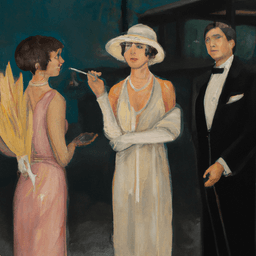
In Chapter 6, Nick and Gatsby also have a surprise tea with Tom, Daisy's husband, and another traditionally wealthy couple. Gatsby accepts an invitation to dinner with the three guests, which is silently rebuked when the three ride off on horseback before Gatsby can grab his things. Later in the chapter, Daisy and Tom attend one of Gatsby's parties with Nick and spend the night gawking at the 'new money' party and guests. Daisy dances with Gatsby and even steals away with him to speak privately at one point in the night. Nick describes the party in a grotesque way, influenced by how Daisy and Tom perceive the party.
Which of the following statements best demonstrates an understanding of the significance of the conversation between Tom and Nick in Chapter 6 of The Great Gatsby?
At the end of the night, Nick waits with Daisy and Tom for their car. While waiting, Tom inquires after Gatsby's profession, proclaiming that many newly rich men got their millions by bootlegging, an illegal business in 1920s America. Nick and Daisy both defend Gatsby against Tom's implied accusation, and the conversation ends. After Daisy and Tom leave, Nick returns to Gatsby to find him in a state of distress. Gatsby tells Nick that his only wish in life is to regain Daisy's love. He fears that she did not enjoy the party and is depressed that he may never have her again. Nick attempts to console his friend with an old saying but forgets the saying before he can repeat it.
Which of the following statements best demonstrates an understanding of the significance of the humanization of Gatsby in Chapter 6 of The Great Gatsby?
In Chapter 6, the great Gatsby himself is brought down to earth for the reader. The story Nick tells about Gatsby humanizes him. Instead of Gatsby's mysterious, almost godlike image from the beginning of the book, the reader is presented with a heartbroken man who has everything but the one thing in life he wants most: love. Gatsby has found the same spark he once had with Daisy, and he wants nothing more than to make her happy and love her. The reader begins to see a soft, tender side of Gatsby which makes him both more human and more relatable.
Which of the following statements accurately describes Nick's experience at Gatsby's party?
Nick's experience at Gatsby's party is heavily influenced how Daisy and Tom view the partygoers. Whereas, to Nick, other parties have seemed fun and lovely, if a bit shallow, this one is much more grotesque. He is hyper-aware of the drunkenness and gaudiness of the partiers around them and, influenced by Daisy's opinion specifically, has less fun at the party than usual. He describes the party as the typical Gatsby gathering but mentions something sinister hiding below the surface, which could be his awareness of Tom and Daisy's traditional dislike of the nouveau riche and their lifestyle.
Which of the following accurately describes the role of the American Dream in The Great Gatsby?
Money divided 1920s American society. The traditionally rich were inherited. The 'nouveau riche' made their money recently, usually through illegal activities, celebrity, gold-mining, or a combination of the three. In The Great Gatsby, Tom and Daisy are 'old money', while Gatsby and his party guests are new money. Class dynamics keep Daisy and Gatsby apart. American classrooms still promote the American Dream. The early 1900s belief was that the typical American can get to any level they chose. In the book, Gatsby chases fortune and attention, then turns to his idealized Daisy. Fitzgerald's novel doesn't address the American Dream's feasibility. If the American Dream exists, Jay Gatsby (James Gatz) seems unlikely to realize it.
Match each character from The Great Gatsby with a short description of them:
