Loading...

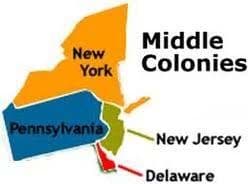
The Middle Colonies
Quiz by Amy Luken
Customize this quiz to suit your class
Instantly translate to 100+ languages
Tag the questions with any skills you have. Your dashboard will track each student's mastery of each skill.
Give this quiz to my class
 The Middle Colonies - DOL check The Middle Colonies and Cultural Diversity - Starter QuizWhy was religious tolerance practiced in the Middle colonies?Unit 4 Lesson 3: Settling the Middle ColoniesThink about the geography and location of the city or town you live in. Are there bodies of water like rivers and lakes or a coast nearby? Perhaps you live in a place with vast open fields suitable for farming or raising livestock. The natural environment is important when understanding how cities and towns developed. The earliest North American colonies depended on their natural environment. The type of soil, climate, length of seasons, and proximity to bodies of water all played a role in how each colony prospered. By the 1700’s, the American colonies grew into three distinct regions. The New England, Middle, and Southern regions each had different geographical and cultural characteristics that determined the development of their economy, society, and relationships to each other. The New England Colonies included Connecticut, Rhode Island, Massachusetts, and New Hampshire. The geography of this region featured dense forests and hills. Combined with the hard rocky land, cold climate and long winters, New England was a poor area for large farming operations. However, many colonists known as "yeoman farmers" had small family-owned farms that grew a variety of crops. Many other colonists relied on fishing and whaling off the New England coast. Others settled in small towns and became craftsmen or merchants. The forests provided excellent lumber for building boats and homes for the growing population. Many of the settlers to the New England Colonies were Puritans, hardworking, and very religious. Close families and strong communities were very important to them. The Middle Colonies included Pennsylvania, Delaware, New York, and New Jersey. The geography of this region featured a warmer climate with fertile soil, flat land, easily navigable rivers, and wide valleys making it perfect for farming and growing crops. Wealthy farmers grew cash crops and raised livestock. Mining and trading were also important aspects of the economy here. Over time, cities grew, and urban merchants sold and traded goods with people throughout the other colonies. Compared to other regions, the people of the middle colonies supported religious freedom and tolerance and had a diverse population with settlers arriving from many areas in Europe. The Southern Colonies included the first English colony of Virginia, and grew to include Maryland, North Carolina, South Carolina, and Georgia. The geography included rich, fertile soil with broad coastal plains that made it possible for large plantations to grow tobacco, rice, and indigo. Most of these plantations featured a labor force of enslaved Black people. These enslaved men, women, and children had few, if any, rights and often saw their families torn apart at the whim of the plantation owner. Enslaved children were even put to work as young as age three, weeding fields, carrying drinking water, or helping in the home. Smaller farms owned by subsistence farmers also existed across the Southern Colonies. Often, the people working these would grow crops for their families with little left over to sell or trade. Indentured servants also arrived in the South who would work for 5-7 years in exchange for their passage to North America. The Church of England (also known as the Anglican Church) was the dominant religion in the region. Most settlers to the South did not come for religious freedom like they did in the northern colonies. Therefore, they often maintained their allegiance to the established Church of England. RTI 1/27/23 Slavery in the 13 Colonies & The Middle Passage Part 2 Colonial Period Early colonial settlements were similar in that each developed near the coastline. EX) Jamestown (1607) Plymouth (1620) New England Colonies- the New England Colonies developed initially as religious outposts by various subjugated groups. Influenced by good harbors, abundant forests, rocky soil, and a short growing season. Geographic factors influenced the economy of New England by promoting the growth of trade and manufacturing. Developed villages with town-hall meetings. Had small farms and commercial fishing. American Indians were viewed by the Puritans as needing to be saved from their sinful ways since they were not Christians. In the early years of English colonization, Puritans did not openly embrace the American Indians but relied on them for help in the difficult early years for survival. As the English population increased, so did the conflict with natives of the area. A series of bloody wars (King Philip’s War and the Pequot Wars) during the colonial period between the Puritans and the American Indians of New England Southern Colonies- The climate (long growing season), rich soil, and deep rivers of the southeastern U.S. had a major impact on the history of the U.S. before 1860 because the region provided agricultural products that were processed in the North and in Europe. Developed plantations (large farms that used slave labor) because of fertile land and a long growing season. Relations with American Indians in the Southern Colonies began somewhat as a peaceful coexistence. As more English colonists began to arrive and encroach further into native lands, the relationship became more violent. Mid Atlantic (Middle Colonies)- were created from the previous Dutch New Netherland colony and had good harbors and river systems that shaped their development. The Hudson and Delaware Rivers provided highways to the interior of North America. Furs acquired from American Indians through trade for European goods were transported toward the coast along swift rivers. Later, the region’s farmers were able to use the rivers to ship wheat and other agricultural goods to markets in other colonies and Europe. The rivers also provided colonists access to manufactured goods imported from European markets. Harbors in cities such as Philadelphia and New York City allowed the Mid-Atlantic Colonies to grow into major commercial hubs for all of England’s American colonies. Ship building was common in the mid Atlantic colonies. The natives (American Indians) who resided there were typically relied upon for trade with the English and not the target of war, as was often the case in the other English colonial regions. Pennsylvania, in particular, treated the American Indians with more respect as evidenced by William Penn’s insistence on compensating the natives for their lanWhen Europeans met American Indians in the late 15th century, the people of two continents exchanged many beneficial customs and goods. Europeans received New World crops such as potatoes and corn. American Indians acquired cloth and horses. However, besides the beneficial exchanges, Europeans and American Indians often traded deadly germs–bacteria and viruses–for which they had no immunity. Smallpox and Indians Image 1: Smallpox epidemics helped Europeans conquer the Aztec and Incan Empires of Mexico and South America. North American Indians quickly concluded that contact with Europeans often resulted in devastating diseases that caused widespread death. This drawing, made in the 1500s in Mexico, shows how the disease was passed from a European to an American Indian through simple contact. Many of the diseases that were common in Europe were entirely new to the peoples of North America. Diseases such as tuberculosis and measles could be fatal, but Europeans had developed resistance to the disease, so many people survived. However, when European diseases infected American Indians with no previous exposure, the people suffered terribly. The most devastating of these diseases was smallpox which is caused by a virus (Variola major). Smallpox, like many other diseases, had a latent period of about one week between the time the person was exposed to the disease and the time when signs of the disease became apparent. During this time, the sick person might begin a journey and carry the germs along with him. Anyone the person met would be exposed to smallpox. Anything the victim touched including clothing, bedding, or unwashed dishes carried living germs of smallpox. Cotton Mather Image 2: Cotton Mather was a Boston minister. When smallpox threatened Boston, he remembered reading about how the Turks inoculated people with dried material from smallpox blisters. The inoculation usually gave the person a mild case of the disease and future immunity. The procedure was highly controversial, but it helped save the lives of 274 people who were inoculated during the Boston smallpox epidemic of 1721. Symptoms of the disease began with fever, chills, and aches. The fever might raise a person’s temperature from the normal 98.6o to a dangerous 106o. After four days of misery, the victim entered the second stage when large pustules (fluid-filled bumps) appeared on the body. The rash made the person feel as if their skin were on fire. After suffering with the rash for nine days, the victim entered a new stage-if he or she had survived this long. The pustules opened and dried up. Each pustule formed a scab that turned into a scar that marked the person’s face for the rest of his or her life. Complications of smallpox for those who survived might include loss of vision or damage to the lungs, heart, or liver. Waterhouse Image 3: Dr. Benjamin Waterhouse of Harvard University brought Jenner’s smallpox preventative to the United States. It was called vaccination and used cowpox as the infective material. This much milder form of pox gave immunity to smallpox with fewer complications. Dr. Waterhouse encouraged President-elect Thomas Jefferson to promote vaccination. Jefferson responded, “Every friend of humanity must look with pleasure on this discovery, by which one evil more is withdrawn from the condition of man.” (T. Jefferson 12/25/1800 to Benjamin Waterhouse, December 25, 1800) Historians have found evidence of smallpox as far back as 1157 B.C. when the Egyptian pharaoh Ramses V apparently died of smallpox. From Egypt, where scientists believe smallpox began, the disease spread to Asia. Europeans began to experience periodic epidemics of smallpox in the14th century when Crusaders returning from the Middle East brought smallpox to Europe. People who survived the disease were immune and could not get smallpox again. This fact explains why epidemics struck periodically and the disease was not a constant threat to European societies. Smallpox Vaccination 1803 Image 4: Dr. Edward Jenner’s new smallpox vaccination (from cowpox) was widely accepted. This medical image was published by a Spanish physician to teach colonial doctors how to apply the vaccine to native Mexicans. The scratches were supposed to go through several stages of development as evidence that the vaccine had given the patient immunity. Vaccination was very effective in preventing smallpox epidemics among those who received the vaccine. In 1520, while Cortés was trying to conquer the Aztecs, smallpox broke out among the Spaniards and was transferred to the Aztecs. By 1527, the disease had migrated through Central America to Peru where it helped Pizarro conquer the Incas. (See Image 1.) In 1633, smallpox infected American Indians living near the English colony of Plymouth, Massachusetts. The disease traveled very quickly to tribes living far inland from the English colonies. In 1721, a smallpox epidemic threatened the English colonists of Boston. (See Image 2.) Cotton Mather, a Boston minister, wanted to inoculate people against the disease. He knew that Turkish healers took material from a dried smallpox scab and injected it into the body of a healthy person by scratching the surface of the skin. The patients developed a mild form of the disease from which they recovered. The procedure was highly controversial in Boston where about 280 Bostonians accepted inoculation. The epidemic infected more than half of the people living in Boston at the time. About 15% of those who got sick died of the disease. Among those who were inoculated, only six (2%) died of smallpox. The practice of inoculation spread to other English colonies, but not to the American Indian tribes living near the colonies. Late in the 18th century, British doctor Edward Jenner recognized that people who milked cows never came down with smallpox. They had already been infected with cowpox, a similar, but much milder disease that gave them immunity to smallpox. In 1796, Jenner inoculated a young man with cowpox virus he had collected from a milkmaid. The young man had a mild infection for less than 24 hours and recovered. Jenner’s efforts resulted in a widespread acceptance of vaccination (vaccine comes from Latin words meaning “taken from a cow”). By 1800, many Americans were receiving smallpox vaccinations. (See Image 3.) President Thomas Jefferson supported and encouraged the vaccination program in major American cities. (See Image 4.) By the middle of the 19th century, smallpox was under control, but broke out from time to time among unvaccinated people. Bismarck, Dakota Territory, experienced a small outbreak of smallpox in 1882. American Indians, however, were still subject to the disease in its most dangerous form.