Loading...

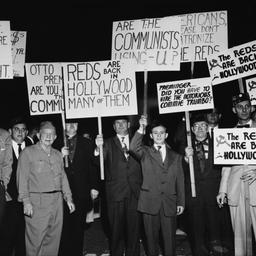
The Second Red Scare and the Cold War
Quiz by Amy Kelly
Customize this quiz to suit your class
Instantly translate to 100+ languages
Tag the questions with any skills you have. Your dashboard will track each student's mastery of each skill.
Give this quiz to my class
Being put on a list of people who are disapproved of and therefore should be avoided (or not hired)
Red Channels
Blacklisted
McCarthyism
Hollywood Ten
Senator Joseph McCarthy claimed he had a list with the names of 205 Communists working for the ______.
House of Representatives
Executive Branch
Department of the Interior
State Department
Being put on a list of people who are disapproved of and therefore should be avoided (or not hired)
Senator Joseph McCarthy claimed he had a list with the names of 205 Communists working for the ______.
To protect themselves from a nuclear bomb, some families built backyard _____ and stocked them with canned goods.
Fear that Communists were trying to infiltrate or overthrow the American government
An American diplomat who served under FDR at Yalta and who helped organize the United Nations; accused of being a Communist spy
New York Communist couple accused of selling atomic bomb secrets to the soviets
Making accusations of disloyalty to the country, subversion or treason without proper evidence in the 1950s
Wisconsin senator claimed to have list of communists in American gov't, but no credible evidence; took advantage of fears of communism post WWII to become incredibly influential
A congressional committee that investigated Communist influence inside and outside the U.S. government in the years following World War II.
a political theory derived from Karl Marx, advocating class war and leading to a society in which all property is publicly owned and each person works and is paid according to their abilities and needs.
Actor in the 1950s who testified about people he knew or suspected to be Communists; he would later be elected president in 1980
ten witnesses from the film industry who refused to cooperate with the HUAC's investigation of Communist influence in Hollywood
An investigation carried on with much publicity, supposedly to uncover dangerous activity but actually intended to weaken the political opposition.
A country that is dominated politically and economically by another nation.
A phrase used by Winston Churchill in 1946 to describe the imaginary line that separated Communist countries in the Soviet bloc of Eastern Europe from the countries in Western Europe.
The idea that if a nation falls under communist control, nearby nations will also fall under communist control
plan in which the US gave economic aid to eastern European countries to help them rebuild and to prevent them from falling to communism
the forgotten war; occurred because North Korea invaded South Korea (crossed the 38th parallel); the US supported South Korea; armistice ended the war and no changes were made leaving a divided North and South Korea
Students were urged to DUCK under their desks and COVER their heads to protect themselves from the dangerous debris and radiation associated with a nuclear detonation.
set up as an organization of countries that would work to keep peace in the world
 McCarthyism and the second Red ScareMaria's Family Celebration It is Mexican Independence Day! Maria and Luis are getting ready for a big party. "We can decorate the house," says Maria. "Let's paint a picture of our family." "Mama was born first. She is the oldest," says Maria. "Papa was born second," Maria says. "He is one year younger." "Next is Emily," says Maria. "She is Mama and Papa's first child." "After Emily, you were born," says Luis. "That's right!" says Maria. "I am Mama and Papa's second child." "What about me?" asks Luis. "You were the last to be born," says Maria. "You are the youngest." "There!" says Maria. "Our family picture is done!" "Green, white, and red are the colors of the Mexican flag," says Maria. Maria and Luis blow up five green balloons. They blow up five white balloons and five red balloons, too. "I'm out of breath!" says Luis. "Let's see," says Maria. "We painted a picture first. We blew up balloons second. The third thing we can do is fill the piñata." Maria gets the striped fish piñata from the shelf. Maria and Luis stuff the piñata with candy. When Luis thinks Maria isn't looking, he pops a piece of candy into his mouth. Maria gives him a hug. "You are silly," she says. Papa hangs the piñata. "We need a blindfold," says Maria. "We need a stick to break the piñata, toо." Abuela finds a red-checked scarf for Maria and a long stick for Luis. "The piñata is ready!" says Maria. "The fourth thing to do is practice dancing, Luis!" Maria and Luis dress in their party clothes. Then, they dance and spin. Soon, the house fills up with food, family, and music. There are six cousins, two aunts, three uncles, and three grandparents. There is Papa, Mama, Emily, Maria, and Luis, too. "There is one last thing we can do," Maria says. "And it's the most fun!" "What is it?" asks Luis. "CELEBRATE!" says Maria.Carlos's Family Celebration It's Mexican Independence Day! Carlos and Selena are getting ready for a big party. "We can decorate the house," says Carlos. "Let's paint a picture of our family." "Mama was born first. She is the oldest," says Carlos. "Papa was born second," Carlos says. "He is one year younger." "Next is Mateo," says Carlos. "He is Mama and Papa's first child." "After Mateo, you were born," says Selena. "That's right!" says Carlos. I am Mama and Papa's second child." "What about me?" asks Selena. "You were the last to be born," says Carlos. "You are the youngest." "There!" says Carlos. "Our family picture is done!" "Green, white, and red are the colors of the Mexican flag," says Carlos. Carlos and Selena blow up five green balloons. They blow up five white balloons and five red balloons, too. "I'm out of breath!" says Selena. "Let's see,"says Carlos. "We painted a picture first. We blew up balloons second. The third thing we can do is fill the piñata.” Carlos gets the big star piñata from the shelf. Carlos and Selena stuff the piñata with candy. When Selena thinks Carlos isn't looking, she pops a piece of candy into her mouth. Carlos gives her a hug. "You are silly," he says. Mateo hangs the piñata in the apartment's grassy yard. "We need a blindfold," says Carlos. "And a stick to break the piñata, too." Abuela finds a red-checked scarf for Carlos and a long stick for Selena. "The piñata is ready!" says Carlos. "The fourth thing to do is practice dancing, Selena!" Carlos and Selena dress in their party clothes. Then, they dance and spin. Soon, the house fills up with food, family, and music. There are cousins, aunts, uncles, new babies, and new friends. There is Papa, Mama, Mateo, Carlos and Selena, too. "There is one last thing we can do," Carlos says. "And it's the most fun!" "What is it?" asks Selena. "CELEBRATE!" says Carlos.CARBOHYDRATES Carbohydrates are organic compounds composed of carbon, hydrogen, and oxygen in a ratio of about one carbon atom to two hydrogen atoms to one oxygen atom. The number of carbon atoms in a carbohydrate varies. Some carbohydrates serve as a source of energy. Other carbohydrates are used as structural materials. Carbohydrates can exist as monosaccharides, disaccharides, or polysaccharides. Monosaccharides A monomer of a carbohydrate is called a monosaccharide (MAHN-oh-SAK-uh-RIED). A monosaccharide—or simple sugar— contains carbon, hydrogen, and oxygen in a ratio of 1:2:1. The gen- eral formula for a monosaccharide is written as (CH2O)n, where n is any whole number from 3 to 8. For example, a six-carbon mono- saccharide, (CH2O)6, would have the formula C6H12O6. The most common monosaccharides are glucose, fructose, and galactose, as shown in Figure 3-6. Glucose is a main source of energy for cells. Fructose is found in fruits and is the sweetest of the monosaccharides. Galactose is found in milk. Notice in Figure 3-6 that glucose, fructose, and galactose have the same molecular formula, C6H12O6, but differing structures. The different structures determine the slightly different properties of the three compounds. Compounds like these sugars, with a single chemical formula but different structural forms, are called isomers (IE-soh-muhrz). SECTION 2 OBJECTIVES ● Distinguish between monosaccharides, disaccharides, and polysaccharides. ● Explain the relationship between amino acids and protein structure. ● Describe the induced fit model of enzyme action. ● Compare the structure and function of each of the different types of lipids. ● Compare the nucleic acids DNA and RNA. VOCABULARY carbohydrate monosaccharide disaccharide polysaccharide protein amino acid peptide bond polypeptide enzyme substrate active site lipid fatty acid phospholipid wax steroid nucleic acid deoxyribonucleic acid (DNA) ribonucleic acid (RNA) nucleotide C HO H C H OH C OH H C CH2OH H C H OH O Glucose C OH C O H OH C OH H CH2OH C H CH2OH Fructose C H HO C OH H C OH H C CH2OH H C H OH O Galactose Glucose, fructose, and galactose have the same chemical formula, but their structural differences result in different properties among the three compounds. FIGURE 3-6 Copyright © by Holt, Rinehart and Winston. All rights reserved. 56 CHAPTER 3 Disaccharides and Polysaccharides In living things, two monosaccharides can combine in a condensa- tion reaction to form a double sugar, or disaccharide (die-SAK-e-RIED). For example in Figure 3-4, the monosaccharides fructose and glu- cose can combine to form the disaccharide sucrose. A polysaccharide is a complex molecule composed of three or more monosaccharides. Animals store glucose in the form of the polysaccharide glycogen. Glycogen consists of hundreds of glucose molecules strung together in a highly branched chain. Much of the glucose that comes from food is ultimately stored in your liver and muscles as glycogen and is ready to be used for quick energy. Plants store glucose molecules in the form of the polysaccha- ride starch. Starch molecules have two basic forms—highly branched chains that are similar to glycogen and long, coiled, unbranched chains. Plants also make a large polysaccharide called cellulose. Cellulose, which gives strength and rigidity to plant cells, makes up about 50 percent of wood. In a single cellu- lose molecule, thousands of glucose monomers are linked in long, straight chains. These chains tend to form hydrogen bonds with each other. The resulting structure is strong and can be broken down by hydrolysis only under certain conditions. PROTEINS Proteins are organic compounds composed mainly of carbon, hydrogen, oxygen, and nitrogen. Like most of the other biological macromolecules, proteins are formed from the linkage of monomers called amino acids. Hair and horns, as shown in Figure 3-7a, are made mostly of proteins, as are skin, muscles and many biological catalysts (enzymes). Amino Acids There are 20 different amino acids, and all share a basic structure. As Figure 3-7b shows, each amino acid contains a central carbon atom covalently bonded to four other atoms or functional groups. A single hydrogen atom, highlighted in blue in the illustration, bonds at one site. A carboxyl group, —COOH, highlighted in green, bonds at a second site. An amino group, —NH2, highlighted in yel- low, bonds at a third site. A side chain called the R group, high- lighted in red, bonds at the fourth site. The main difference among the different amino acids is in their R groups. The R group can be complex or it can be simple, such as the CH3 group shown in the amino acid alanine in Figure 3-7b. The differences among the amino acid R groups gives different proteins very different shapes. The different shapes allow pro- teins to carry out many different activities in living things. Amino acids are commonly shown in a simplified way such as balls, as shown in Figure 3-7c. (a) Many structures, such as hair and horns are made of proteins. (b) Proteins are made up of amino acids. Amino acids differ only in the type of R group (shown in red) they carry. Polar R groups can dissolve in water, but nonpolar R groups cannot. (c) Amino acids have complex structures, so, in this and other textbooks, they are often simplified into balls. FIGURE 3-7 (b) Alanine (an amino acid) (c) Simplified version of amino acid CH3 H N OH C C H O H (a) Copyright © by Holt, Rinehart and Winston. All rights reserved. BIOCHEMISTRY 57 H H N C C OH H O H CH3 H2O Glycine Alanine H N OH C C H O H H H N C C H O H CH3 N OH C C H O H (a) (b) (a) The peptide bond (shaded blue) that binds amino acids together to form a polypeptide results from a condensation reaction that produces water. (b) Poly- peptides are commonly shown as a string of balls in this textbook and elsewhere. Each ball represents an amino acid. FIGURE 3-8 Substrate Products Enzyme 1 2 3 In the induced fit model of enzyme action, the enzyme can attach only to a substrate (reactant) with a specific shape. The enzyme then changes and reduces the activation energy of the reaction so reactants can become products. The enzyme is unchanged and is available to be used again. 3 2 1 FIGURE 3-9 Dipeptides and Polypeptides Figure 3-8a shows how two amino acids bond to form a dipeptide (die-PEP-TIED). In this condensation reaction, the two amino acids form a covalent bond, called a peptide bond (shaded in blue in Figure 3-8a) and release a water molecule. Amino acids often form very long chains called polypeptides (PAHL-i-PEP-TIEDZ). Proteins are composed of one or more polypep- tides. Some proteins are very large molecules, containing hun- dreds of amino acids. Often, these long proteins are bent and folded upon themselves as a result of interactions—such as hydrogen bonding—between individual amino acids. Protein shape can also be influenced by conditions such as temperature and the type of solvent in which a protein is dissolved. For exam- ple, cooking an egg changes the shape of proteins in the egg white. The firm, opaque result is very different from the initial clear, runny material. Enzymes Enzymes—RNA or protein molecules that act as biological catalysts—are essential for the functioning of any cell. Many enzymes are proteins. Figure 3-9 shows an induced fit model of enzyme action. Enzyme reactions depend on a physical fit between the enzyme molecule and its specific substrate, the reactant being catalyzed. Notice that the enzyme has folds, or an active site, with a shape that allows the substrate to fit into the active site. An enzyme acts only on a specific substrate because only that substrate fits into its active site. The linkage of the enzyme and substrate causes a slight change in the enzyme’s shape. The change in the enzyme’s shape weakens some chemical bonds in the substrate, which is one way that enzymes reduce activation energy, the energy needed to start the reaction. After the reaction, the enzyme releases the products. Like any catalyst, the enzyme itself is unchanged, so it can be used many times. An enzyme may not work if its environment is changed. For example, change in temperature or pH can cause a change in the shape of the enzyme or the substrate. If such a change happens, the reaction that the enzyme would have catalyzed cannot occur.Commas Directions: Correct the sentences by adding commas where needed. 1. After the sound of the bell we realized it was a false alarm. 2. Mr. Yoshino the head of the department resigned yesterday. 3. The gentleman with the black umbrella who is an ambassador to the United States said hello to us as we were entering the hotel. 4. Even though we won the game the players unfortunately did not play their best. 5. Heather walked quickly up to the door and knocked hoping that someone would answer. Author’s Purpose 6. An author writes a story about a boy who saves his town from a flood by using his quick thinking. The author includes exciting descriptions of the boy's bravery. What is the author’s most likely purpose for writing this story? A. To inform readers about the dangers of floods B. To entertain readers with a heroic tale C. To explain how to prevent floods D. To persuade readers to prepare for emergencies 7. Which of the following is an example of an author writing to persuade? A. A science textbook chapter explaining the water cycle B. A commercial encouraging people to adopt shelter pets C. A short story about a girl who finds a magical necklace D. A recipe for making chocolate chip cookies 8. Read the following sentence: "Studies show that students who read for 20 minutes a day score higher on tests. Reading is one of the best habits you can develop for success in school and life." What is the author’s purpose in this passage? A. To entertain readers with a fun story B. To persuade readers to read more often C. To inform readers about how books are written D. To explain how to find books to read 9. An author writes a how-to guide titled 10 Easy Steps to Plant a Garden. What is the author’s primary purpose? A. To persuade readers to grow their own vegetables B. To inform readers how to plant a garden C. To entertain readers with funny garden tips 10. Read the excerpt: "Long ago, in a village surrounded by mountains, the people discovered a secret about their water well. Every full moon, the well water turned to gold for just one night. But no one knew why. This mystery brought travelers from far and wide, hoping to uncover the truth." What is the author’s purpose in this excerpt? A. To persuade readers to visit the village B. To inform readers about a historical event C. To entertain readers with a mysterious tale D. To explain the science behind the water Main Idea When I stepped out into the bright sunlight from the darkness of the movie house, I had only two things on my mind: Paul Newman and a ride home. I was wishing I looked like Paul Newman--- he looks tough and I don't--- but I guess my own looks aren't so bad. I have light-brown, almost-red hair and greenish-gray eyes. I wish they were more gray because I hate most guys that have green eyes, but I have to be content with what I have. My hair is longer than a lot of boys wear theirs, squared off in back and long at the front and sides, but I am a greaser and most of my neighborhood rarely bothers to get a haircut. Besides, I look better with long hair. 11. What is the main idea? The narrator likes movies. The narrator wishes he was Paul Newman. The narrator is content with his appearance. The narrator looks better with long hair. 12. The narrator believes. . . looks are important. he should get a haircut. green eyes are bad. that he has red hair. Once there were four girls who shared a pair of pants. The girls were all different sizes and shapes, and yet the pants fit each of them. You may think this is a suburban myth. But I know it's true, because I am one of them, one of the sisters of the Traveling Pants. We discovered their magic last summer, purely by accident. The four of us were splitting up for the first time in our lives. Carmen had gotten them from a secondhand place without even bothering to try them on. She was going to throw them away, but by chance, Tibby spotted them. First Tibby tried them; then me, Lena; then Bridget; then Carmen. By the time Carmen pulled them on, we knew something extraordinary was happening. If the same pants fit and I mean really fit the four of us, they aren't ordinary. They don't belong completely to the world of things you can see and touch. My sister, Effie, claims I don't believe in magic, and maybe I didn't then. But after the first summer of the Traveling Pants, I do. 13. What is the main idea? Four friends were connected through a special pair of pants. A pair of pants called the Traveling Pants. Carmen finding a pair of pants from a second-hand shop. The girls believing in magic. 14. The narrator included that the pants fit all of them to emphasize how the girls become friends. the girls are different sizes. why the pants are special. where the pants came from. If you are interested in stories with happy endings, you would be better off reading some other book. In this book, not only is there no happy ending, there is no happy beginning and very few happy things in the middle. This is because not very many happy things happened in the lives of the three Baudelaire youngsters. Violet, Klaus, and Sunny Baudelaire were intelligent children, and they were charming, and resourceful, and had pleasant facial features, but they were extremely unlucky, and most everything that happened to them was rife with misfortune, misery, and despair. I'm sorry to tell you this, but that is how the story goes. 15. What is the main idea? description about the story to come. A warning about the story and its sad content. A declaration about the Baudelaire family. A beginning for the end of the story. 16. The narrator believes the reader does not like sad stories. likes stories with happy endings. can’t enjoy the story. will find the story unhappy. 17. Read the following sentence: Of course you can exaggerate your story, but what you say must be based on truth. Which word means the same as exaggerate? repeat reveal overstate increase 18. What is the meaning of the word inaugurated, used in the following sentence: Less than two months after Abraham Lincoln was inaugurated President in 1861, he encountered one of the most difficult tasks ever experienced by a United States leader: civil war. elected by a vote brought into office identified by name viewed as an authority 19. What does the phrase “practice your presentation so much that you could do it in your sleep” suggest in the following sentence: The best advice is to practice your presentation so much that you could do it in your sleep. get plenty of sleep the night before giving a presentation give their presentations in front of a small audience first take advice from their teachers on how to write a presentation memorize their presentations before they give them 20. Read the following sentence: The Phoenix Mars Lander is a NASA spacecraft that landed on the Red Planet in May 2009 to study the history of water and potential for life on the planet. What is another word for potential? existence situation possibility qualification The Second Red ScareAm I all right? Why do doctors wear green or blue clothes while doing an operation? Look at the first picture. Stare at the dot for 10 seconds. Then look at the second picture. What can you see? What you see is called afterimage. Afterimage is an image that continues to appear in people's vision after the image has disappeared. The blood is red. But if you look at blood for a long time, you will be affected by afterimage. Doctors change their scrubs from white into green because green may help doctors see the room clearly after staring at blood for a long time.Ions Ions are charged substances that have formed through the gain or loss of electrons. Cations form from the loss of electrons and have a positive charge while anions form through the gain of electrons and have a negative charge. Cation Formation Cations are the positive ions formed by the loss of one or more electrons. The most commonly formed cations of the representative elements are those that involve the loss of all of the valence electrons. Consider the alkali metal sodium (Na) . It has one valence electron in the n=3 energy level. Upon losing that electron, the sodiu ion now has an octet of electrons from the second energy level and a charge of 1+ . The electron arrangement of the sodium ion is now the same as that of the noble gas neon. Consider a similar process with magnesium and aluminum. In this case, the magnesium atom loses its two valence electrons in order to achieve the same arrangement as the noble gas neon and a charge of 2+ . The aluminum atom loses its three valence electrons to have the same electron arrangement as neon and a charge of 3+ . For representative elements under typical conditions, three electrons is usually the maximum number that will be los. Representative elements will not lose electrons beyond their valence because they would have to "break" the octet of the previous energy level which provides stability to the ion. Anions Anions are the negative ions formed from the gain of one or more electrons. When nonmetal atoms gain elections, they often do so until their outermost principal energy level achieves an octet. For fluorine, which has an electron arrangement of (2, 7), it only needs to gain one electron to have the same electron arrangement as neon. Forming an octet (eight electrons in the outer shell) provides stability to the atom. Fluorine will gain one electron and have a charge of 1− . The electron arrangement of the fluoride ion (2, 8) will also change to reflect the gain of an electron. Oxygen has an electron arrangement of (2, 6) and needs to gain two electrons to fill the n=2 energy level and achieve an octet of electrons in the outermost shell. The oxide ion will have a charge of 2− as a result of gaining two electrons. Under typical conditions, three electrons is the maximum that will be gained in the formation of anions. Subatomic Particles in an Ion Since ions form from the gain or loss of electrons, we can also look at the number of subatomic particles (protons, neutrons, and electrons) found in an ion. Remember that the number of protons determines the identity of the element and will not change in a chemical process. Example 2.5.1 How many protons, neutrons, and electrons in a single oxide (O2−) ion? Solution Oxygen has the atomic number 8 so both the atom and the ion will have 8 protons. The average atomic mass of oxygen is 16. Therefore, there will be 8 neutrons (atomic mass−atomic number=neutrons) . A neutral oxygen atom would have 8 electrons. However, the anion has gained two electrons so O2− has 10 electrons. We can also use information about the subatomic particles to determine the identity of an ion. Example 2.5.2 An ion with a 2+ charge has 18 electrons. Determine the identity of the ion. Solution If an ion has a 2+ charge then it must have lost electrons to form the cation. If the ion has 18 electrons and the atom lost 2 to form the ion, then the neutral atom contained 20 electrons. Since it was neutral, it must also have had 20 protons. Therefore the element is calcium. Polyatomic Ions A polyatomic ion is an ion composed of two or more atoms that have a charge as a group (poly = many). The ammonium ion (see figure below) consists of one nitrogen atom and four hydrogen atoms. Together, they comprise a single ion with a 1+ charge and a formula of NH+4 . The hydroxide ion (see figure below) contains one hydrogen atom and one oxygen atom with an overall charge of 1− . The carbonate ion (see figure below) consists of one carbon atom and three oxygen atoms and carries an overall charge of 2− . The formula of the carbonate ion is CO2−3 . The atoms of a polyatomic ion are tightly bonded together and so the entire ion behaves as a single unit. The figures below show several examples. Soult Screenshot 2-2-1.png Figure 2.5.1 : The ammonium ion (NH+4) is a nitrogen atom (blue) bonded to four hydrogen atoms (white). Soult Screenshot 2-2-2.png Figure 2.5.2 : The hydroxide ion (OH−) is an oxygen atom (red) bonded to a hydrogen atom. Soult Screenshot 2-2-3.png Figure 2.5.3 : The carbonate ion (CO2−3) is a carbon atom (black) bonded to three oxygen atoms. The table below lists a number of polyatomic ions by name and by structure. The heading for each column indicates the charge on the polyatomic ions in that group. Note that the vast majority of the ions listed are anions - there are very few polyatomic cations. 1− 2− 3− 1+ Table 2.5.1 : Common Polyatomic Ions acetate, CH3COO− carbonate, CO2−3 arsenate, AsO3−3 ammonium, NH+4 bromate, BrO−3 chromate, CrO2−4 phosphite, PO3−3 chlorate, ClO−3 dichromate, Cr2O2−7 phosphate, PO3−4 chlorite, ClO−2 hydrogen phosphate, HPO2−4 cyanide, CN− oxalate, C2O2−4 dihydrogen phosphate, H2PO−4 peroxide, O2−2 hydrogen carbonate, HCO−3 silicate, SiO2−3 hydrogen sulfate, HSO−4 sulfate, SO2−4 hydrogen sulfide, HS− sulfite, SO2−3 hydroxide, OH− hypochlorite, ClO− nitrate, NO−3 nitrite, NO−2 perchlorate, ClO−4 permanganate, MnO−4 The vast majority of polyatomic ions are anions, many of which end in -ate or -ite. Notice that in some cases such as nitrate (NO−3) and nitrite (NO−2) , there are multiple anions that consist of the same two elements. In these cases, the difference between the ions is the number of oxygen atoms present, while the overall charge is the same. As a class, these are called oxyanions. When there are two oxyanions for a particular element, the one with the greater number of oxygen atoms gets the -ate suffix, while the one with the fewer number of oxygen atoms gets the -ite suffix. The four oxyanions of chlorine are shown below, which also includes the use of the prefixes hypo- and per-. ClO− , hypochlorite ClO−2 , chlorite ClO−3 , chlorate ClO−4 , perchlorate Not your usual ion Soult Screenshot 2-2-4.png "Drink you milk. It's good for your bones." We're told this from early childhood, and with good reason. Milk contains a good supply of calcium, part of the structure of bone. However, there are two other ionic components of hydroxyapatite, the mineral component. Phosphate ion and hydroxide ion make up the remainder of the inorganic material in bone. News You Can Use Bone is a very complex structure. It is composed of protein (mainly collagen), hydroxyapatite (a calcium-phosphate-hydroxide mixture), some other minerals, and contains 10 - 20% water. The calcium/phosphate ratios are not stoichiometric, but vary somewhat from one portion of bone to the next. Bones are very strong but will break under enough stress. Regular exercise and proper nutrition help to increase bone strength. Watch a video about bone structure at http://www.youtube.com/watch?v=d9owEvYdouk Nitrate is an anion with a complex bonding structure. Major sources for this ion in drinking water are runoff from fertilizer, septic tank leakage, sewage, and natural deposits. High concentrations of nitrates represent a significant health hazard, especially to infants. The nitrate in the body is converted to nitrite, which then binds to hemoglobin. This binding decreases the ability of hemoglobin to transport oxygen, thus depriving the cells of the O2 needed for proper functioning. Cyanide production is widespread throughout nature. Forest fires will produce significant amounts of cyanide. Many plants contain cyanide, and it is produced by a number of bacteria, algae, and fungi. Cyanide is used industrially in metal finishing, iron and steel mills, and in organic synthesis processes. This material is also an important component for the refining of precious metals. Formation of a complex between cyanide and gold allows extraction of this metal from a mixture.