Loading...


The structure and function of the skin
Quiz by Maria Owen
Customize this quiz to suit your class
Instantly translate to 100+ languages
Tag the questions with any skills you have. Your dashboard will track each student's mastery of each skill.
Give this quiz to my class
Which of the following is the outside of the skin
Subcutaneous fat layer
Epidermis
Dermis
Nerve endings
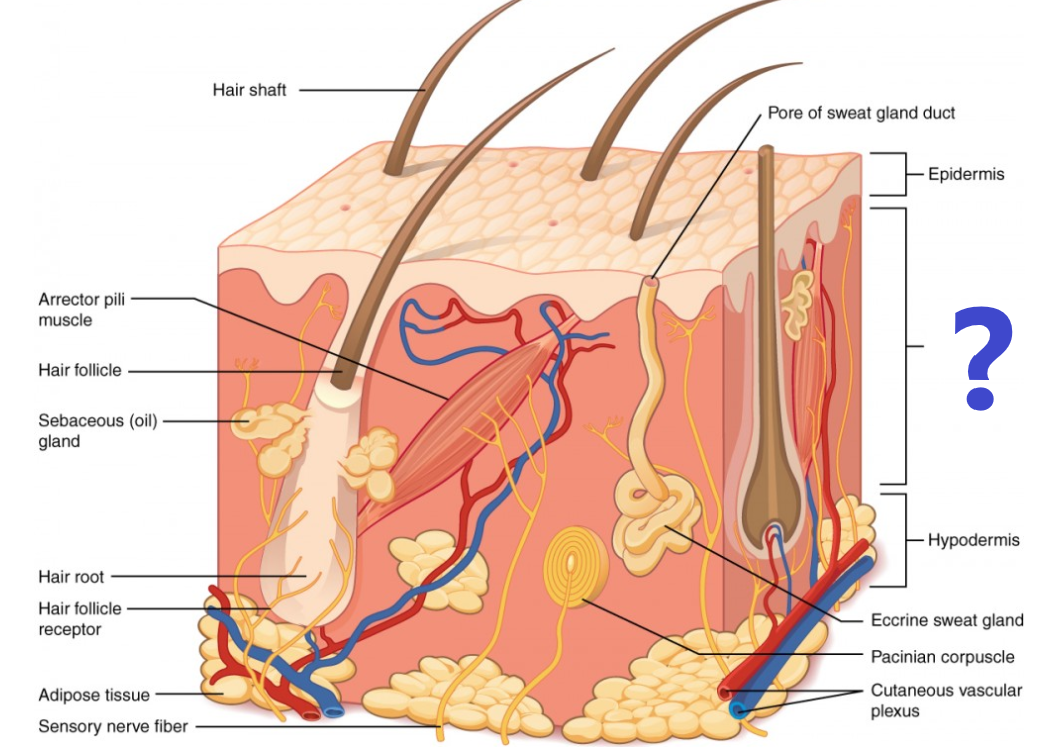
Which layer of the skin has not been named on the diagram has not been named? (blue question mark)
Dermis
Epidermis
Pores
Subcutaneous fat
Which of the following is the outside of the skin
Which layer of the skin has not been named on the diagram has not been named? (blue question mark)

The _______________ is the layer of skin that contains nerve endings, blood vessels, oil glands, and sweat glands.
_____________ are tiny holes in the skin that allow sweat to escape.
Hair follicles have their roots in which layer of skin?
The skin is the largest organ of the human body.
Which of the following is not a job of the epidermis?
The skin is involved in producing which of the following vitamins?
Which layer contains the nerves & blood vessels?
Which layer of the skin does NOT contain blood vessels?
Cells of different organisms and even cells within the same organism are very diverse in terms of shape, size, and internal organization. One theme that occurs again and again throughout biology is that form follows function. In other words, a cell’s function influences its physical features. Cell Shape The diversity in cell shapes reflects the different functions of cells. Compare the cell shapes shown in Figure 4-4. The long extensions that reach out in various directions from the nerve cell shown in Figure 4-4a allow the cell to send and receive nerve impulses. The flat, platelike shape of skin cells in Figure 4-4b suits their function of covering and protecting the surface of the body. As shown below, a cell’s shape can be simple or complex depending on the function of the cell. Each cell has a shape that has evolved to allow the cell to perform its function effectively. SECTION 2 OBJECTIVES ● Explain the relationship between cell shape and cell function. ● Identify the factor that limits cell size. ● Describe the three basic parts of a cell. ● Compare prokaryotic cells and eukaryotic cells. ● Analyze the relationship among cells, tissues, organs, organ systems, and organisms. VOCABULARY plasma membrane cytoplasm cytosol nucleus prokaryote eukaryote organelle tissue organ organ system Cells have various shapes. (a) Nerve cells have long extensions. (b) Skin cells are flat and platelike. (c) Egg cells are spherical. (d) Some bacteria are rod shaped. (e) Some plant cells are rectangular. FIGURE 4-4 (a) Nerve cell (b) Skin cells (c) Egg cell (d) Bacterial cells (e) Plant cells Copyright © by Holt, Rinehart and Winston. All rights reserved. 1. All cubes have volume and surface area. The total surface area is equal to the sum of the areas of each of the six sides (area = length X width). 2. If you split the first cube into eight smaller cubes, you get 48 sides. The volume remains constant, but the total surface area doubles. 3. If you split each of the eight cubes into eight smaller cubes, you have 64 cubes that together contain the same volume as the first cube. The total surface area, however, has doubled again. CELL STRUCTURE AND FUNCTION 73 Cell Size Cells differ not only in their shape but also in their size. A few types of cells are large enough to be seen by the unaided human eye. For example, the nerve cells that extend from a giraffe’s spinal cord to its foot can be 2 m (about 6 1/2 ft) long. A human egg cell is about the size of the period at the end of this sentence. Most cells, how- ever, are only 10 to 50 μm in diameter, or about 1/500 the size of the period at the end of this sentence. The size of a cell is limited by the relationship of the cell’s outer surface area to its volume, or its surface area–to-volume ratio. As a cell grows, its volume increases much faster than its surface area does, as shown in Figure 4-5. This trend is important because the materials needed by a cell (such as nutrients and oxygen) and the wastes produced by a cell (such as carbon dioxide) must pass into and out of the cell through its surface. If a cell were to become very large, the volume would increase much more than the surface area. Therefore, the surface area would not allow materials to enter or leave the cell quickly enough to meet the cell’s needs. As a result, most cells are microscopic in size. Comparing Surface Cells Materials microscope, prepared slides of plant (dicot) stem and ani- mal (human) skin, pencil, paper Procedure Examine slides by using medium magnification (100). Observe and draw the sur- face cells of the plant stem and the animal skin. Analysis How do the surface cells of each organism differ from the cells beneath the surface cells? What is the function of the surface cells? Explain how surface cells are suited to their function based on their shape. Quick Lab Small cells can exchange substances more readily than large cells because small objects have a higher surface area–to-volume ratio. FIGURE 4-5 mb06se_csfs02.qxd 5/18/07 10:54 AM Page 73 74 CHAPTER 4 BASIC PARTS OF A CELL Despite the diversity among cells, three basic features are common to all cell types. All cells have an outer boundary, an interior sub- stance, and a control region. Plasma Membrane The cell’s outer boundary, called the plasma membrane (or the cell membrane), covers a cell’s surface and acts as a barrier between the inside and the outside of a cell. All materials enter or exit through the plasma membrane. The surface of a plasma mem- brane is shown in Figure 4-6a. Cytoplasm The region of the cell that is within the plasma membrane and that includes the fluid, the cytoskeleton, and all of the organelles except the nucleus is called the cytoplasm. The part of the cytoplasm that includes molecules and small particles, such as ribosomes, but not membrane-bound organelles is the cytosol. About 20 percent of the cytosol is made up of protein. Control Center Cells carry coded information in the form of DNA for regulating their functions and reproducing themselves. The DNA in some types of cells floats freely inside the cell. Other cells have a mem- brane-bound organelle that contains a cell’s DNA. This membrane- bound structure is called the nucleus. Most of the functions of a eukaryotic cell are controlled by the cell’s nucleus. The nucleus is often the most prominent structure within a eukaryotic cell. It maintains its shape with the help of a protein skeleton called the nuclear matrix. The nucleus of a typical animal cell is shown inCARBOHYDRATES Carbohydrates are organic compounds composed of carbon, hydrogen, and oxygen in a ratio of about one carbon atom to two hydrogen atoms to one oxygen atom. The number of carbon atoms in a carbohydrate varies. Some carbohydrates serve as a source of energy. Other carbohydrates are used as structural materials. Carbohydrates can exist as monosaccharides, disaccharides, or polysaccharides. Monosaccharides A monomer of a carbohydrate is called a monosaccharide (MAHN-oh-SAK-uh-RIED). A monosaccharide—or simple sugar— contains carbon, hydrogen, and oxygen in a ratio of 1:2:1. The gen- eral formula for a monosaccharide is written as (CH2O)n, where n is any whole number from 3 to 8. For example, a six-carbon mono- saccharide, (CH2O)6, would have the formula C6H12O6. The most common monosaccharides are glucose, fructose, and galactose, as shown in Figure 3-6. Glucose is a main source of energy for cells. Fructose is found in fruits and is the sweetest of the monosaccharides. Galactose is found in milk. Notice in Figure 3-6 that glucose, fructose, and galactose have the same molecular formula, C6H12O6, but differing structures. The different structures determine the slightly different properties of the three compounds. Compounds like these sugars, with a single chemical formula but different structural forms, are called isomers (IE-soh-muhrz). SECTION 2 OBJECTIVES ● Distinguish between monosaccharides, disaccharides, and polysaccharides. ● Explain the relationship between amino acids and protein structure. ● Describe the induced fit model of enzyme action. ● Compare the structure and function of each of the different types of lipids. ● Compare the nucleic acids DNA and RNA. VOCABULARY carbohydrate monosaccharide disaccharide polysaccharide protein amino acid peptide bond polypeptide enzyme substrate active site lipid fatty acid phospholipid wax steroid nucleic acid deoxyribonucleic acid (DNA) ribonucleic acid (RNA) nucleotide C HO H C H OH C OH H C CH2OH H C H OH O Glucose C OH C O H OH C OH H CH2OH C H CH2OH Fructose C H HO C OH H C OH H C CH2OH H C H OH O Galactose Glucose, fructose, and galactose have the same chemical formula, but their structural differences result in different properties among the three compounds. FIGURE 3-6 Copyright © by Holt, Rinehart and Winston. All rights reserved. 56 CHAPTER 3 Disaccharides and Polysaccharides In living things, two monosaccharides can combine in a condensa- tion reaction to form a double sugar, or disaccharide (die-SAK-e-RIED). For example in Figure 3-4, the monosaccharides fructose and glu- cose can combine to form the disaccharide sucrose. A polysaccharide is a complex molecule composed of three or more monosaccharides. Animals store glucose in the form of the polysaccharide glycogen. Glycogen consists of hundreds of glucose molecules strung together in a highly branched chain. Much of the glucose that comes from food is ultimately stored in your liver and muscles as glycogen and is ready to be used for quick energy. Plants store glucose molecules in the form of the polysaccha- ride starch. Starch molecules have two basic forms—highly branched chains that are similar to glycogen and long, coiled, unbranched chains. Plants also make a large polysaccharide called cellulose. Cellulose, which gives strength and rigidity to plant cells, makes up about 50 percent of wood. In a single cellu- lose molecule, thousands of glucose monomers are linked in long, straight chains. These chains tend to form hydrogen bonds with each other. The resulting structure is strong and can be broken down by hydrolysis only under certain conditions. PROTEINS Proteins are organic compounds composed mainly of carbon, hydrogen, oxygen, and nitrogen. Like most of the other biological macromolecules, proteins are formed from the linkage of monomers called amino acids. Hair and horns, as shown in Figure 3-7a, are made mostly of proteins, as are skin, muscles and many biological catalysts (enzymes). Amino Acids There are 20 different amino acids, and all share a basic structure. As Figure 3-7b shows, each amino acid contains a central carbon atom covalently bonded to four other atoms or functional groups. A single hydrogen atom, highlighted in blue in the illustration, bonds at one site. A carboxyl group, —COOH, highlighted in green, bonds at a second site. An amino group, —NH2, highlighted in yel- low, bonds at a third site. A side chain called the R group, high- lighted in red, bonds at the fourth site. The main difference among the different amino acids is in their R groups. The R group can be complex or it can be simple, such as the CH3 group shown in the amino acid alanine in Figure 3-7b. The differences among the amino acid R groups gives different proteins very different shapes. The different shapes allow pro- teins to carry out many different activities in living things. Amino acids are commonly shown in a simplified way such as balls, as shown in Figure 3-7c. (a) Many structures, such as hair and horns are made of proteins. (b) Proteins are made up of amino acids. Amino acids differ only in the type of R group (shown in red) they carry. Polar R groups can dissolve in water, but nonpolar R groups cannot. (c) Amino acids have complex structures, so, in this and other textbooks, they are often simplified into balls. FIGURE 3-7 (b) Alanine (an amino acid) (c) Simplified version of amino acid CH3 H N OH C C H O H (a) Copyright © by Holt, Rinehart and Winston. All rights reserved. BIOCHEMISTRY 57 H H N C C OH H O H CH3 H2O Glycine Alanine H N OH C C H O H H H N C C H O H CH3 N OH C C H O H (a) (b) (a) The peptide bond (shaded blue) that binds amino acids together to form a polypeptide results from a condensation reaction that produces water. (b) Poly- peptides are commonly shown as a string of balls in this textbook and elsewhere. Each ball represents an amino acid. FIGURE 3-8 Substrate Products Enzyme 1 2 3 In the induced fit model of enzyme action, the enzyme can attach only to a substrate (reactant) with a specific shape. The enzyme then changes and reduces the activation energy of the reaction so reactants can become products. The enzyme is unchanged and is available to be used again. 3 2 1 FIGURE 3-9 Dipeptides and Polypeptides Figure 3-8a shows how two amino acids bond to form a dipeptide (die-PEP-TIED). In this condensation reaction, the two amino acids form a covalent bond, called a peptide bond (shaded in blue in Figure 3-8a) and release a water molecule. Amino acids often form very long chains called polypeptides (PAHL-i-PEP-TIEDZ). Proteins are composed of one or more polypep- tides. Some proteins are very large molecules, containing hun- dreds of amino acids. Often, these long proteins are bent and folded upon themselves as a result of interactions—such as hydrogen bonding—between individual amino acids. Protein shape can also be influenced by conditions such as temperature and the type of solvent in which a protein is dissolved. For exam- ple, cooking an egg changes the shape of proteins in the egg white. The firm, opaque result is very different from the initial clear, runny material. Enzymes Enzymes—RNA or protein molecules that act as biological catalysts—are essential for the functioning of any cell. Many enzymes are proteins. Figure 3-9 shows an induced fit model of enzyme action. Enzyme reactions depend on a physical fit between the enzyme molecule and its specific substrate, the reactant being catalyzed. Notice that the enzyme has folds, or an active site, with a shape that allows the substrate to fit into the active site. An enzyme acts only on a specific substrate because only that substrate fits into its active site. The linkage of the enzyme and substrate causes a slight change in the enzyme’s shape. The change in the enzyme’s shape weakens some chemical bonds in the substrate, which is one way that enzymes reduce activation energy, the energy needed to start the reaction. After the reaction, the enzyme releases the products. Like any catalyst, the enzyme itself is unchanged, so it can be used many times. An enzyme may not work if its environment is changed. For example, change in temperature or pH can cause a change in the shape of the enzyme or the substrate. If such a change happens, the reaction that the enzyme would have catalyzed cannot occur.Cell Size Cells differ not only in their shape but also in their size. A few types of cells are large enough to be seen by the unaided human eye. For example, the nerve cells that extend from a giraffe’s spinal cord to its foot can be 2 m (about 6 1/2 ft) long. A human egg cell is about the size of the period at the end of this sentence. Most cells, how- ever, are only 10 to 50 μm in diameter, or about 1/500 the size of the period at the end of this sentence. The size of a cell is limited by the relationship of the cell’s outer surface area to its volume, or its surface area–to-volume ratio. As a cell grows, its volume increases much faster than its surface area does, as shown in Figure 4-5. This trend is important because the materials needed by a cell (such as nutrients and oxygen) and the wastes produced by a cell (such as carbon dioxide) must pass into and out of the cell through its surface. If a cell were to become very large, the volume would increase much more than the surface area. Therefore, the surface area would not allow materials to enter or leave the cell quickly enough to meet the cell’s needs. As a result, most cells are microscopic in size. Comparing Surface Cells Materials microscope, prepared slides of plant (dicot) stem and ani- mal (human) skin, pencil, paper Procedure Examine slides by using medium magnification (100). Observe and draw the sur- face cells of the plant stem and the animal skin. Analysis How do the surface cells of each organism differ from the cells beneath the surface cells? What is the function of the surface cells? Explain how surface cells are suited to their function based on their shape. Quick Lab Small cells can exchange substances more readily than large cells because small objects have a higher surface area–to-volume ratio. FIGURE 4-5 mb06se_csfs02.qxd 5/18/07 10:54 AM Page 73 74 CHAPTER 4 BASIC PARTS OF A CELL Despite the diversity among cells, three basic features are common to all cell types. All cells have an outer boundary, an interior sub- stance, and a control region. Plasma Membrane The cell’s outer boundary, called the plasma membrane (or the cell membrane), covers a cell’s surface and acts as a barrier between the inside and the outside of a cell. All materials enter or exit through the plasma membrane. The surface of a plasma mem- brane is shown in Figure 4-6a. Cytoplasm The region of the cell that is within the plasma membrane and that includes the fluid, the cytoskeleton, and all of the organelles except the nucleus is called the cytoplasm. The part of the cytoplasm that includes molecules and small particles, such as ribosomes, but not membrane-bound organelles is the cytosol. About 20 percent of the cytosol is made up of protein. Control Center Cells carry coded information in the form of DNA for regulating their functions and reproducing themselves. The DNA in some types of cells floats freely inside the cell. Other cells have a mem- brane-bound organelle that contains a cell’s DNA. This membrane- bound structure is called the nucleus. Most of the functions of a eukaryotic cell are controlled by the cell’s nucleus. The nucleus is often the most prominent structure within a eukaryotic cell. It maintains its shape with the help of a protein skeleton called the nuclear matrix. The nucleus of a typical animal cell is shown in Figure 4-6b. Most animal cells have a cell membrane, a nucleus, and a variety of other organelles embedded in a watery substance. The surface of the cell membrane can be seen in (a). The organelles inside the cell are labeled in the diagram (b). FIGURE 4-6 (a) (b) Mitochondrion Microfilaments Lysosome Golgi apparatus Smooth ER Ribosomes Cell membrane Microtubules Rough ER Nuclear pore Nuclear envelope Nucleolus Nucleus Copyright © by Holt, Rinehart and Winston. All rights reserved. Cell wall Ribosome Cell membrane Peptidoglycan Pili Flagellum DNA CELL STRUCTURE AND FUNCTION 75 A prokaryotic cell lacks a membrane- bound nucleus and membrane-bound organelles. Most prokaryotic cells are much smaller than eukaryotic cells are. FIGURE 4-7 A white blood cell (eukaryotic) changes shape as it attacks purple- stained bacterial cells that are much smaller (prokaryotic). FIGURE 4-8 TWO BASIC TYPES OF CELLS Fossil evidence suggests that the earliest cells on Earth were simple cells similar to some present-day bacteria. As cells evolved, they differentiated into two major types: prokaryotes and eukaryotes. Prokaryotes Prokaryotes (proh-KAR-ee-OHTS) are organisms that lack a membrane- bound nucleus and membrane-bound organelles. Although prokaryotic cells lack a nucleus, their genetic information—in the form of DNA—is often concentrated in a part of the cell called the nucleoid. Figure 4-7 shows a typical prokaryotic cell. Prokaryotes are divided into two domains: Bacteria and Archaea (ahr-KEE-uh). The domain Bacteria includes organisms that are similar to the first cellular life-forms. The domain Archaea includes organisms that are thought to be more closely related to eukaryotic cells found in all other kingdoms of life. Eukaryotes Organisms made up of one or more cells that have a nucleus and membrane-bound organelles are called eukaryotes (yoo-KAR-ee-OHTS). Eukaryotic cells also have a variety of subcellular structures called organelles, well-defined, intracellular bodies that perform specific functions for the cell. Many organelles are surrounded by a mem- brane. The organelles carry out cellular processes just as a person’s pancreas, heart, and other organs carry out a person’s life processes. Eukaryotic cells are generally much larger than prokary- otic cells, as seen in Figure 4-8, which shows a white blood cell (eukaryote) destroying tiny bacterial cells (prokaryotes).A solution is a mixture in which one or more substances are uniformly distributed in another substance. Solutions can be mixtures of liquids, solids, or gases. For example, plasma, the liquid part of blood, is a very complex solution. It is composed of many types of ions and large molecules, as well as gases, that are dissolved in water. A solute (SAHL-YOOT) is a substance dissolved in the solvent. The particles that compose a solute may be ions, atoms, or molecules. The solvent is the substance in which the solute is dissolved. For example, when sugar, a solute, and water, a solvent, are mixed, a solution of sugar water results. Though the sugar dissolves in the water, neither the sugar molecules nor the water molecules are altered chemically. If the water is boiled away, the sugar molecules remain and are unchanged. Solutions can be composed of various proportions of a given solute in a given solvent. Thus, solutions can vary in concentra- tion. The concentration of a solution is the amount of solute dis- solved in a fixed amount of the solution. For example, a 2 percent saltwater solution contains 2 g of salt dissolved in enough water to make 100 mL of solution. The more solute dissolved, the greater is the concentration of the solution. A saturated solution is one in which no more solute can dissolve. Aqueous (AY-kwee-uhs) solutions—solutions in which water is the solvent—are universally important to living things. Marine microorganisms spend their lives immersed in the sea, an aqueous solution. Most nutrients that plants need are in aqueous solutions in moist soil. Body cells exist in an aqueous solution of intercellu- lar fluid and are themselves filled with fluid; in fact, most chemical reactions that occur in the body occur in aqueous solutions. Copyright © by Holt, Rinehart and Winston. All rights reserved. Liquid water Solid water Ice (solid water) is less dense than liquid water because of the structure of ice crystals. The water molecules in ice are bonded to each other in a way that creates large amounts of open space between the molecules, relative to liquid water. FIGURE 2-12 solvent from the Latin solvere, meaning “to loosen” Word Roots and Origins CHEMISTRY OF LIFE 43 ACIDS AND BASES One of the most important aspects of a living system is the degree of its acidity or alkalinity. What do we mean when we use the terms acid and base? Ionization of Water As water molecules move about, they bump into one another. Some of these collisions are strong enough to result in a chemical change: one water molecule loses a proton (a hydrogen nucleus), and the other gains this proton. This reaction really occurs in two steps. First, one molecule of water pulls apart another water molecule, or dissociates, into two ions of opposite charge: H2O ∏ H OH The OH ion is known as the hydroxide ion. The free H ion can react with another water molecule, as shown in the equation below. H H2O ∏ H3O The H3O ion is known as the hydronium ion. Acidity or alkalin- ity is a measure of the relative amounts of hydronium ions and hydroxide ions dissolved in a solution. If the number of hydronium ions in a solution equals the number of hydroxide ions, the solution is said to be neutral. Pure water contains equal numbers of hydro- nium ions and hydroxide ions and is therefore a neutral solution. Acids If the number of hydronium ions in a solution is greater than the number of hydroxide ions, the solution is an acid. For example, when hydrogen chloride gas, HCl, is dissolved in water, its mol- ecules dissociate to form hydrogen ions, H, and chloride ions, Cl, as is shown in the equation below. HCl ∏ H Cl These free hydrogen ions combine with water molecules to form hydronium ions, H3O. This aqueous solution contains many more hydronium ions than it does hydroxide ions, making it an acidic solution. Acids tend to have a sour taste; how- ever, never taste a substance to test it for acidity. In concentrated forms, they are highly corrosive to some materials, as you can see in Figure 2-13. Bases If sodium hydroxide, NaOH, a solid, is dissolved in water, it dissociates to form sodium ions, Na, and hydroxide ions, OH, as shown in the equation below. NaOH ∏ Na OH Copyright © by Holt, Rinehart and Winston. All rights reserved. Eco Connection onnection Acid Precipitation Acid precipitation, more commonly called acid rain, describes rain, snow, sleet, or fog that contains high levels of sulfuric and nitric acids. These acids form when sulfur dioxide gas, SO2, and nitrogen oxide gas, NO, react with water in the atmosphere to produce sulfuric acid, H2SO4, and nitric acid, HNO3. Acid precipitation makes soil and bodies of water, such as lakes, more acidic than normal. These high acid levels can harm plant and animal life directly. A high level of acid in a lake may kill mollusks, fish, and amphibians. Even in a lake that does not have a very elevated level of acid, acid precipitation may leach aluminum and magnesium from soils, poisoning water- dwelling species. Reducing fossil-fuel consump- tion, such as occurs in gasoline engines and coal-burning power plants, should reduce high acid levels in precipitation. Sulfur dioxide, SO2, which is produced when fossil fuels are burned, reacts with water in the atmosphere to produce acid precipitation. Acid precipitation, or acid rain, can make lakes and rivers too acidic to support life and can even corrode stone, such as the face of this statue. FIGURE 2-13 44 CHAPTER 2 This solution then contains more hydroxide ions than hydronium ions and is therefore defined as a base. The adjective alkaline refers to bases. Bases have a bitter taste; however, never taste a substance to test for alkalinity. They tend to feel slippery because the OH ions react with the oil on our skin to form a soap. In fact, commercial soap is the product of a reaction between a base and a fat. pH Scientists have developed a scale for comparing the relative con- centrations of hydronium ions and hydroxide ions in a solution. This scale is called the pH scale, and it ranges from 0 to 14, as shown in Figure 2-14. A solution with a pH of 0 is very acidic, a solution with a pH of 7 is neutral, and a solution with a pH of 14 is very basic. A solution’s pH is measured on a logarithmic scale. That is, the change of one pH unit reflects a 10-fold change in the acidity or alkalinity. For example, urine has 10 times the H3O ions at a pH of 6 than water does at a pH of 7. Vinegar, has 1,000 times more H3O ions at a pH of 3 than urine at a pH of 6, and 10,000 times more H3O ions than water at a pH of 7. The pH of a solution can be measured with litmus paper or with some other chemical indicator that changes color at various pH levels. Buffers The control of pH is important for living systems. Enzymes can function only within a very narrow pH range. The control of pH in organisms is often accomplished with buffers. Buffers are chemi- cal substances that neutralize small amounts of either an acid or a base added to a solution. As Figure 2-14 shows, the composition of your internal environment—in terms of acidity and alkalinity— varies greatly. Some of your body fluids, such as stomach acid and urine, are acidic. Others, such as intestinal fluid and blood, are• There are two groups of animals which are important in agriculture. • The groups are domestic and wild animals. 1. Domestic animals • These are animals which are trained to live with people in their homes. • Some examples includes : Uses of domestic animals • Source of food, for example milk, eggs and meat. • For cultural purposes, for example paying lobola. • Some are used for transport and labour. • Domestic animals can also be a source of income. 2 . Wild animals • These are animals which are found in game reserves and in the forests • They are also called game animals. • Examples of wild animals are: Uses of wild animals • Some of the wild animals give us meat, hides and ivory. • Wild animals attract visitors from other countries, so the country gets money. Wednesday 06 September 2023 Exercise: Domestic animals 1. What is a domestic animal? [2] 2. What is a wild animal? [2] 3. Name any 4 domestic animals that you know. [4] 4. State any 2 uses of domestic animals. [2] 5. Name any 3 wild animals that you know. [3] 6. Give 2 uses of wild ani mals. [2] 7. Wild animals can also be called animals. [1] • Animals, like human beings need good food to help them to grow and reproduce. • The main sources of food for animals include stock feeds, pastures, veld grass, crop remains and cereal grains. • These foods contain the most needed essential nutrients. Nutrient Function carbohydrates Gives energy Fats Give energy and warmth Proteins Helps in growth and repair of body parts Minerals Help in the formation of bones and teeth Vitamins Help develop good sight, improve fertility and help animals fight diseases Water Transports food in the body, cools the body and remove waste from the body. • Livestock are domesticated animals that are kept for food, use or for sale. • Small livestock has many uses. • They are a good source of food. • They also give us manure to use in gardens. • We get clothes and medicine as well from small livestock • Examples of small livestock are rabbits, sheep, goats and all form of poultry Poultry • All animals that are kept by farmers which have wings and feathers and lay eggs are called poultry. • They are a good source of white meat, eggs and manure. • They are also a source of income when we well them and their products. • Poultry includes chicken, guinea fowl, ducks, turkey, pigeons and quail birds. Rabbits • Rabbits have 3 known uses which are: They are kept for meat Kept for pelts. (pelt is animal skin used to make blankets, hats and jackets) They are used at agricultural shows • Rabbits are cheap to buy, easy to keep and feed. • They take about 4 months to mature. • Rabbits are fed using green vegetables and rabbit pellets. Wednesday 20 September 2023 Small livestock 1. Give 3 examples of small livestock. [3] 2. State 3 things that are provided by small livestock. [3] 3. What are the 2 uses of rabbits? [2] 4. Pelts are used to make _________________ [1] 5. State any 4 examples poultry. [4] 6. Rabbits take ___________ months to mature. [1] 7. What is poultry? • Apiculture is the keeping of bees in order for them to produce honey for sale. • Apiculture is very important because: (i) Provides honey - a valuable nutritional food (ii) Provides bees wax - which has many uses in industry Uses of wax For making candles Polish furniture Make crayons Prevent tools from rusting (iii) Honey bees are excellent pollinating agents, thus increasing agricultural yields. BEE COLONY Inhabitants of the bee colony and their roles • A honey bee colony typically consists of three kinds of adult bees: workers, drones and the queen 1. Workers • Workers are the smallest and constitute the majority of bees occupying the colony. • They do not lay eggs. • Workers have specialized structures, such as brood food glands, scent glands, wax glands, and pollen baskets. • these allow them to perform all the labors of the hive. Roles of the worker bees they forage for nectar, pollen, water, and plant sap. They clean and polish the cells. feed the brood. care for the queen. remove debris. handle incoming nectar. build beeswax combs. guard the entrance. 2. Drones • Drones (male bees) are the largest bees in the colony. • They are generally present only during late spring and summer. • The drone’s head is much larger than that of either the queen or worker. • Drones have no stinger, pollen baskets, or wax glands. • Their main function is to mate with the queen. 3 . Queen • Each colony has only one queen. • The queen is the largest of the bees in a bee colony. • The Queen Bee plays a vital role in the hive because she is the only female with fully developed ovaries. • She produces both fertilized and unfertilized eggs. • Queens lay the greatest number of eggs in the spring and early summer. • The queen also produce chemical scents that help regulate the unity of the colony. 1. What is apiculture? [2] 2. Give 3 reasons why apiculture is important in Zimbabwe. [3] 3. Name the 3 inhabitants of the bee colony. [3] 4. Briefly explain the roles of each inhabitant named in number 3. • Apart from using hand tools, farmers also use some farm implements and machinery to carry out their field work. • Machines help farmers do their work more easily and quickly. • The most common implements used by farmers to grow, harvest and transport their produces are: mouldboard plough Cultivator Scotch cart Harrow Planter Maize sheller combine harvesters Boom sprayers Disc harrow Spike toothed harrow KNAPSACK SPRAYER • Farming is a business. • Communal farmers grow crops and keep animal mainly for their own use. • If there is any extra they sell to get money. • Commercial farmers grow crops and keep animals for sale. • Crops and animals produced are called farm produce. • There are places were farmers have to sell their produce. • Farmers can take their produce to local markets. • A market is a place where buying and selling occurs. • Some of the local markets includes: A shopping centre A school A nearest bus stop A local village A school Local Grain Marketing Board depot (GMB) Types of farm produce Beef Fruits Mutton Eggs Vegetables Pork Milk Chicken Cereals/grains beans SYI-1.D: Describe the structure and/ or function of subcellular components and organelles. ★ SYI-1.E: Explain how subcellular components and organelles contribute to the function of the cell. ★ SYI-1.F: Describe the structural features of a cell that allow organisms to capture, store, and use energy. ★ ENE-1.B: Explain the effect of surface area-to-volume ratios on the exchange of materials between cells or organisms and the environment. ★ ENE-1.C: Explain how specialized structures and strategies are used for the efficient exchange of molecules to the environment. ★ ENE-2.A: Describe the roles of each of the components of the cell membrane in maintaining the internal environment of the cell. ★ ENE-2.B: Describe the Fluid Mosaic Model of cell membranes. ★ ENE-2.C: Explain how the structure of biological membranes influences selective permeability. ★ ENE-2.D: Describe the role of the cell wall in maintaining cell structure and function. ★ ENE-2.E: Describe the mechanisms that organisms use to maintain solute and water balance. ★ ENE-2.F: Describe the mechanisms that organisms use to transport large molecules across the plasma membrane. ★ ENE-2.G: Explain how the structure of a molecule affects its ability to pass through the plasma membrane. ★ ENE-2.H: Explain how concentration gradients affect the ★ movement of molecules across membranes. ★ ENE-2.I: Explain how osmoregulatory mechanisms contribute to the health and survival of organisms. ★ ENE-2.J: Describe the processes that allow ions and other molecules to move across membranes. ★ ENE-2.K: Describe the membrane-bound structures of the eukaryotic cell. ★ ENE-2.L: Explain how internal membranes and membrane- bound organelles contribute to compartmentalization of eukaryotic cell functions. ★ EVO-1.A: Describe similarities and/or differences in compartmentalization between prokaryotic and eukaryotic cells. ★ EVO-1.B: Describe the relationship between the functions of endosymbiotic organelles and their free-living ancestral counterpartsMost of the functions of a eukaryotic cell are controlled by the nucleus, shown in Figure 4-12. The nucleus is filled with a jellylike liquid called the nucleoplasm, which holds the contents of the nucleus and is similar in function to a cell’s cytoplasm. The nucleus houses and protects the cell’s genetic information. The hereditary information that contains the instructions for the structure and function of the organism is coded in the organism’s DNA, which is contained in the nucleus. When a cell is not dividing, the DNA is in the form of a threadlike material called chromatin. When a cell is about to divide, the chromatin condenses to form chromosomes. Chromosomes are structures in the nucleus made of DNA and protein. The nucleus is the site where DNA is transcribed into ribonucleic acid (RNA). RNA moves through nuclear pores to the cytoplasm, where, depending on the type of RNA, it carries out its function. Nuclear Envelope The nucleus is surrounded by a double membrane called the nuclear envelope. The nuclear envelope is made up of two phos- pholipid bilayers. Covering the surface of the nuclear envelope are tiny, protein-lined holes, which are called nuclear pores. The nuclear pores provide passageways for RNA and other materials to enter and leave the nucleus. Nucleolus Most nuclei contain at least one denser area, called the nucleolus (noo-KLEE-uh-luhs). The nucleolus (plural, nucleoli) is the site where DNA is concentrated when it is in the process of making ribosomal RNA. Ribosomes (RIE-buh-SOHMZ) are organelles made of protein and RNA that direct protein synthesis in the cytoplasm. The nucleus of a cell is surrounded by a double membrane called the nuclear envelope. The nucleus stores the cell’s DNA. FIGURE 4-12 Nuclear envelope Nucleolus Nuclear pores DNA (chromatin) Copyright © by Holt, Rinehart and Winston. All rights reserved. 80 CHAPTER 4 MITOCHONDRIA Mitochondria (MIET-oh-KAHN-dree-uh) (singular, mitochondrion) are tiny organelles that transfer energy from organic molecules to adenosine triphosphate (ATP). ATP ultimately powers most of the cell’s chemical reactions. Highly active cells, such as muscle cells, can have hundreds of mitochondria. Cells that are not very active, such as fat-storage cells, have few mitochondria. Like a nucleus, a mitochondrion has an inner and an outer phos- pholipid membrane, as shown in Figure 4-13. The outer membrane separates the mitochondrion from the cytosol. The inner membrane has many folds, called cristae (KRIS-tee). Cristae contain proteins that carry out energy-harvesting chemical reactions. Mitochondrial DNA Mitochondria have their own DNA and can reproduce only by the division of preexisting mitochondria. Scientists think that mito- chondria originated from prokaryotic cells that were incorporated into ancient eukaryotic cells. This symbiotic relationship provided the prokaryotic invaders with a protected place to live and pro- vided the eukaryotic cell with an increased supply of ATP. RIBOSOMES Ribosomes are small, roughly spherical organelles that are respon- sible for building protein. Ribosomes do not have a membrane. They are made of protein and RNA molecules. Ribosome assembly begins in the nucleolus and is completed in the cytoplasm. One large and one small subunit come together to make a functioning ribosome, shown in Figure 4-14. Some ribosomes are free within the cytosol. Others are attached to the rough endoplasmic reticulum.The plasma membrane (also called the cell membrane) has several functions. For example, it allows only certain molecules to enter or leave the cell. It separates internal metabolic reactions from the external environment. In addition, the plasma membrane allows the cell to excrete wastes and to interact with its environment. Membrane Lipids The plasma membrane, as well as the membranes of cell organelles, is made primarily of phospholipids. Phospholipids have a polar, hydrophilic (“water-loving”) phosphate head and two nonpolar, hydrophobic (“water-fearing”) fatty acid tails. Water molecules sur- round the plasma membrane. The phospholipids line up so that their heads point outward toward the water and their tails point inward, away from water. The result is a double layer called a phospholipid bilayer, as shown in Figure 4-10. The cell membranes of eukaryotes also contain lipids, called sterols, between the tails of the phospho- lipids. The major membrane sterol in animal cells is cholesterol. Sterols in the plasma membrane make the membrane more firm and prevent the membrane from freezing at low temperatures. SECTION 3 OBJECTIVES ● Describe the structure and function of a cell’s plasma membrane. ● Summarize the role of the nucleus. ● List the major organelles found in the cytosol, and describe their roles. ● Identify the characteristics of mitochondria. ● Describe the structure and function of the cytoskeleton. VOCABULARY phospholipid bilayer chromosome nuclear envelope nucleolus ribosome mitochondrion endoplasmic reticulum Golgi apparatus lysosome cytoskeleton microtubule microfilament cilium flagellum centriole Cell membranes are made of a phospholipid bilayer. Each phospholipid molecule has a polar “head” and a two-part nonpolar “tail.” FIGURE 4-10 Copyright © by Holt, Rinehart and Winston. All rights reserved. 78 CHAPTER 4 OUTSIDE OF CELL INSIDE OF CELL 1. Cell-surface marker: Glycoprotein that identifies cell type 3. Enzyme: Assists chemical reactions inside the cell 2. Receptor protein: Recognizes and binds to substances outside the cell 4. Transport protein: Helps substances move across cell membrane Carbohydrate portion Protein portion Phospholipid heads Phospholipid tails Phospholipid Cholesterol bilayer Membrane Proteins Plasma membranes often contain specific proteins embedded within the lipid bilayer. These proteins are called integral proteins. Figure 4-11 shows that some integral proteins, such as cell surface markers, emerge from only one side of the membrane. Others, such as receptor proteins and transport proteins, extend across the plasma membrane and are exposed to both the cell’s interior and exterior environments. Proteins that extend across the plasma membrane are able to detect environmental signals and transmit them to the inside of the cell. Peripheral proteins, such as the enzyme shown in Figure 4-11, lie on only one side of the membrane and are not embedded in it. As Figure 4-11 shows, integral proteins exposed to the cell’s external environment often have carbohydrates attached. These carbohydrates can act as labels on cell surfaces. Some labels help cells recognize each other and stick together. Viruses can use these labels as docks for entering and infecting cells. Integral proteins play important roles in actively transporting molecules into the cell. Some act as channels or pores that allow certain substances to pass. Other integral proteins bind to a mol- ecule on the outside of the cell and then transport it through the membrane. Still others act as sites where chemical messengers such as hormones can attach. Fluid Mosaic Model A cell’s plasma membrane is surprisingly dynamic. Scientists describe the cell membrane as a fluid mosaic. The fluid mosaic model states that the phospholipid bilayer behaves like a fluid more than it behaves like a solid. The membrane’s lipids and pro- teins can move laterally within the bilayer, like a boat on the ocean. As a result of such lateral movement, the pattern, or “mosaic,” of lipids and proteins in the cell membrane constantly changes.