Loading...

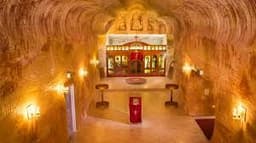
The Town That is Underground
Quiz by Antonina Simkuniene
Customize this quiz to suit your class
Instantly translate to 100+ languages
Tag the questions with any skills you have. Your dashboard will track each student's mastery of each skill.
Give this quiz to my class
 Tobruk, a small town on the Libyan coast, was central to much of the fighting that took place in the Western Desert during the Second World War. It had originally been developed by the Italians during their colonisation of eastern Libya during the early decades of the 20th century. With a sheltered deep water harbour it became a key naval outpost. It was fortified during the 1930s with both coastal defence batteries and a 50 kilometre-long perimeter of reinforced concrete platoon posts, and other supporting infrastructure such as gun positions, headquarters bunkers, underground supply dumps, and observation towers. When British and Commonwealth forces advanced out of Egypt and into Libya in January 1941, Tobruk was their second objective. The Italian defence perimeter was attacked by the 6th Australian Division on the morning of 22 January and the town fell the next morning. The operation resulted in approximately 27,000 Italian prisoners and the capture of over 200 artillery pieces, but cost 49 Australian lives. The 6th Division's advance pressed on beyond Tobruk and eventually they were withdrawn from Libya to be deployed to Greece.The 9th Australian Division was moved in to Libya in February 1941 to garrison the territory captured by the 6th. By this time, however, German troops had arrived in Libya to reinforce their Italian allies and they launched an offensive that the British Commonwealth forces were ill-disposed to hold back. A retreat towards Egypt commenced. The 9th Division was ordered to fall back upon Tobruk, hold it in order deny its port facilities to the Germans, and delay their advance so as to provide time for defences on the Egyptian frontier to be prepared. Tobruk and the 9th Division were subsequently encircled, beginning what became known as "the siege of Tobruk". Reinforced by the 18th Brigade of the 7th Australian Division and other British and Commonwealth troops, and resupplied by the sea, the 9th Division held Tobruk from April to September 1941. During this period it repelled two major German attacks. In September and October the 9th Division, its condition steadily declining, was relieved by the British 70th Division, which continued to defend Tobruk until the siege was finally lifted by Operation Crusader in December. The defence of Tobruk resulted in 749 Australian deaths, and another 604 became prisoners of war. Tobruk was the scene of further heavy fighting in June 1942 when the fortunes of war again saw a British Commonwealth force seeking to deny the port to the enemy. The Axis forces, however, were in no mood for another siege and launched a massive attack to capture it on 20 June. It remained in their hands until their final retreat from Libya in November 1942.John Hurst Edmondson (1914-1941), soldier, was born on 8 October 1914 at Wagga Wagga, New South Wales, only child of native-born parents Joseph William Edmondson, farmer, and his wife Maude Elizabeth, née Hurst. The family moved to a farm near Liverpool when Jack was a child. Educated at Hurlstone Agricultural High School, he worked with his father and became a champion rifle-shooter. He was a council-member of the Liverpool Agricultural Society and acted as a steward at its shows. Having served (from March 1939) in the 4th Battalion, Militia, he enlisted in the Australian Imperial Force on 20 May 1940 and was posted to the 2nd/17th Battalion. Later that month he was promoted acting corporal (substantive in November). Well built and about 5 ft 9 ins (175 cm) tall, Edmondson settled easily into army life and was known as a quiet but efficient soldier. His battalion embarked for the Middle East in October and trained in Palestine. In March 1941 the 2nd/17th moved with other components of the 9th Division to Libya and reached Marsa Brega before an Axis counter-attack forced them to retreat to Tobruk. The siege of the fortress began on 11 April. Two days later the Germans probed the perimeter, targeting a section of the line west of the El Adem Road near Post R33. This strong-point was garrisoned by the 2nd/17th's No.16 Platoon in which Edmondson was a section leader. The enemy intended to clear the post as a bridgehead for an armoured assault on Tobruk.Under cover of darkness thirty Germans infiltrated the barbed wire defences, bringing machine-guns, mortars and two light field-guns. Lieutenant Austin Mackell, commanding No.16 Platoon, led Edmondson's five-man section in an attempt to repel the intruders. Armed with rifles, fixed bayonets and grenades, the party of seven tried to outflank the Germans, but were spotted by the enemy who turned their machine-guns on them. Unknown to his mates, Edmondson was severely wounded in the neck and stomach. Covering fire from R33 ceased at the pre-arranged time of 11.45 p.m. and Mackell ordered his men to charge. Despite his wounds, Edmondson accounted for several enemy soldiers and saved Mackell's life. When the remaining Germans fled, the Australians returned to their lines. Although Edmondson was treated for his wounds, he died before dawn on 14 April 1941. The Germans' armoured attack that morning was thwarted, partly due to the earlier disruption of their plans. Edmondson was buried in Tobruk war cemetery. He had not married. His Victoria Cross, gazetted on 4 July, was the first awarded to a member of Australia's armed forces in World War II. In April 1960 Mrs Edmondson gave her son's medals to the Australian War Memorial, Canberra, where they are displayed alongside his portrait (1958) by Joshua Smith. At Liverpool a public clock commemorates Edmondson, as do the clubrooms used by the sub-branch of the Returned Services League of Australia.Perhaps my nerves will be more under control when I am by myself. There were no entries in the diary until Friday April 18 when she wrote: Fighting terrific in Greece and North Africa…. I dread the casualty list also the heaviest air raid over London to date. Account …. of heavy fighting and much use of bayonet at Tobruk. Also gives an account of a charge in which a Lieutenant and a Corporal took prominent parts on Easter Sunday night. Of course, no names. When I read it …. I was sure the Corporal was Jack…. It said no casualties but …. I know … that all is not well with Jack. ….. (and) Stuffy ….has not come home yet. On Wednesday April 23 she received a letter from Jack dated March 30 and for the first time he said the conditions were bad. The food short, water one bottle for 48 hours. It worried me terribly so I posted a parcel (of) milk tablets, chocolate milk, biscuits (and) cigarettes.Tuesday April 15 I was feeling afraid of something while I was working and packing the cake (and) had a couple of brandys to (keep going).April 26 Received the following telegram in the mail, the bus man brought it in. “It is with deep regret that I have to inform you that Corporal John Hurst Edmondson was killed in action on the 14th April and desire to convey the profound sympathy of the Ministry for the Army and the Military Board.”Her final entryHi, I'm John Green, this is Crash Course U.S. History, and today, we're going to talk about slavery, which is not funny. 0:06 Yeah, so we put a lei on the eagle to try and cheer you up, but let's face it, this is going to be depressing. 0:10 With slavery, every time you think, like, "Aw, it couldn't have been that bad," it turns out to have been much worse. 0:14 Mr. Green, Mr. Green! But what about – 0:15 Yeah, Me from the Past, I'm going to stop you right there, because you're going to embarrass yourself. Slavery was hugely important to America. 0:20 I mean, it led to a civil war and it also lasted what, at least in U.S. history, counts as a long-ass time, from 1619 to 1865. 0:29 And yes, I know there's a 1200-year-old church in your neighborhood in Denmark, but we're not talking about Denmark! 0:35 But slavery is most important because we still struggle with its legacy. 0:38 So, yes, today's episode will probably not be funny, but it will be important. 0:42 [Theme Music] North & South economic ties 0:51 So the slave-based economy in the South is sometimes characterized as having been separate from the Market Revolution, but that's not really the case. 0:57 Without southern cotton, the North wouldn't have been able to industrialize, at least not as quickly, because cotton textiles were one of the first industrially products. 1:04 And the most important commodity in world trade by the nineteenth century, and 3/4 of the world's cotton came from the American South. 1:11 And speaking of cotton, why has no one mentioned to me that my collar has been half popped this entire episode, like I'm trying to recreate the Flying Nun's hat. 1:18 And although there were increasingly fewer slaves in the North as northern states outlawed slavery, cotton shipments overseas made northern merchants rich. 1:26 Northern bankers financed the purchase of land for plantations. 1:29 Northern insurance companies insured slaves who were, after all, considered property, and very valuable property. 1:35 And in addition to turning cotton into cloth for sale overseas, northern manufacturers sold cloth back to the South, where it was used to clothe the very slaves who had cultivated it. 1:45 But certainly the most prominent effects of the slave-based economy were seen in the South. Slave-based agriculture in the South 1:49 The profitability of slaved-based agriculture, especially King Cotton, meant that the South would remain largely agricultural and rural. 1:56 Slave states were home to a few cities, like St. Louis and Baltimore, but with the exception of New Orleans, 2:00 almost all southern urbanization took place in the upper South, further away from the large cotton plantations. 2:06 And slave-based agriculture was so profitable that it siphoned money away from other economic endeavors. 2:11 Like, there was very little industry in the South. 2:13 It produced only 10% of the nation's manufactured goods. 2:16 And, as most of the capital was being plowed into the purchase of slaves, there was very little room for technological innovation, like, for instance, railroads. 2:23 This lack of industry and railroads would eventually make the South suck at the Civil War, thankfully. 2:27 In short, slavery dominated the South, shaping it both economically and culturally, and slavery wasn't a minor aspect of American society. Popular attitudes concerning slavery 2:35 By 1860, there were four million slaves in the U.S., and in the South, they made up one third of the total population. 2:42 Although in the popular imagination, most plantations were these sprawling affairs with hundreds of slaves, 2:47 in reality, the majority of slaveholders owned five or fewer slaves. 2:51 And, of course, most white people in the South owned no slaves at all, though, if they could afford to, they would sometimes rent slaves to help with their work. 2:57 These were the so-called yeoman farmers who lived self-sufficiently, raised their own food, and purchased very little in the Market Economy. 3:04 They worked the poorest land and, as a result, were mostly pretty poor themselves. 3:08 But even they largely supported slavery, partly, perhaps, for aspirational reasons, and partly because the racism inherent to the system gave even the poorest whites legal and social status. 3:18 And southern intellectuals worked hard to encourage these ideas of white solidarity and to make the case for slavery. 3:23 Many of the founders, a bunch of whom you'll remember, held slaves, saw slavery as a necessary evil. 3:29 Jefferson once wrote, quote, "As it is, we have the wolf by the ear, and we can neither hold him, nor safely let him go. 3:37 Justice is on one scale, and self-preservation in the other." 3:41 The belief that justice and self-preservation couldn't sit on the same side of the scale was really opposed to the American idea, 3:47 and, in the end, it would make the Civil War inevitable. 3:50 But as slavery became more entrenched in these ideas of liberty and political equality were embraced by more people, 3:55 some southerners began to make the case that slavery wasn't just a necessary evil. 3:59 They argued, for instance, that slaves benefited from slavery. 4:03 Because, you know, because their masters fed them and clothed them and took care of them in their old age. 4:07 You still hear this argument today, astonishingly. 4:09 In fact, you'll probably see asshats in the comments saying that in the comments. 4:12 I will remind you, it's not cursing if you are referring to an actual ass. 4:15 This paternalism allowed masters to see themselves as benevolent and to contrast their family-oriented slavery with the cold, mercenary Capitalism of the free-labor North. 4:26 So yeah, in the face of rising criticism of slavery, some southerners began to argue that the institution was actually good for the social order. 4:33 One of the best-known proponents of this view was John C. Calhoun, who, in 1837, said this in a speech on the Senate floor: 4:40 "I hold that, in the present state of civilization, 4:43 where two races of different origin and distinguished by color and other physical differences as well as intellectual, are brought together, 4:51 the relation now existing in the slave-holding states between the two is, instead of an evil, a good. A positive good." 4:59 Now, of course, John C. Calhoun was a fringe politician, and nobody took his views particularly seriously. 5:04 Stan: Well, he was Secretary of State from 1844 to 1845. 5:07 John: Well, I mean, who really cares about the Secretary of State, Stan? 5:10 Danica: Eh, he was also Secretary of War from 1817 to 1825. 5:13 John: All right, but we don't even have a Secretary of War anymore, so... 5:16 Meredith: And he was Vice President from 1825 to 1832. 5:19 John: Oh my god, were we insane?! 5:21 We were, of course, but we justified the insanity with Biblical passages and with the examples of the Greeks and Romans, 5:28 and with outright racism, arguing that black people were inherently inferior to whites. 5:33 And that not to keep them in slavery would upset the natural order of things. 5:37 A worldview popularized millennia ago by my nemesis, Aristotle. God, I hate Aristotle. 5:42 You know what defenders of Aristotle always say? 5:44 "He was the first person to identify dolphins." 5:47 Well, ok, dolphin identifier. 5:50 Yes, that is what he should be remembered for, but he's a terrible philosopher! Lives & experiences of enslaved people 5:53 Here's the truth about slavery: 5:55 It was coerced labor that relied upon intimidation and brutality and dehumanization. 6:00 And this wasn't just a cultural system, it was a legal one. 6:03 I mean, Louisiana law proclaimed that a slave "owes his master... a respect without bounds, and an absolute obedience." 6:09 The signal feature of slaves' lives was work. 6:12 I mean, conditions and tasks varied, but all slaves labored, usually from sunup to sundown, and almost always without any pay. 6:20 Most slaves worked in agriculture on plantations, and conditions were different, depending on which crops are grown. 6:25 Like, slaves on the rice plantations of South Carolina had terrible working conditions, 6:29 but they labored under the task system, which meant that once they had completed their allotted daily work, they would have time to do other things. 6:36 But lest you imagine this is like how we have work and leisure time, bear in mind that they were owned and treated as property. 6:42 On cotton plantations, most slaves worked in gangs, usually under the control of an overseer, or another slave who was called a "driver." 6:49 This was back-breaking work done in the southern sun and humidity, and so it's not surprising that whippings – or the threat of them – were often necessary to get slaves to work. 6:58 It's easy enough to talk about the brutality of slave discipline, but it can be difficult to internalize it. 7:03 Like, you look at these pictures, but because you've seen them over and over again, they don't have the power they once might have. 7:09 The pictures can tell a story about cruelty, but they don't necessarily communicate how arbitrary it all was. 7:14 As, for example, in this story, told by a woman who was a slave as a young girl: 7:18 "[The] overseer... went to my father one morning and said, "Bob, I'm gonna whip you this morning." 7:22 Daddy said, "I ain't done nothing," and he said, "I know it, I'm going to whip you to keep you from doing nothing," 7:28 and he hit him with that cowhide – you know it would cut the blood out of you with every lick if they hit you hard." 7:33 That brutality – the whippings, the brandings, the rape – was real, and it was intentional, because, in order for slavery to function, slaves had to be dehumanized. 7:43 This enabled slaveholders to rationalize what they were doing, and it was hoped to reduce slaves to the animal property that is implied by the term "chattel slavery." 7:51 So the idea was that slaveholders wouldn't think of their slaves as human, and slaves wouldn't think of themselves as human. 7:57 But it didn't work. Let's go to the Thought Bubble. 7:59 Slaves' resistance to their dehumanization took many forms, but the primary way was by forming families. Family, love, & religion of enslaved people 8:05 Family was a refuge for slaves and a source of dignity that masters recognized and sought to stifle. 8:10 A paternalistic slave owner named Bennet H. Barrow wrote in his rules for the Highland Plantation: 8:15 "No rule that I have stated is of more importance than that relating to Negroes marrying outside of the plantation... It creates a feeling of independence." 8:23 Most slaves did marry, usually for life, and, when possible, slaves grew up in two-parent households. 8:28 Single-parent households were common, though, as a result of one parent being sold. 8:32 In the upper South, where the economy was shifting from tobacco to different, less labor-intensive cash crops, the sale of slaves was common. 8:40 Perhaps one-third of slave marriages in states like Virginia were broken up by sale. 8:45 Religion was also an important part of life in slavery. 8:47 While masters wanted their slaves to learn the parts of the Bible that talked about being happy in bondage, 8:52 slave worship tended to focus on the stories of Exodus, where Moses brought the slaves out of bondage, 8:57 or Biblical heroes, who overcame great odds, like Daniel and David. 9:01 And, although most slaves were forbidden to learn to read and write, many did anyway. And some became preachers. 9:07 Slave preachers were often very charismatic leaders, and they roused the suspicion of slave owners, and not without reason. 9:13 Two of the most important slave uprisings in the South were led by preachers. 9:16 Thanks, Thought Bubble. 9:17 Oh, it's time for the Mystery Document? Mystery Document 9:19 We're doing two set pieces in a row? All right. [buzzing noise] [music] 9:24 The rules here are simple. 9:26 I wanted to re-shoot that, but Stan said no. 9:29 I guess the author of the Mystery Document. 9:30 If I am wrong, I get shocked with the shock pen. 9:33 "Since I have been in the Queen's dominions I have been well contented, yes well contented for sure, man is as God intended he should be. 9:40 That is, all are born free and equal. 9:43 This is a wholesome law, not like the southern laws which puts man made in the image of God on level with brutes. 9:49 O, what will become of the people, and where will they stand in the day of judgment. 9:53 Would that the 5th verse of the 3rd chapter of Malachi were written as with a bar of iron, 9:59 and the point of a diamond upon every oppressor's heart that they might repent of this evil, and let the oppressed go free..." 10:06 All right, it's definitely a preacher, because only preachers have read Malachi. 10:10 Probably African American, probably not someone from the South. 10:13 I'm going to guess that it is Richard Allen, the founder of the African Methodist Episcopal Church? 10:18 [buzzing noise] DAAAH, DANG IT! 10:19 It's Joseph Taper, and Stan just pointed out to me that I should have known it was Joseph Taper because it starts out, 10:24 "Since I have been in the Queen's dominions..." 10:27 He was in Canada. He escaped slavery to Canada. The Queen's dominions! 10:31 All right, Canadians, I blame you for this, although, thank you for abolishing slavery decades before we did. 10:36 [electric sounds] AHHH! How people resisted & escaped slavery 10:37 So, the Mystery Document shows one of the primary ways that slaves resisted their oppression: by running away. 10:42 Although some slaves like Joseph Taper escaped for good by running away to northern free states, 10:47 or even to Canada, where they wouldn't have to worry about fugitive slave laws, even more slaves ran away temporarily, hiding out in the woods or the swamps, and eventually returning. 10:55 No one knows exactly how many slaves escaped to freedom, but the best estimate is that a thousand or so a year made the journey northward. 11:01 Most fugitive slaves were young men, but the most famous runaway has been hanging out behind me all day long: Harriet Tubman. 11:07 Harriet Tubman escaped to Philadelphia at the age of 29, and over the course of her life, she made about 20 trips back to Maryland to help friends and relatives make the journey north on the Underground Railroad. 11:17 But a more dramatic form of resistance to slavery was actual, armed rebellion, which was attempted. 11:22 Now, individuals sometimes took matters into their own hands and beat or even killed their white overseers or masters. 11:27 Like Bob, the guy who received the arbitrary beating, responded to it by killing his overseer with a hoe. 11:33 But that said, large-scale slave uprisings were relatively rare. 11:36 The four most famous ones all took place in a 35-year period at the beginning of the 19th century. Slave rebellions 11:41 Gabriel's Rebellion in 1800 – which we've talked about before – was discovered before he was able to carry out his plot. 11:45 Then, in 1811, a group of slaves upriver from New Orleans seized cane, knives, and guns, and marched on the city before militia stopped them. 11:52 And in 1822, Denmark Vesey, a former slave who had purchased his freedom, may have organized a plot to destroy Charleston, South Carolina. 11:59 I say "may have" because the evidence against him is disputed and comes from a trial that was not fair. 12:05 But regardless, the end result of that trial was that he was executed, as were 34 slaves. Nat Turner's Rebellion 12:09 But the most successful slave rebellion, at least in the sense that they actually killed some people, was Nat Turner's in August 1831. 12:15 Turner was a preacher, and with a group of about 80 slaves, he marched from farm to farm in South Hampton County, Virginia, 12:21 killing the inhabitants, most of whom were women and children, because the men were attending a religious revival meeting in North Carolina. 12:27 Turner and 17 other rebels were captured and executed, but not before they struck terror into the hearts of whites all across the American South. 12:34 Virginia's response was to make slavery worse, passing even harsher laws that forbade slaves from preaching, and prohibited teaching them to read. 12:42 Other slave states followed Virginia's lead and, by the 1830s, slavery had grown, if anything, more harsh. 12:47 So, this shows that large-scaled armed resistance was – Django Unchained aside – not just suicidal, but also a threat to loved ones and, really, to all slaves. How enslaved people resisted their oppression & why it matters 12:55 But, it is hugely important to emphasize that slaves did resist their oppression. 12:59 Sometimes this meant taking up arms, but usually it meant more subtle forms of resistance, 13:03 like intentional work slowdowns or sabotaging equipment, or pretending not to understand instructions. 13:08 And, most importantly, in the face of systematic legal and cultural degradation, they re-affirmed their humanity through family and through faith. 13:16 Why is this so important? 13:17 Because too often in America, we still talk about slaves as if they failed to rise up, 13:21 when, in fact, rising up would not have made life better for them or for their families. 13:26 The truth is, sometimes carving out an identity as a human being in a social order that is constantly seeking to dehumanize you, is the most powerful form of resistance. 13:34 Refusing to become the chattel that their masters believed them to be is what made slavery untenable and the Civil War inevitable, so make no mistake, slaves fought back. 13:45 And in the end, they won. I'll see you next week. Credits 13:48 Crash Course is produced and directed by Stan Muller. 13:50 The script supervisor is Meredith Danko. 13:52 Our associate producer is Danica Johnson. 13:54 The show is written by my high school history teacher Raoul Meyer and myself. 13:57 And our graphics team is Thought Cafe. 13:58 Every week, there's a new caption to the Libertage, but today's episode was so sad that we couldn't fit a Libertage in... 14:04 UNTIL NOW! [Libertage Rock Music] 14:08 Suggest Libertage caption in comments, where you can also ask questions about today's video that will be answered by our team of historians. 14:13 Thanks for watching Crash Course, and as we say in my home town, don't forget to be abolitionist.Jack-o-Lanterns What Is a Jack-o'-Lantern? Carved pumpkins are called jack-o'- lanterns. Jack-o'-lanterns are used to decorate for Halloween. People started carving jack-o'-lanterns more than a hundred years ago. At first, people didn't carve pumpkins. They used other vegetables instead. An old fable from Ireland may tell how people began carving jack-o'-lanterns. The fable is about a man named Stingy Jack, who liked to play tricks on everyone. When he died, he was cursed to walk in darkness forever. He carved a turnip and put a light inside. His ghost was known as "Jack of the Lantern," and then "Jack-o'-lantern." Modern Jack-o'-Lanterns The Stingy Jack fable later became part of a night called All Hallows' Eve. In Europe, people lit fires and dressed up to keep away ghosts. In Ireland and England, people carved scary faces on vegetables and placed a light inside. All Hallows' Eve later became known as Halloween. When jack-o'-lantern carving was brought to the United States, people started using pumpkins. About 1.5 billion pounds (more than 680 million kg) of pumpkins are grown in the United States each year. Carving Jack-o'-Lanterns Carving pumpkins is fun for people of all ages. Smooth pumpkins work well for jack-o'-lanterns. Some people buy carving kits, while others carve without any help. First, with help from a parent, cut a hole in the top of the pumpkin to make a lid. Next, scoop out the inside flesh and seeds. Draw a design on the pumpkin, and then carve it carefully. After the pumpkin is carved, place a candle or other light inside. Finally, put the pumpkin lid back on toр. Jack-o'-Lantern Events Many cities have events to show off their carved pumpkins. In Hudson Valley, New York, jack-o'-lanterns make up a big display with spooky sounds and music. Pumpkins are used to make snakes, dinosaurs, and a dome carved with twinkling stars. A huge display in Los Angeles, California, has pumpkin cars and dinosaurs, and pumpkin carvings of famous people. The artists carve their pumpkins at the event while people watch. A town in New Hampshire broke a world record for the most lit jacko'-lanterns. The town had thirty thousand jack-o'-lanterns lit at once! The Tradition Continues. Carving pumpkins into jack-o'- lanterns is a fun holiday activity. However they are carved, jack-о'- lanterns are a sure sign that Halloween is around the corner.Trees These are also historical features. Some of these trees are historic because their existence dates back to ancient times. Some trees tell interesting stories about events in the community. Examples are Agia tree in the ancient town of Badagry, Iroko tree and Oji tree. Hills and Mountains These are also historical features. A hill is an area of land that is higher than the surrounding land. A mountain is any portion of the earth crust that rises above the surrounding surface. A mountain is higher than a hill. The Chappal Waddi mountain, popularly called Gangirwal mountain, is the highest mountain in Nigeria. It is also called the mountain of death and it is located in Taraba State. The following are some of the hills and mountains in Nigeria: 1. Tsaunin Kwaiki Mountain: It is located in Niger State. 2. Kumari Mountain: It is located in Borno State. 3. Mount Dimilang: It is located in Adamawa State. 4. Sankwala Mountain: It is located in Cross River State. 5. Shere Hills: It is located in Plateau State. 6. Idanre Hills: It is located in Ondo State.The Thanksgiving the Jacks Built This is the Thanksgiving the Jacks built. This is the family that ate the Thanksgiving the Jacks built. This is the turkey all stuffed and fat that fed the family that ate the Thanksgiving the Jacks built. This is the mother whose name is Pat who cooked the turkey all stuffed and fat that fed the family that ate the Thanksgiving the Jacks built. This is the father in a chef's hat who helped the mother whose name is Pat, who cooked the turkey all stuffed and fat that fed the family that ate the Thanksgiving the Jacks built. This is the grocer who lives in the town who waited on Father in a chef's hat who helped the mother whose name is Pat who cooked the turkey all stuffed and fat that fed the family that ate the Thanksgiving the Jacks built. This is the truck with tires worn down that supplied the grocer who lives in the town who waited on Father in a chef's hat who helped the mother whose name is Pat who cooked the turkey all stuffed and fat that fed the family that ate the Thanksgiving the Jacks built. This is the farmer all smiles and no frown who loaded the truck with tires worn down that supplied the grocer who lives in the town who waited on Father in a chef's hat who helped the mother whose name is Pat who cooked the turkey all stuffed and fat that fed the family that ate the Thanksgiving the Jacks built. This is the boy with scratched up knees who watched the farmer all smiles and no frown who loaded the truck with tires worn down that supplied the grocer who lives in the town who waited on Father in a chef's hat who helped the mother whose name is Pat who cooked the turkey all stuffed and fat that fed the family that ate the Thanksgiving the Jacks built. This is the dog as proud as you please that followed the boy with the scratched up knees who watched the farmer all smiles and no frown who loaded the truck with tires worn down that supplied the grocer who lives in the łown who waited on Father in a chef's hat who helped the mother whose name is Pat who cooked the turkey all stuffed and fat that fed the family that ate the Thanksgiving the Jacks built.Commas Directions: Correct the sentences by adding commas where needed. 1. After the sound of the bell we realized it was a false alarm. 2. Mr. Yoshino the head of the department resigned yesterday. 3. The gentleman with the black umbrella who is an ambassador to the United States said hello to us as we were entering the hotel. 4. Even though we won the game the players unfortunately did not play their best. 5. Heather walked quickly up to the door and knocked hoping that someone would answer. Author’s Purpose 6. An author writes a story about a boy who saves his town from a flood by using his quick thinking. The author includes exciting descriptions of the boy's bravery. What is the author’s most likely purpose for writing this story? A. To inform readers about the dangers of floods B. To entertain readers with a heroic tale C. To explain how to prevent floods D. To persuade readers to prepare for emergencies 7. Which of the following is an example of an author writing to persuade? A. A science textbook chapter explaining the water cycle B. A commercial encouraging people to adopt shelter pets C. A short story about a girl who finds a magical necklace D. A recipe for making chocolate chip cookies 8. Read the following sentence: "Studies show that students who read for 20 minutes a day score higher on tests. Reading is one of the best habits you can develop for success in school and life." What is the author’s purpose in this passage? A. To entertain readers with a fun story B. To persuade readers to read more often C. To inform readers about how books are written D. To explain how to find books to read 9. An author writes a how-to guide titled 10 Easy Steps to Plant a Garden. What is the author’s primary purpose? A. To persuade readers to grow their own vegetables B. To inform readers how to plant a garden C. To entertain readers with funny garden tips 10. Read the excerpt: "Long ago, in a village surrounded by mountains, the people discovered a secret about their water well. Every full moon, the well water turned to gold for just one night. But no one knew why. This mystery brought travelers from far and wide, hoping to uncover the truth." What is the author’s purpose in this excerpt? A. To persuade readers to visit the village B. To inform readers about a historical event C. To entertain readers with a mysterious tale D. To explain the science behind the water Main Idea When I stepped out into the bright sunlight from the darkness of the movie house, I had only two things on my mind: Paul Newman and a ride home. I was wishing I looked like Paul Newman--- he looks tough and I don't--- but I guess my own looks aren't so bad. I have light-brown, almost-red hair and greenish-gray eyes. I wish they were more gray because I hate most guys that have green eyes, but I have to be content with what I have. My hair is longer than a lot of boys wear theirs, squared off in back and long at the front and sides, but I am a greaser and most of my neighborhood rarely bothers to get a haircut. Besides, I look better with long hair. 11. What is the main idea? The narrator likes movies. The narrator wishes he was Paul Newman. The narrator is content with his appearance. The narrator looks better with long hair. 12. The narrator believes. . . looks are important. he should get a haircut. green eyes are bad. that he has red hair. Once there were four girls who shared a pair of pants. The girls were all different sizes and shapes, and yet the pants fit each of them. You may think this is a suburban myth. But I know it's true, because I am one of them, one of the sisters of the Traveling Pants. We discovered their magic last summer, purely by accident. The four of us were splitting up for the first time in our lives. Carmen had gotten them from a secondhand place without even bothering to try them on. She was going to throw them away, but by chance, Tibby spotted them. First Tibby tried them; then me, Lena; then Bridget; then Carmen. By the time Carmen pulled them on, we knew something extraordinary was happening. If the same pants fit and I mean really fit the four of us, they aren't ordinary. They don't belong completely to the world of things you can see and touch. My sister, Effie, claims I don't believe in magic, and maybe I didn't then. But after the first summer of the Traveling Pants, I do. 13. What is the main idea? Four friends were connected through a special pair of pants. A pair of pants called the Traveling Pants. Carmen finding a pair of pants from a second-hand shop. The girls believing in magic. 14. The narrator included that the pants fit all of them to emphasize how the girls become friends. the girls are different sizes. why the pants are special. where the pants came from. If you are interested in stories with happy endings, you would be better off reading some other book. In this book, not only is there no happy ending, there is no happy beginning and very few happy things in the middle. This is because not very many happy things happened in the lives of the three Baudelaire youngsters. Violet, Klaus, and Sunny Baudelaire were intelligent children, and they were charming, and resourceful, and had pleasant facial features, but they were extremely unlucky, and most everything that happened to them was rife with misfortune, misery, and despair. I'm sorry to tell you this, but that is how the story goes. 15. What is the main idea? description about the story to come. A warning about the story and its sad content. A declaration about the Baudelaire family. A beginning for the end of the story. 16. The narrator believes the reader does not like sad stories. likes stories with happy endings. can’t enjoy the story. will find the story unhappy. 17. Read the following sentence: Of course you can exaggerate your story, but what you say must be based on truth. Which word means the same as exaggerate? repeat reveal overstate increase 18. What is the meaning of the word inaugurated, used in the following sentence: Less than two months after Abraham Lincoln was inaugurated President in 1861, he encountered one of the most difficult tasks ever experienced by a United States leader: civil war. elected by a vote brought into office identified by name viewed as an authority 19. What does the phrase “practice your presentation so much that you could do it in your sleep” suggest in the following sentence: The best advice is to practice your presentation so much that you could do it in your sleep. get plenty of sleep the night before giving a presentation give their presentations in front of a small audience first take advice from their teachers on how to write a presentation memorize their presentations before they give them 20. Read the following sentence: The Phoenix Mars Lander is a NASA spacecraft that landed on the Red Planet in May 2009 to study the history of water and potential for life on the planet. What is another word for potential? existence situation possibility qualification Here’s your **edited version** of the activity, now focused on **Shirley Jackson’s *“The Lottery”*** and **past and present participles**, while keeping the fun “Great Grammar Magician” game theme: --- ### 🎩 THE GREAT GRAMMAR MAGICIAN: “THE LOTTERY SPELL!” 🍀 It seems like you already know how **past and present participles** can transform simple verbs into more descriptive and expressive words. Now, it’s time to show your magical grammar powers and help the Great Grammar Magician complete her enchanting performance inspired by *“The Lottery”* by Shirley Jackson! --- ### 🌼 **THE LOTTERY SPELL!** **Directions:** The class will be divided into two groups, and each group will work together to help the Great Grammar Magician finish her magical act! Each group will receive **three magic flags** that can be used as advantages during the game: 🟩 **Green Flag** – Use for a clue about the question. 🟨 **Yellow Flag** – Use to look at the question first and decide whether to answer it or choose another one. 🟦 **Blue Flag** – Use to get another chance to answer the same question. The goal is to earn the **highest points** as a group. The first representative to raise their hand gets to choose a question to answer. There will be **six questions**, representing the **six stones** drawn during the “lottery.” Each stone contains a **Magic Spell Card** with a question your group must answer correctly to earn a point. --- ### 🪄 **MAGIC SPELL QUESTIONS** **1. Remembering** **Question:** Who is the author of *“The Lottery”?* **Expected Answer:** Shirley Jackson. --- **2. Understanding** **Question:** What is *“The Lottery”* mainly about? **Expected Answer:** It’s about a small town that follows a cruel tradition of holding a lottery where one person is chosen to be sacrificed. --- **3. Applying** **Question:** Identify a **past or present participle** used in *“The Lottery.”* Explain its function in the sentence. **Expected Answer:** Example: *“The children assembled first, of course.”* — “assembled” is a **past participle** used to describe what the children did before the lottery began. --- **4. Analyzing** **Question:** How does Shirley Jackson use participles to create suspense or describe actions in the story? **Expected Answer:** Participles like “gathered,” “watching,” or “whispered” make the actions more vivid and help build tension in the story. --- **5. Evaluating** **Question:** Do you think the townspeople’s calm behavior (described with participles like “smiling,” “talking,” “laughing”) makes the story more shocking? Why or why not? **Expected Answer:** (Open-ended) Yes, because the ordinary actions make the violent ending more disturbing / No, because it just shows how normal the ritual is to them. --- **6. Creating** **Question:** Write your own short two-line description using **past or present participles** to show tension or fear in a situation like the one in *“The Lottery.”* **Expected Answer:** (Open-ended) Example: *Shaking hands held the paper tight.* *The crowd waited, holding their breath.* --- ### 🪶 **Tie-Breaker Question** **Question:** If you were in *“The Lottery,”* what would you be doing as the black box was brought out? Use at least one participle in your answer. **Expected Answer:** (Open-ended; checks creativity and grammar) Example: *Standing in silence, I would watch the slips being drawn, my heart pounding.* --- Would you like me to make this version **visually formatted for a classroom printout** (e.g., with bold headers, emojis, and clear section boxes)?Community Government Introduction. A community is a place where people live, work, and play. A community can be large, like a city, or small, like a town or village. People run their community with a government. The people in the government are part of the community. City Government Leaders. The mayor is the leader of the community. If someone wants to be mayor, he or she runs in an election. When people vote, they make a choice. People vote for a mayor in an election every two or four years. People vote for the person they think will be the best mayor. The person with the most votes becomes mayor. The mayor is in charge of many departments, such as the police department and the fire department. The mayor is usually in charge of the town or city council. The council decides how money is spent in the community. It might spend money to build or fix roads, buildings, and parks. It has meetings for people to talk about ideas for the community. Laws in a Community. The mayor and council also work together to make laws. Laws are important. A community needs laws to keeр people safe and keep the community clean. Some laws say how fast cars can go on the roads. Other laws say people must not throw their trash on the ground. Police officers make sure people follow the laws. They also help people who are in trouble. When people break the laws, they may go to court. In court, a judge or a jury decides whether someone broke the law. A judge is the head of the court. A jury is a group of people from the community. The jury listens to both sides and decides whether someone broke the law. Sometimes there is no jury, and the judge decides. If the judge or jury decides that someone broke the law, the judge decides the punishment. Other Jobs in the Community Other people in the government also help the community. Firefighters put out fires and help people get away from fires. Emergency workers help people who are sick or hurt. They may take people to a hospital. Conclusion. The community government is important. It makes a difference in the lives of people every day. The government gives people in a community a good and safe place to live. People can make a difference in their government, too. They can run in an election. They can vote. They can speak at community meetings. They can also offer to help in parks and other places. What can you do to make a difference?