Loading...

Tag the questions with any skills you have. Your dashboard will track each student's mastery of each skill.
A student prepares noodles for lunch. She fills a pot with water and lets it come to a boil on the stove. After it starts boiling, she observes that bubbles move in a circular motion from the bottom to the top of the pot. She adds the noodles to the boiling water. After a few minutes, she uses a metal spoon to stir the noodles. The metal spoon feels hot in her hand as she stirs.
Which heat transfer process causes the motion of the boiling water?
A student prepares noodles for lunch. She fills a pot with water and lets it come to a boil on the stove. After it starts boiling, she observes that bubbles move in a circular motion from the bottom to the top of the pot. She adds the noodles to the boiling water. After a few minutes, she uses a metal spoon to stir the noodles. The metal spoon feels hot in her hand as she stirs.
Which heat transfer process causes the metal spoon to get hot?
Heat is transferred from the stove to the bottom of the pot through
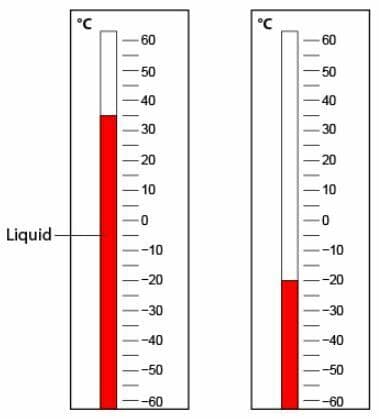
The image shows a thermometer measuring temperature at 35°C and -20°C.
Which BEST describes why the liquid in the thermometer falls when the temperature decreases?
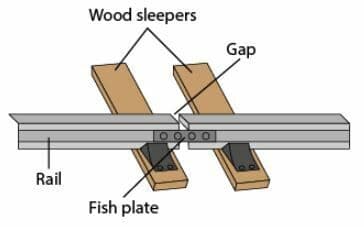
Railroad tracks have narrow gaps between them at regular intervals, as shown in the diagram.
What is the most likely purpose of the narrow gaps?
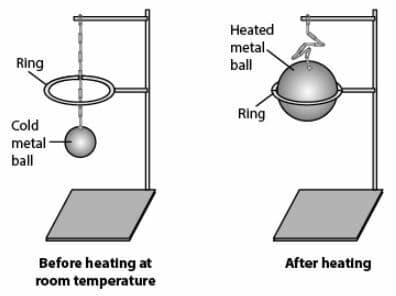
A student conducts an experiment using a metal ball and ring attached to a stand. The metal ball moves through the ring at room temperature. The student then heats the ball on a burner and tries to pass it through the ring again, as shown in the image of the experiment setup.
A solar box cooker can be made by using a sealed, glass-covered box lined with aluminum foil. Food is put into a thin-walled black pot. Placed in the sun, the box becomes an oven that can be used to bake or cook a meal. How does the cooker work?
One ounce of water at 75°F is poured into each of four different containers (foil, glass, paper, foam) of the same thickness. The temperature in each container is measured every two minutes. After 10 minutes, which container of water will have the least change in temperature?
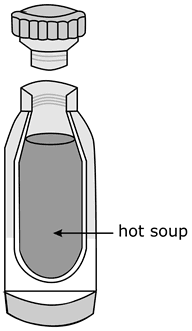
Denver puts hot coffee in the thermos shown below. Why is the coffee still warm when he drinks it several hours later?
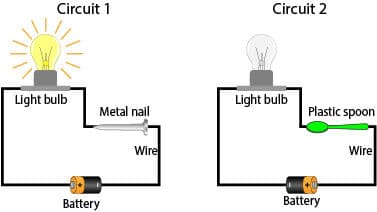
Materials that allow an electric current to pass through easily are called conductors. Examples of conductors are copper, steel, iron, and other metals. Insulators are materials that do not allow an electric current to pass through them. Glass, wood, and rubber are some examples of insulators.
Circuits allow electric currents to pass through them. The image shows two circuits that a student has built. When an electric current passes through the circuit, it lights the light bulb. When an electric current cannot pass through the circuit, the light bulb is not lit.
Which statement best describes the items that the student used in the circuits?
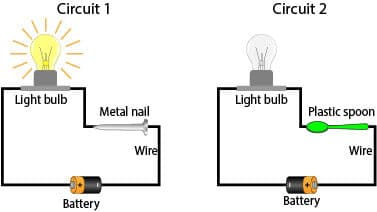
The student wants to make the light bulb in Circuit 2 light up.
Which change will make the light bulb light up?
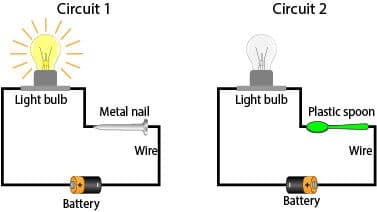
The student replaces the metal nail in Circuit 1 with an unknown material. What evidence would prove that the material is an insulator?