Loading...


Thermodynamics
Quiz by Sourish Paul
Tag the questions with any skills you have. Your dashboard will track each student's mastery of each skill.
Thermodynamics is not concerned about____.
(a) energy changes involved in a chemical reaction.
(b) the extent to which a chemical reaction proceeds.
(c) the rate at which a reaction proceeds
(d) the feasibility of a chemical reaction.
Which of the following statements is not true regarding thelaws of thermodynamics ?
(a) It deal with energy changes of macroscopic systems.
(b) It deal with energy changes of microscopic systems.
(c) It does not depends on the rate at which these energytransformations are carried out.
(d) It depends on initial and final states of a systemundergoing the change
A……………... in thermodynamics refers to that part of universe in which observations are made and remaining universe constitutes the……………...
(a) surroundings, system
(b) system, surroundings
(c) system, surroundings
(d) system, boundary
The universe refers to
(a) only system
(b) only surroundings
(c) both system and surroundings
(d) None of these
Which of the following statements is correct?
(a) The presence of reacting species in a covered beaker is an example of open system.
(b) There is an exchange of energy as well as matter between the system and the surroundings in a closed system.
(c) The presence of reactants in a closed vessel made up of copper is an example of a closed system.
(d) The presence of reactants in a thermos flask or any other closed insulated vessel is an example of a closed system.
Which of the following is closed system ?
(a) Jet engine
(b) Tea placed in a steel kettle
(c) Pressure cooker
(d) Rocket engine during propulsion
An isolated system is that system in which
(a) There is no exchange of energy with the surroundings
(b) There is exchange of mass and energy with the surroundings
(c) There is no exchange of mass or energy with the surroundings
(d) There is exchange of mass with the surroundings
The state of a thermodynamic system is described by itsmeasurable or macroscopic (bulk) properties. These are
(a) Pressure and volume
(b) Pressure, volume, temperature and amount
(c) Volume, temperature and amount
(d) Pressure and temperature
Which of the following are not state functions ?(I) q + w (II) q(III) w (IV) H - TS
(a) (I) and (IV)
(b) (II), (III) and (IV)
(c) (I), (II) and (III)
(d) (II) and (III)
Among the following the state function(s) is (are)
(i) Internal energy
(ii) Irreversible expansion work
(iii) Reversible expansion work
(iv) Molar enthalpy
(a) (ii) and (iii) (b) (i), (ii) and (iii)
(c) (i) and (iv) (d) (i) only
11.

………………. is a quantity which represents the total energy of the system
(a) Internal energy
(b) Chemical energy
(c) Electrical energy
(d) Mechanical energy
Which of the following factors affect the internal energy of the system ?
(a) Heat passes into or out of the system.
(b) Work is done on or by the system.
(c) Matter enters or leaves the system.
(d) All of the above
The system that would not allow exchange of heat between the system and surroundings through its boundary is considered as
(a) isothermal
(b) adiabatic
(c) isobaric
(d) isochoric
The enthalpy change of a reaction does not depend on
(a) The state of reactants and products
(b) Nature of reactants and products
(c) Different intermediate reactions
(d) Initial and final enthalpy change of a reaction.
The q is ……………. when heat is transferred from the surroundings to the system and q is………………………..When heat is transferred from system to the surroundings.
(a) positive , negative
(b) negative , positive
(c) high, low
(d) low, high
17.
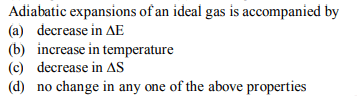
Which of the following statements is incorrect?
(a) q is a path dependent function.
(b) H is a state function.
(c) Both H and q are state functions.
(d) Both (a) and (b)
19.
20.
21.
During isothermal expansion of an ideal gas, its
(a) internal energy increases
(b) enthalpy decreases
(c) enthalpy remains unaffected
(d) enthalpy reduces to zero.
23.

24.

25.
26.
27.
28.

Among the following, the intensive properties are
(i) molar conductivity
(ii) electromotive force
(iii) resistance
(iv) heat capacity
(a) (ii) and (iii) (b) (i), (ii) and (iii)
(c) (i) and (iv) (d) (i) only
Which is an extensive property of the system ?
(a) Volume
(b) Viscosity
(c) Temperature
(d) Refractive index