Loading...

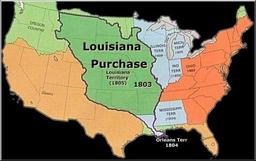
Thomas Jefferson and the Louisiana Purchase
Quiz by Amy Ives
Customize this quiz to suit your class
Instantly translate to 100+ languages
Tag the questions with any skills you have. Your dashboard will track each student's mastery of each skill.
Give this quiz to my class
What political party did Thomas Jefferson belong to?
Federalist
Democratic-Republican
Free Soil
Whigs
Why did Jefferson want the city of New Orleans?
It was the central point of the Mississippi River
It was a good military post
It had rich farmland
It was an important port city for trade
What political party did Thomas Jefferson belong to?
Why did Jefferson want the city of New Orleans?
How much money were Livingston and Monroe allowed to spend to purchase New Orleans?
Which historic figure sold all of the Louisiana Territory to the USA?
The Louisiana Territory was sold in order to:
The United States purchased the Louisiana Territory from what country?
How much did the United States pay for the Louisiana Territory?
How did the Louisiana Purchase effect the geography of the United States?
When did the United States of America purchase the territory of Louisiana?
Which two individuals did Jefferson choose to explore the Louisiana Territory?
 Thomas Jefferson and the Louisiana Purchase - Starter QuizWith the Louisiana Purchase in 1803, the territory of the United States doubled overnight. Months before the $15 million deal was finalized, though, President Thomas Jefferson won approval from Congress to send a team of intrepid explorers to find a passable water route west to the Pacific Ocean. Jefferson tapped his personal secretary, Meriwether Lewis, to lead the “Corps of Discovery,” and once Lewis grasped the full scope and challenges of the expedition, he called on his Army friend and fellow Virginian, William Clark, to be his equal in command. “If therefore there is anything… in this enterprise, which would induce you to participate with me in it’s fatiegues, it’s dangers and it’s honors,” Lewis wrote to Clark, “believe me there is no man on earth with whom I should feel equal pleasure in sharing them as with yourself.” Below is a timeline of Lewis and Clark's extraordinary expedition.When Europeans met American Indians in the late 15th century, the people of two continents exchanged many beneficial customs and goods. Europeans received New World crops such as potatoes and corn. American Indians acquired cloth and horses. However, besides the beneficial exchanges, Europeans and American Indians often traded deadly germs–bacteria and viruses–for which they had no immunity. Smallpox and Indians Image 1: Smallpox epidemics helped Europeans conquer the Aztec and Incan Empires of Mexico and South America. North American Indians quickly concluded that contact with Europeans often resulted in devastating diseases that caused widespread death. This drawing, made in the 1500s in Mexico, shows how the disease was passed from a European to an American Indian through simple contact. Many of the diseases that were common in Europe were entirely new to the peoples of North America. Diseases such as tuberculosis and measles could be fatal, but Europeans had developed resistance to the disease, so many people survived. However, when European diseases infected American Indians with no previous exposure, the people suffered terribly. The most devastating of these diseases was smallpox which is caused by a virus (Variola major). Smallpox, like many other diseases, had a latent period of about one week between the time the person was exposed to the disease and the time when signs of the disease became apparent. During this time, the sick person might begin a journey and carry the germs along with him. Anyone the person met would be exposed to smallpox. Anything the victim touched including clothing, bedding, or unwashed dishes carried living germs of smallpox. Cotton Mather Image 2: Cotton Mather was a Boston minister. When smallpox threatened Boston, he remembered reading about how the Turks inoculated people with dried material from smallpox blisters. The inoculation usually gave the person a mild case of the disease and future immunity. The procedure was highly controversial, but it helped save the lives of 274 people who were inoculated during the Boston smallpox epidemic of 1721. Symptoms of the disease began with fever, chills, and aches. The fever might raise a person’s temperature from the normal 98.6o to a dangerous 106o. After four days of misery, the victim entered the second stage when large pustules (fluid-filled bumps) appeared on the body. The rash made the person feel as if their skin were on fire. After suffering with the rash for nine days, the victim entered a new stage-if he or she had survived this long. The pustules opened and dried up. Each pustule formed a scab that turned into a scar that marked the person’s face for the rest of his or her life. Complications of smallpox for those who survived might include loss of vision or damage to the lungs, heart, or liver. Waterhouse Image 3: Dr. Benjamin Waterhouse of Harvard University brought Jenner’s smallpox preventative to the United States. It was called vaccination and used cowpox as the infective material. This much milder form of pox gave immunity to smallpox with fewer complications. Dr. Waterhouse encouraged President-elect Thomas Jefferson to promote vaccination. Jefferson responded, “Every friend of humanity must look with pleasure on this discovery, by which one evil more is withdrawn from the condition of man.” (T. Jefferson 12/25/1800 to Benjamin Waterhouse, December 25, 1800) Historians have found evidence of smallpox as far back as 1157 B.C. when the Egyptian pharaoh Ramses V apparently died of smallpox. From Egypt, where scientists believe smallpox began, the disease spread to Asia. Europeans began to experience periodic epidemics of smallpox in the14th century when Crusaders returning from the Middle East brought smallpox to Europe. People who survived the disease were immune and could not get smallpox again. This fact explains why epidemics struck periodically and the disease was not a constant threat to European societies. Smallpox Vaccination 1803 Image 4: Dr. Edward Jenner’s new smallpox vaccination (from cowpox) was widely accepted. This medical image was published by a Spanish physician to teach colonial doctors how to apply the vaccine to native Mexicans. The scratches were supposed to go through several stages of development as evidence that the vaccine had given the patient immunity. Vaccination was very effective in preventing smallpox epidemics among those who received the vaccine. In 1520, while Cortés was trying to conquer the Aztecs, smallpox broke out among the Spaniards and was transferred to the Aztecs. By 1527, the disease had migrated through Central America to Peru where it helped Pizarro conquer the Incas. (See Image 1.) In 1633, smallpox infected American Indians living near the English colony of Plymouth, Massachusetts. The disease traveled very quickly to tribes living far inland from the English colonies. In 1721, a smallpox epidemic threatened the English colonists of Boston. (See Image 2.) Cotton Mather, a Boston minister, wanted to inoculate people against the disease. He knew that Turkish healers took material from a dried smallpox scab and injected it into the body of a healthy person by scratching the surface of the skin. The patients developed a mild form of the disease from which they recovered. The procedure was highly controversial in Boston where about 280 Bostonians accepted inoculation. The epidemic infected more than half of the people living in Boston at the time. About 15% of those who got sick died of the disease. Among those who were inoculated, only six (2%) died of smallpox. The practice of inoculation spread to other English colonies, but not to the American Indian tribes living near the colonies. Late in the 18th century, British doctor Edward Jenner recognized that people who milked cows never came down with smallpox. They had already been infected with cowpox, a similar, but much milder disease that gave them immunity to smallpox. In 1796, Jenner inoculated a young man with cowpox virus he had collected from a milkmaid. The young man had a mild infection for less than 24 hours and recovered. Jenner’s efforts resulted in a widespread acceptance of vaccination (vaccine comes from Latin words meaning “taken from a cow”). By 1800, many Americans were receiving smallpox vaccinations. (See Image 3.) President Thomas Jefferson supported and encouraged the vaccination program in major American cities. (See Image 4.) By the middle of the 19th century, smallpox was under control, but broke out from time to time among unvaccinated people. Bismarck, Dakota Territory, experienced a small outbreak of smallpox in 1882. American Indians, however, were still subject to the disease in its most dangerous form.Alexander Hamilton, a key figure in the founding of the United States, served as the first Secretary of the Treasury under President George Washington. Aaron Burr, on the other hand, was the sitting Vice President under Thomas Jefferson at the time of the duel. The animosity between Hamilton and Burr was well-documented, stemming from political disagreements and personal slights over the years. The Duel Date and Location: The duel took place on July 11, 1804, in Weehawken, New Jersey, a common site for duels due to its less strict enforcement of anti-dueling laws compared to New York. Cause: The immediate cause of the duel was a series of letters and meetings between intermediaries after Hamilton allegedly insulted Burr at a dinner, which was later reported in a newspaper. Burr demanded an apology; Hamilton refused, leading to the challenge. The Event: On the morning of the duel, both men, along with their seconds and a doctor, rowed across the Hudson River to the dueling ground. The exact events are a matter of historical debate, but it is generally believed that Hamilton fired his shot into the air, adhering to a principle of honor without intent to kill. Burr, however, aimed directly at Hamilton, hitting him in the abdomen. Outcome: Hamilton was severely wounded and transported back to New York City, where he died the following day, surrounded by family and friends5. Aftermath Public Reaction: The news of Hamilton's death caused widespread grief and indignation. Angelica Schuyler Church, Hamilton's sister-in-law, expressed the communal sorrow in a letter, highlighting the shock and consternation that gripped the town5. Impact on Burr: Although Burr was never tried for the duel, his political career suffered greatly. He became a pariah in many circles and faced various legal and financial troubles in the years that followed. Historical Significance: The duel is often cited as a turning point in American political culture, highlighting the dangers of political rivalry and the need for civility in discourse. Conclusion The duel between Alexander Hamilton and Aaron Burr remains a poignant reminder of the intense personal and political conflicts that shaped the early years of the United States. It underscores the tragic potential of unchecked animosity and the importance of reconciliation and dialogue in a democratic society.James Armistead and Thomas Jefferson PracticeJames Madison and Thomas Jefferson (Story Pawn Stars)James Madison and Thomas Jefferson (Article Pawn Stars)Thomas Jefferson