


Topic 7.2-7.5 Summative assessment
Quiz by Leesa Halcro
Feel free to use or edit a copy
includes Teacher and Student dashboards
Measure skillsfrom any curriculum
Measure skills
from any curriculum
Tag the questions with any skills you have. Your dashboard will track each student's mastery of each skill.
With a free account, teachers can
- edit the questions
- save a copy for later
- start a class game
- automatically assign follow-up activities based on students’ scores
- assign as homework
- share a link with colleagues
- print as a bubble sheet
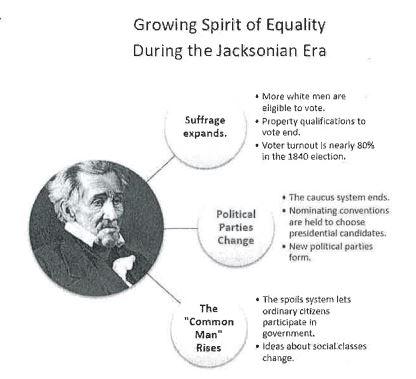
- Q 1/25Score 0After Jackson's presidency in 1828, why did his supporters call him "The People's President"?29More people were involved in the voting processHe invited his political opponents to his reception at the White HouseJackson put an end to the spoils system.Government officials were replaced with those who could do the job better.


25 questions
Show answers
- Q1After Jackson's presidency in 1828, why did his supporters call him "The People's President"?More people were involved in the voting processHe invited his political opponents to his reception at the White HouseJackson put an end to the spoils system.Government officials were replaced with those who could do the job better.30s
- Q2Which of the following did President Andrew Jackson think favored the wealthy?the National Bankthe national debtthe right to voteThe Indian Removal Act30s
- Q3How did high tariffs place the Southern states at a disadvantage compared to the Northern states?The North had more manufacturing, but the South had more taxable trade with Europe.The South sent more manufactured items to the North, who had to pay taxes on them.The South had more manufacturing and more trade with Europe than the North.The South lost economic power from protesting the tariffs and they wanted federal support.30s
- Q4When Jackson was president, how did more people participate in the political process?Southerners gained a louder voice in objecting to high tariffs.Southern states began nullifying, or refusing to obey, some federal laws.Bureaucrats were fired and replaced with Jackson’s supporters.Democrats used nominating conventions, rather than caucuses, to choose candidates.30s
- Q5President Van Buren responded to the depression following the Panic of 1837 by creatinga new national bank.a much lower tariff.a new cabinet position.an independent federal treasury.30s
- Q6Which president served for the shortest period?Abrham LincolnWilliam Henry HarrisonBen FranklinJohn Tyler30s
- Q7The U.S. government established Indian Territory in present-day Oklahoma becausesome members of the Five Civilized Tribes already lived in the region.few white settlers wanted to move to the area.the fertile land would support farms owned by native peoples.the Five Civilized Tribes expressed interest in the region.30s
- Q8Based on map, which statement best describes the consequences of the Indian Removal Act?The Sioux led other native American groups in a war of resistanceNative Americans voluntarily left thier homes to move east of the Mississippi.President Jackson ordered U.S. troops to protect Native American lands in GeorgiaDue to forced removal, most Native American groups eventually moved west of the Mississippi River.30s
- Q9In Worcester v. Georgia (1832), the Supreme Court ruled that the Cherokeewere not citizens and therefore no treaties with them were binding.removal was legal only if the government provided food for the long journey.are a separate nation and not subject to the laws of Georgia.could be moved only if they were paid fairly for their land.30s
- Q10What was President Jackson’s response to the Supreme Court ruling in Worcester v. Georgia?He disagreed with the ruling and approved a treaty to relocate the Cherokee.He supported the ruling but allowed settlers to push the Cherokee people off their own landHe supported the ruling and immediately forced the Cherokee people to relocate.He disagreed with the ruling and made a compromise treaty with all Cherokee leaders.30s
- Q11In 1838, President Van Buren ordered the U.S. Army topay Native Americans to relocate in the West.move the Choctaw but allow the Cherokee to remain in Georgia.forcibly remove over 15,000 Cherokee people from thier landseize all weapons from native peoples in Georgia.30s
- Q12Which best describes how the Seminole responded to the Indian Removal Act of 1830?They turned to the U.S. Supreme Court to defend their claims to their land.They lost their land and were forced to travel on the Trail of Tears.They agreed to sell their land and move to Indian Territory.They joined with Black Seminoles to attack white settlements in Florida.30s
- Q13“[T]he only means of preserving the Indians from that utter extinction which threatens them, is to remove them from the sphere of this [white settlers’] influence . . . no change has occurred, or probably can occur . . . by which the progress of their declension [decrease] can be arrested [stopped], so long as they occupy their present situation.”—Lewis Cass, from “Removal of the Indians,” The North American Review, 1830 What is Cass suggesting in this passage?that further white settlement into native lands should be haltedthat Native Americans should be removed from their landsthat some land where Native Americans currently reside should be set aside for themthat the U.S. government should honor its treaties with Native Americans30s
- Q14“[T]he only means of preserving the Indians from that utter extinction which threatens them, is to remove them from the sphere of this [white settlers’] influence . . . no change has occurred, or probably can occur . . . by which the progress of their declension [decrease] can be arrested [stopped], so long as they occupy their present situation.”—Lewis Cass, from “Removal of the Indians,” The North American Review, 1830 What reason does Cass give for his proposal?He wants to preserve the natural resources on native land.He thinks white settlers are more entitled to the land than native peoples.He hopes Native Americans and white settlers can both occupy the land.He believes this is the only way for the Native American population to survive.30s
- Q15Which of the following best summarizes the concept of Manifest Destiny?Slavery should be restricted to states south of the Mason-Dixon Line.The United States had the right to expand to the Pacific Ocean.Native Americans had an equal claim to lands acquired in the Adams-Onís Treaty.European nations would no longer be allowed to interfere in the Americas.30s
