Describe the structure of atoms, including the masses, electrical charges, and locations, of protons and neutrons in the nucleus and electrons in the electron cloud;
Recognize that chemical formulas are used to identify substances and determine the number of atoms of each element in chemical formulas containing subscripts; and
Investigate how evidence of chemical reactions indicates that new substances with different properties are formed and how that relates to the law of conservation of mass.
Track each student's skills and progress in your Mastery dashboards
Give this quiz to my class
Q 1/21
Score 0
A researcher wants to experiment with an element that reacts like phosphorus (P) but has a greater atomic mass. Which element should the researcher select for the experiment?
60
Silicon (Si)
Arsenic (As)
Sulfur (S)
Nitrogen (N)
Q 2/21
Score 0
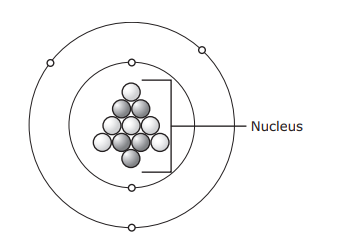
A model of an atom is shown below. An atom of which element is represented by this model?
60
Sodium (Na)
Neon (Ne)
Carbon (C)
Boron (B)
21 questions
Q.
A researcher wants to experiment with an element that reacts like phosphorus (P) but has a greater atomic mass. Which element should the researcher select for the experiment?
1
60 sec
8.5c
Q.
A model of an atom is shown below. An atom of which element is represented by this model?
2
60 sec
8.5b
Q.
Which of the following best describes an electron?
3
60 sec
8.5a
Q.
Which information could a student determine from only the chemical formula of a protein?
4
60 sec
8.5d
Q.
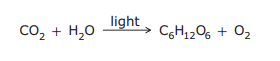
A teacher asks a student to write the chemical equation for photosynthesis. The student’s response is shown below. The equation is not balanced correctly. Which of these is a balanced equation for photosynthesis?
5
60 sec
8.5e
Q.
When trying to identify an unknown element, a scientist determines what other elements the unknown element reacts with chemically. Which property of the unknown element determines the other elements it reacts with?
6
60 sec
8.5b
Q.
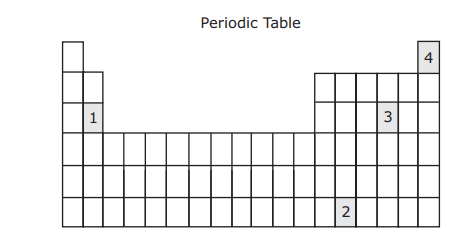
The model of the periodic table below shows the locations of four elements. A student is asked to identify an element that is a pale-yellow brittle solid and does not conduct electricity. At which location in this periodic table would the element most likely be found?
7
60 sec
8.5c
Q.
An atom has 25 protons, 30 neutrons, and 25 electrons. What is the charge of the atom’s nucleus?
8
60 sec
8.5a
Q.
9
60 sec
8.5d
Q.
The atoms of a certain element each contain 11 protons and 1 valence electron. Which statement correctly identifies this element and describes its chemical reactivity?
10
60 sec
8.5b
Q.
An atom of a certain element has 36 protons, 36 electrons, and a mass number of 84. At room temperature, this element is a very stable gas. How many neutrons are in this atom? Be sure to use the correct place value.
11
60 sec
8.5a
Q.
12
60 sec
8.5e
Q.
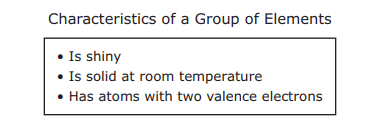
The periodic table is organized into groups and periods of elements. The characteristics of a certain group of elements are listed below. Which of these elements is in this group?
13
60 sec
8.5c
Q.
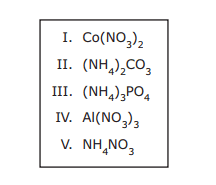
Which of these formulas contain equal numbers of nitrogen atoms?
14
60 sec
8.5d
Q.
15
60 sec
8.5d
Q.
A chemist is identifying the elements present in a sample of seawater. What characteristic of an element’s atoms always determines the element’s identity?
16
60 sec
8.5b
Q.
In the early 1900s, many scientists thought that an atom consisted of a positive substance with negative charges scattered throughout the substance. Then Ernest Rutherford completed an experiment that changed the concept of an atom. His discovery led to the understanding that an atom consists mostly of empty space with —
17
60 sec
8.5a
Q.
Which two elements on the periodic table are in the same period?
18
60 sec
8.5c
Q.
19
60 sec
8.5d
Q.
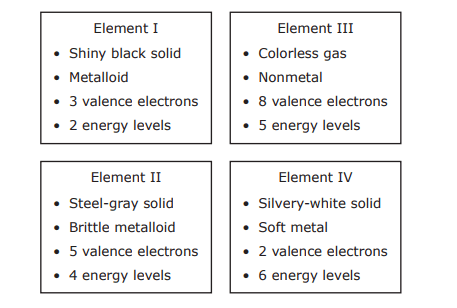
Students were asked to identify the location of elements in the periodic table based on clues printed on game cards. Based on the data, which periodic table shows the correct location of the four elements?
20
60 sec
8.5c
Q.
Which statement correctly describes the location and charge of the electrons in an atom?