Topic Review: Genetics
Quiz by Biology - Texas Education Agency
Feel free to use or edit a copy
includes Teacher and Student dashboards
Measure skillsfrom any curriculum
Measure skills
from any curriculum
Tag the questions with any skills you have. Your dashboard will track each student's mastery of each skill.
With a free account, teachers can
- edit the questions
- save a copy for later
- start a class game
- automatically assign follow-up activities based on students’ scores
- assign as homework
- share a link with colleagues
- print as a bubble sheet

15 questions
Show answers
- Q1If several pea plants with the genotype T TYy are crossed with pea plants with the genotype Ttyy, what percentage of the offspring will be expected to have the T TYy allele combination?50%40%25%75%120s
- Q2In cocker spaniels the allele for a black coat color (B) is dominant over the allele for a brown coat color (b). If a brown cocker spaniel is crossed with a heterozygous black cocker spaniel, which of the following genotypic ratios can be expected?2 BB: 0 Bb: 2 bb1 BB: 2 Bb: 1 bb2 BB: 1 Bb: 0 bb0 BB: 2 Bb: 2 bb120s
- Q3In the 1860s Gregor Mendel performed numerous dihybrid crosses between pea plants. Dihybrid crosses involve the study of the inheritance patterns related to two different traits. In guinea pigs the allele for black fur (B) is dominant over the allele for brown fur (b), and the allele for short fur (F) is dominant over the allele for long fur (f). What percentage of the offspring from a BbFf x bbff cross would be expected to be heterozygous for both traits?50%0%100%25%120s
- Q4In 1917 the biologist Thomas Hunt Morgan conducted studies in which he kept some caterpillars in the dark and placed some others under red, green, or blue lights. Exposure to red light produced butterflies with brightly colored wings. Exposure to green light resulted in dark-colored wings. Exposure to blue light or no light resulted in pale-colored wings. What was the most likely conclusion of Morgan's research?Caterpillars exposed to red and green light are healthier than caterpillars exposed to no light or blue lightThe pigment in butterfly wings absorbs light from the environmentThe genes regulating wing color in butterflies are influenced by environmental factorsThe phenotypic expression of wing shape depends on color pigmentation in butterflies60s
- Q5Sickle-shaped red blood cells result from a mutation in the gene that codes for hemoglobin. This mutation results in sickle-cell anemia. A partial sequence of bases from a normal hemoglobin gene and a sequence that results in sickle-cell anemia are shown below. What type of mutation is depicted in this sequence?SubstitutionFrameshiftDeletionInsertion60s
- Q6Tomato plants usually have hairy stems. Hairless stems are present in tomato plants that are homozygous recessive for this trait. If the stem characteristics are determined by a single gene, what is the expected outcome of crossing two tomato plants that are heterozygous for hairy stems?50% hairy stems: 50% hairless stems100% hairless stems75% hairy stems: 25% hairless stems100% hairy stems120s
- Q7Facial dimples and free earlobes are both considered dominant human traits. What are the expected phenotypes of the offspring of a female with dimples and free earlobes (DDFf) and a male with no dimples and attached earlobes (ddff)?75% with dimples and attached earlobes and 25% with no dimples and free earlobes75% with dimples and free earlobes and 25% with no dimples and attached earlobes50% with dimples and free earlobes and 50% with dimples and attached earlobes50% with dimples and free earlobes and 50% with no dimples and attached earlobes120s
- Q8Normal fruit flies have brownish-yellow bodies, and this body color is dominant. A mutation in the gene for body color can produce flies with an ebony body color. A homozygous normal fruit fly (e+e+) is crossed with a homozygous ebony fruit fly (ee). What is the predicted outcome of this genetic cross?All the offspring will have ebony bodiesOf the offspring, 75% will have ebony bodies, and 25% will have brownish-yellow bodiesAll the offspring will have brownish-yellow bodiesOf the offspring, 75% will have brownish-yellow bodies, and 25% will have ebony bodies60s
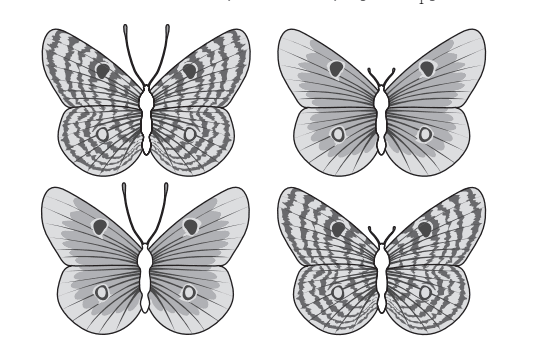
- Q9The four butterflies in the illustrations represent the offspring in the F1 generation. Which statement is best supported by the phenotypes of these offspring?Two of the offspring in the F1 generation will experience a spontaneous mutationThe F1 generation is the result of a dihybrid crossTwo of the offspring in the F1 generation will not be able to reproduceThe F1 generation is composed only of males120s
- Q10Chickens can have different types of feathers. Frizzled feathers curl toward a chicken's head. Assume that feather type is determined by a single gene and that the allele for frizzled feathers is dominant over the allele for straight feathers. In a cross between two chickens with straight feathers, what percentage of the offspring can be expected to have frizzled feathers?25%0%100%50%60s
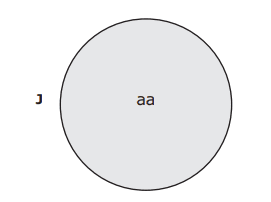
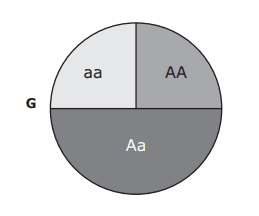
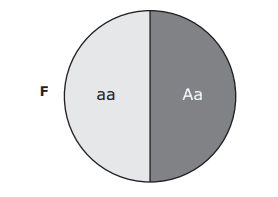
- Q11Albinism is an autosomal recessive condition. Which circle graph shows the genotype probability when an albino female mates with a male that is heterozygous for the albinism trait?60s
- Q12In Holstein cattle the allele for black hair color (B) is dominant over the allele for red hair color (b), and the allele for polled (P), or lacking horns, is dominant over the allele for having horns (p). What is the expected phenotypic ratio of the offspring of a BbPp × BbPp cross if these alleles sort independently?9 black/polled : 3 black/horned : 3 red/polled : 1 red/horned12 black/polled : 0 black/horned : 0 red/polled : 4 red/horned16 black/polled : 0 black/horned : 0 red/polled : 0 red/horned4 black/polled : 4 black/horned : 4 red/polled : 4 red/horned120s
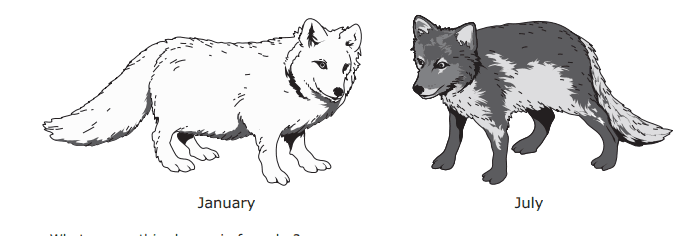
- Q13The arctic fox inhabits northern areas of North America. The same arctic fox is shown in the drawing at different times of the year. What causes this change in fur color?Gene expression for fur color is regulated by temperatureThe arctic fox has two traits for fur color that are determined at birthGene expression for fur color is regulated by latitudeThe alleles for fur color change as the arctic fox grows older60s
- Q14In humans blood type is determined by the A, B, and O alleles. The A and B alleles are codominant to each other and dominant over the O allele. An individual with the AO genotype and an individual with the BO genotype can produce offspring with which of the following phenotypes?A, B, or O onlyA, B, AB, or OO onlyA or B only120s
- Q15In cattle the allele for cloven hooves (H) is dominant over the allele for mule-foot hooves (h). The phenotype for each trait is shown in this picture. What is the probability of cloven hooves in the offspring of parents that are heterozygous for the trait?75%25%50%100%60s