Loading...


U2.1 Review (Nuclear Structure and Stability)
Quiz by Aaron Holley
Tag the questions with any skills you have. Your dashboard will track each student's mastery of each skill.
The study of reactions that involve changes in the structure of the nucleus is known as ____.
The number of protons and neutrons in the nucleus of an atom is referred to as the ____.
The number of protons in the nucleus of an atom is called the ____.
____ are atoms of the same element with the same atomic number but different mass numbers.
In the context of nuclear chemistry, a single isotope is called a ____.
A general term used for the subatomic particles in the nucleus of an atom is ____.
Match the following subatomic particles with their corresponding mass.
Which of the following fundamental forces is responsible for holding the nucleus together?
How many protons are found in an arsenic-77 atom? Type your answer in the space below.
How many neutrons are found in an arsenic-77 atom? Type your answer in the space below.
How many electrons are found in an arsenic-77 atom? Type your answer in the space below.
How many protons are found in the following isotope. Type your answer in the space below.
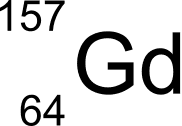
How many neutrons are found in the following isotope. Type your answer in the space below.
How many electrons are found in the following isotope. Type your answer in the space below.
Calculate the theoretical mass of a magnesium-26 atom using the information in the image below. Type your answer to four decimal places, followed by a space and the unit.
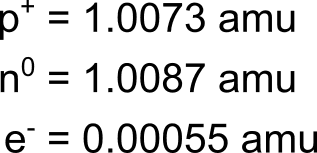
Calculate the theoretical mass of a palladium-102 atom using the information in the image below. Type your answer to four decimal places, followed by a space and the unit.
What is the mass defect for oxygen-18 if the actual mass is 17.9992 amu? Type your answer to four decimal places, followed by a space and the unit.
What is the mass defect for beryllium-9 if the actual mass is 9.0122 amu? Type your answer to four decimal places, followed by a space and the unit.

The energy that is produced when an atom's nucleons are bound together is called the ____.
Nuclear binding energy is much less than the energy that is stored in a chemical bond.
Why do we see a mass defect between the theoretical mass of a nuclide and the experimentally-determined mass of a nuclide?
Who developed the theoretical ideas that help explain the mass defect that exists for elements?
Which equation is used to help us convert between mass and energy?
One amu of mass is equivalent to how much energy?
If there is a mass defect of 0.1506 amu for a nuclide, what is the nuclear binding energy for the nuclide? Type your answer to two decimal places, followed by a space and the unit.
If there is a mass defect of 0.0627 amu for a nuclide, what is the nuclear binding energy for the nuclide? Type your answer to two decimal places, followed by a space and the unit.

The vast majority of nuclides that exist in the universe are stable.
What are the names used to refer to unstable nuclides?
Graphing the number of neutrons vs. the number of protons of all nuclides results in the stable nuclides forming a small group. This very narrow group of stable nuclides is referred to as the ____.

Stable nuclides of elements with an atomic number of 20 or less tend to have neutron-to-proton ratio _____.

Stable nuclides with an atomic number greater than 20 tend to have more neutrons than protons in the nucleus.
Isotopes with an even number of protons, neutrons, or both protons and neutrons are more stable.
Certain numbers of protons and neutrons results in more stable nuclides than others. These values are referred to as ____.
Certain numbers of protons and neutrons results in more stable nuclides than others. These numbers are referred to as magic numbers. Please group the following numbers as magic numbers or non-magic numbers.
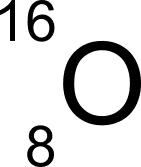
Oxygen-16 is considered a particularly stable nuclide. Why is this nuclide so stable?
Nuclear binding energy alone is not a good indication of the stability of a nuclide. Which of the following is a better measure of the stability of a nuclide?
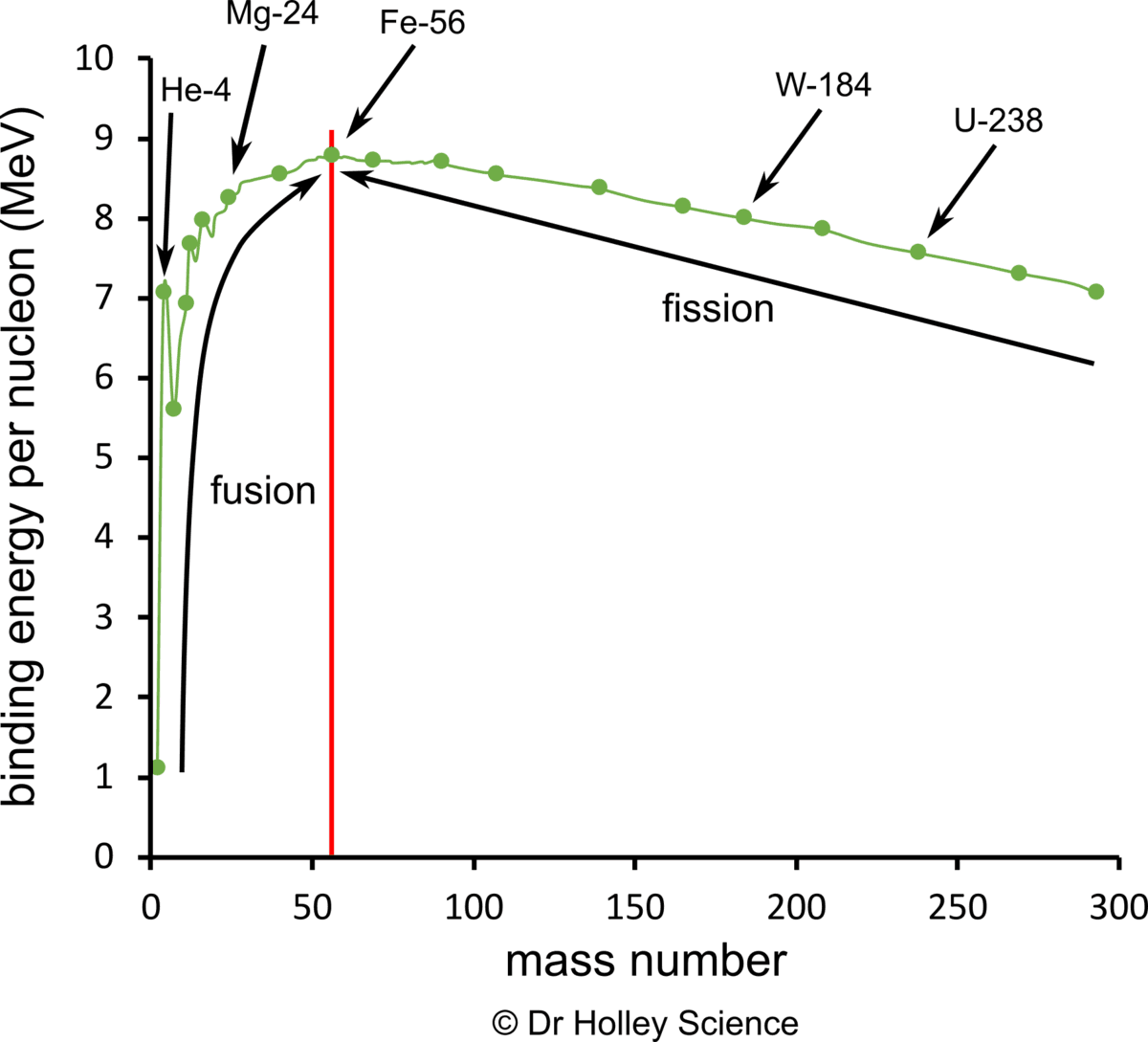
When binding energy per nucleon is graphed against mass number, a very insightful chart is generated. According to this chart, which nuclide is considered the most stable?