Loading...


Union Parliament GRADE X
Quiz by Koel Kundu
Tag the questions with any skills you have. Your dashboard will track each student's mastery of each skill.
1. The federal structure of government of India provides:
A) Two Tier system b)Four tier system
C) three tier system d) none of the above
2. What is the minimum age for holding the office of Lok Sabha?
A) 18 years
B) 21 years
C) 25 years
D) 30 years
3. A motion of no confidence against the government can be introduced in
A) Rajya Sabha
B) Lok Sabha
C) Both a + b
D) Neither a nor b
4. How many sessions of Lok Sabha take place in the year
A) 2
B) 3
C) 4
D) 5
5. Budget is also known as
A) Annual financial statement
B) Monthly financial statement
C) Received and expenditure statement
D) Taxation statement
6. The Essential elements of Indian Parliament are
A) President
B) Lok Sabha +rajyasabha+president
C) Loksabha + vidhansabha
D) Rajyasabha + vidhansabha
7. Who decides whether a bill is a money bill or not
A) President
B) Speaker of Lok Sabha
C) Prime Minister
D) Finance Minister
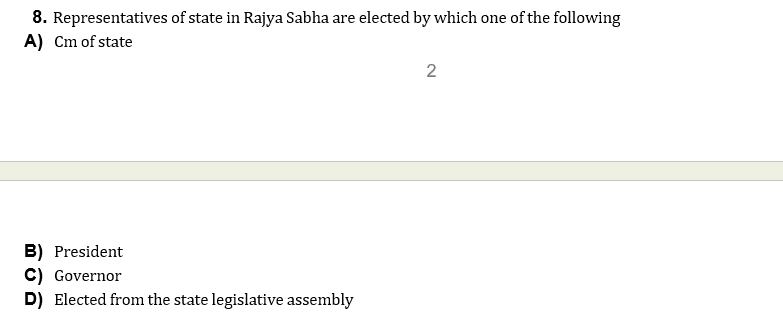
8.
9. How many number of members are nominated by President to the rajya sabha
A) 20
B) 12
C) 18
D) 15
10. The number of representative of Rajya Sabha from the states + UT are among which one of the following
A) 238
B) 212
C) 200
D) 220
11. What are the three types of questions asked in the question hour
A) Starred,unstarred,short notice
B) Very very important, important ,very important
C) Starred,unstarred,emergency
D) Expert , professional ,detailed
12. What is the meaning of word quorum?
A) Minimum number of members to be present in the house before it can conduct any type of business
B) Maximum number of members allowed in any given sessions
C) The discipline of maintaining the decoration in the house
D) Kora means approvalof majority memberspresent during the sitting
13. Find the odd one out in the sessions of parliament
A) Budget session
B) Summer session
C) Winter session
D) Monsoon session
14. Who calls for a joint sitting of the parliament when the deadlock arise
A) Pm
B) Speaker
C) President
D) Vice president
15. The term interpellation means
A) The procedure of suspension of the members
B) A procedure in some legislative bodies of askinga government officialto explain an actor policy
C) The procedure to discuss the crisis of the country
D) None of the above
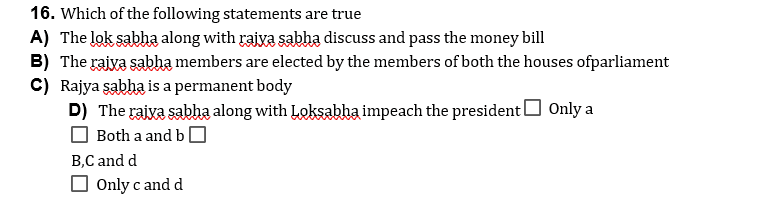
16.
17. The lower house of Indian parliament is known as
A) Rajya sabha
B) Lok sabha
C) Legislative assembly
D) Council of States
18. The members of the parliament are free to raise any matter which according to them is important during-
A) Adjournment motion
B) Question hour
C) Zero hour
D) No confidence motion
19. Members of parliament are the representatives of
A) Government
B) Party
C) People
D) None of the above
20. The parliament begins with
A) Question hour
B) Zero hour
C) Both a & b
D) None of the above
21. What is a significant function of the parliament.
A) Law making
B) Social reform
C) Child development
D) None of the above
22. The Lok Sabha is elected after every dash years
A) 5
B) 6
C) 2
D) 4
23. Rajyasabha is also called
A) Parliament
B) Council of States
C) House of people
D) Parliament
24. Elections in India are held by
A) Secret ballot
B) Shown result
C) Open page
D) Hidden source
25. The president can't _ lok sabha
A) Dissolve
B) Prorogue
C) Adjourn
D) Summon
26. The duration of an ordinance by the President of India is
A) 6 weeks
B) 6 months
C) 1 year
6 weeks from the date of assembly of parliament
27. All speeches made in house of people are addressed to
A) Prime Minister
B) Minister of parliamentary officers
C) Speaker
D) Chief Minister
28. Who presides over the joint sitting of the parliament
A) President
B) Vice president
C) Chief justice
D) Speaker
29. The ex of usual chairman of the council of States is
A) Speaker
B) Deputy speaker
C) Vice president
D) Deputy chairman
30. Who is the person authorized to conduct the elections of speaker in the newly elected Lok Sabha
A) Prime minister
B) Pro-term speaker
C) Speaker
D) Deputy speaker
31. The executive power of India is actually exercised by
A) Speaker
B) Council of ministers
C) President
D) Parliament
32. Maximum gap between two parliamentary sessions
A) 3months
B) 6 months
C) 4months
D) 12months
33. The speaker was the casting vote
A) To maintain status
B) To defeat the government
C) To challenge the opposition
D) In the absence of pm
34. Starred questions requires
A) Oral answer
B) Unwritten answer
C) Supplementary question
D) None of the above
35. Consolidated fund of India is
A) Votable
B) Non plan
C) Non votable
D) None Of the above
36. Council of states in India can create an all India services by
A) Simple majority
B) Two-thirds majority
C) Three fourth majority
D) Unanimously
37. Adjournment of the house is the power of the
A) President
B) Speaker
C) Pm
D) Council of ministers
38. The members of the council of minister are collectively responsible to
A) Judiciary
B) Council of States
C) House of people
D) President
39. Who can initiate the impeachment proceeding against the president of India
A) Either house of the parliament
B) Vidhan sabha
C) Only lok sabha
D) Rajya sabha
40. Which of the following statement is not correct
A ) member of lok sabha directly electedby the people
B) money bills can be introduced in lok sabha
C) the vice President of India is an ex officio chairmanof rajya sabha
D) president nominates four members of anglo-indian communityto lok sabha