Loading...


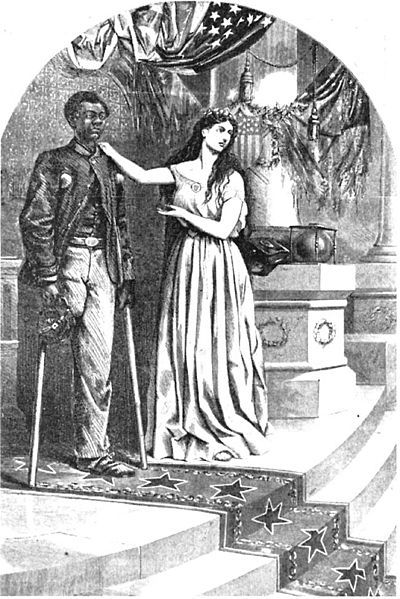
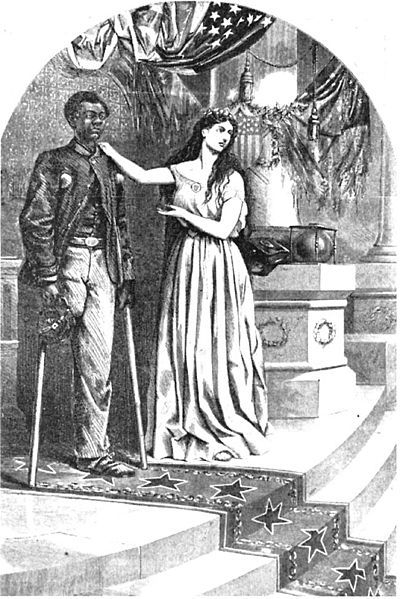
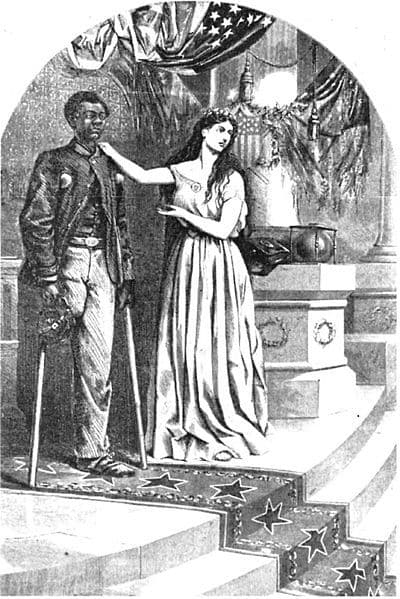
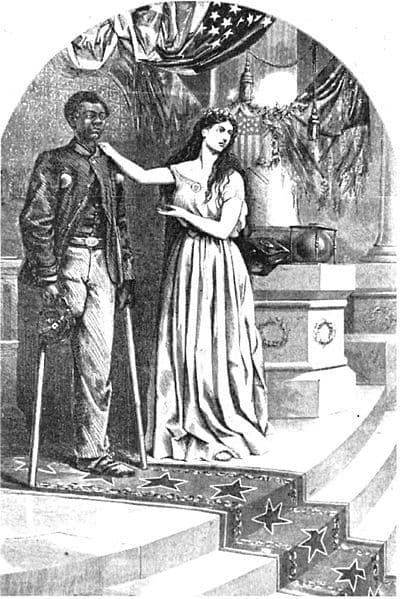
Union Soldier Political Cartoon - United States History
Quiz by Kevin Neal
Customize this quiz to suit your class
Instantly translate to 100+ languages
Tag the questions with any skills you have. Your dashboard will track each student's mastery of each skill.
Give this quiz to my class
 Juneteenth is an important holiday in American history. It honors the day in 1865 when enslaved people in Texas found out they were free. This day marked a major milestone on the path to ending slavery throughout the U.S. On June 19, 1865, Major General Gordon Granger of the Union army arrived in Galveston, Texas. He informed the enslaved people of Texas about the Emancipation Proclamation. The Emancipation Proclamation was a speech made by President Abraham Lincoln two years earlier, on January 1, 1863. It stated that enslaved people in many of the southern states were now free. President Lincoln gave this speech during the height of the Civil War. But by the time the Union soldiers made it to Texas, the Civil War had ended. It took over two years for this message to reach the people still enslaved in Texas! More than 250,000 people celebrated their newfound freedom on June 19. Soon after, many of these freed people decided to migrate to northern states to start a new life. But they continued to celebrate Juneteenth year after year and to share this holiday with their community. In 1872, a group of formerly enslaved people raised money to buy 10 acres of land near Houston, Texas. They named this land ‘Emancipation Park’. To this day, many Americans celebrate Juneteenth in this park to remember their history. Texas also holds a special parade to celebrate this day. Thousands of people participate and enjoy learning and celebrating African American culture and history. They fly the Juneteenth flag. The Juneteenth flag has a white star that symbolizes freedom and new hope for African Americans. Juneteenth is a day to remember the triumphs and struggles of African Americans. Even though enslaved people in Texas learned of their freedom on Juneteenth, they still faced violence, discrimination and inequality. That is why Juneteenth celebrations are so important to many Americans. Juneteenth recognizes the hardships of gaining freedom and the importance of remembering Black history in the United States. What is the concept of popular sovereignty? The idea that the government’s authority comes from the people -- a key idea mentioned in the Preamble of the Constitution What were some of the goals outlined in the Preamble of the Constitution? “To form a more perfect Union” -- wanted states to cooperate with one another and have a strong relationship between the states and the national government “To establish justice” -- wanted to be ruled by laws, not by the might of soldiers or the decisions of kings; wanted laws to apply to everyone “To insure domestic tranquility” -- government’s job to keep peace and maintain order within the country “Provide for the common defense” -- national government responsible for protecting the nation against foreign enemies “To promote the general Welfare” -- government could support an economy and a society in which people could prosper “Secure the Blessings of Liberty to ourselves and our Posterity” -- government would protect the freedoms gained in the American Revolution and preserve them for future Americans as wellBy the late 1800s, the Spanish were losing control of Cuba. Concerned about insurrection in the countryside, they moved rural Cubans to “reconcentration” camps where the Spanish claimed they would be better able to protect them. U.S. Consul-General Fitzhugh Lee forwarded the following account of the conditions of the camps to the U.S. Assistant Secretary of State on November 27, 1897. Lee said the author of the note was “a man of integrity and character.” “[W]e will relate to you what we saw with our own eyes: “Four hundred and sixty women and children thrown on the ground, heaped pellet-mell as animals, some in a dying condition, others sick and others dead. . . . “There is still alive the only living witness, a young girl of 18 years, whom we found seemingly lifeless on the ground; on her right-hand side was the body of a young mother, cold and rigid, but with her young child still alive clinging to her dead body; on her left-hand side was also the corpse of a dead woman holding her son in a dead embrace. . . . “The circumstances are the following: complete accumulation of bodies dead and alive, so that it was impossible to take one step without walking over them; the greatest want of cleanliness, want of light, air, and water; the food lacking in quality and quantity what was necessary to sustain life. . . . From all this we deduct that the number of deaths among the reconcentrados has amounted to 77 per cent.” Source: Unsigned note that was included in a telegram sent by Fitzhugh Lee, U.S. Consul-General in Cuba, to the U.S. Assistant Secretary of State November 27, 1897. consul-general: a government official living in a foreign country charged with overseeing the protection of U.S. citizens and promoting trade pell-mell: state of disorder accumulation: pile want: lack reconcentrados: the reconcentration camp prisoners; The following is an excerpt from Albert J. Beveridge’s speech, delivered September 16, 1898. Beveridge gave this speech while he was campaigning to become a senator for Indiana. The speech helped him win the election and made him one of the leading advocates of American expansion. “Fellow citizens, it is a noble land that God has given us; a land that can feed and clothe the world;. . . . It is a mighty people that he has planted on this soil . . . It is a glorious history our God has bestowed upon his chosen people; . . .a history of soldiers who carried the flag across the blazing deserts and through the ranks of hostile mountains, even to the gates of sunset. . . . “The Opposition tells us that we ought not to govern a people without their consent. I answer: The rule of liberty that all just government derives its authority from the consent of the governed, applies only to those who are capable of self-government. I answer, We govern the Indians without their consent, we govern our territories without their consent, we govern our children without their consent. “They ask us how we will govern these new possessions. I answer: If England can govern foreign lands, so can America. If Germany can govern foreign lands, so can America. . . . “What does all this mean for every one of us? It means opportunity for all the glorious young manhood of the republic, the most virile, ambitious, impatient, militant manhood the world has ever seen. It means that the resources and the commerce of these immensely rich dominions will be increased. . . . “In Cuba, alone, there are 15,000,000 acres of forest unacquainted with the axe. There are exhaustless mines of iron. . . . There are millions of acres yet unexplored. . . . It means new employment and better wages for every laboring man in the Union. . . . Unión EuropeaUnion leaguesUnion ExceutiveUnion and intersection of sets and the different of two setsUnion v. Confederacy